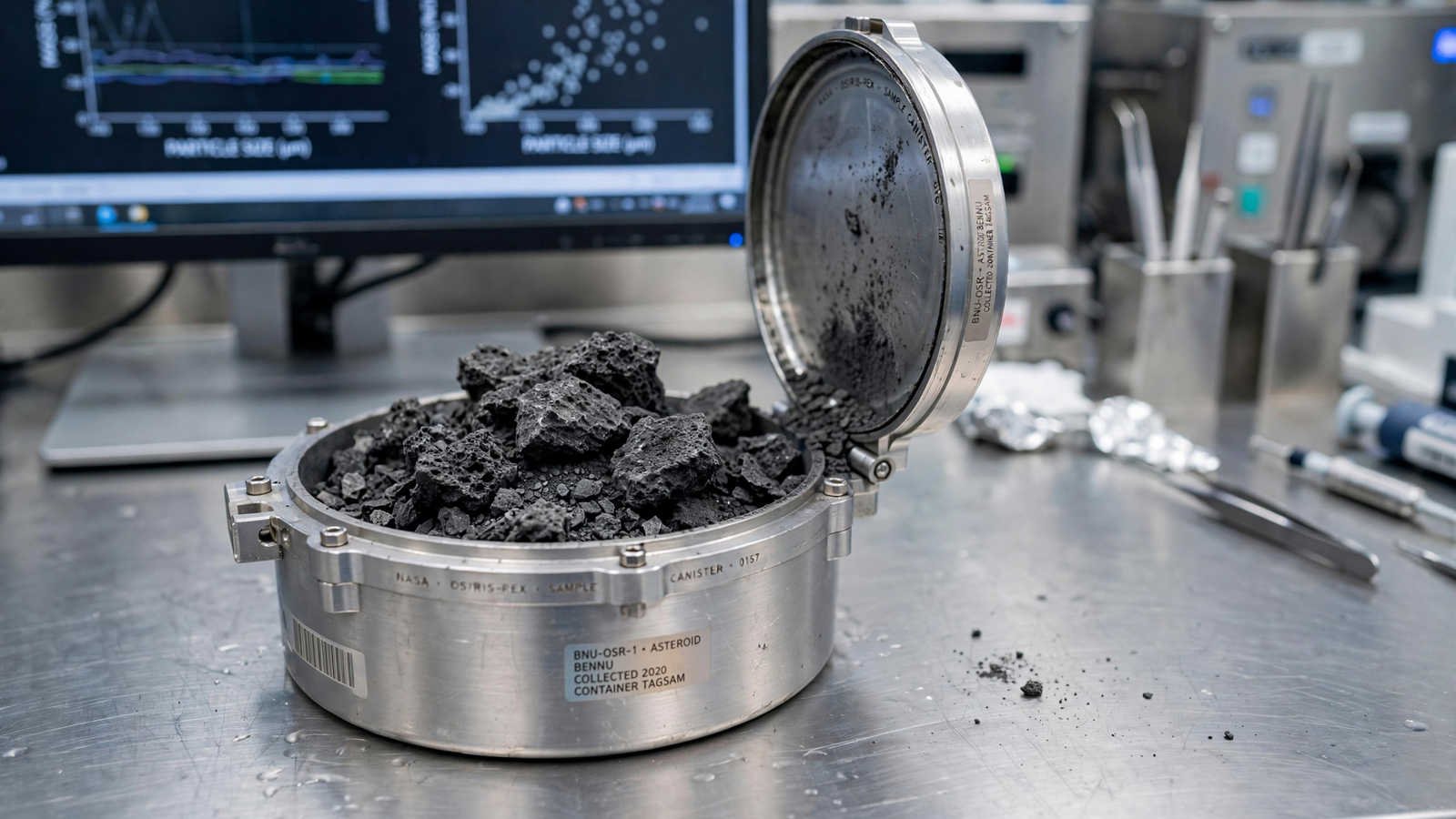
On September 24, 2023, a small capsule streaked through Earth’s atmosphere and landed in Utah’s West Desert. Inside was material gathered from an asteroid nearly 200 million miles away—a carefully preserved piece of the early solar system.
The capsule belonged to NASA’s OSIRIS-REx mission, which spent years studying and sampling the near-Earth asteroid Bennu. Its return marked the first time the United States had brought an asteroid sample back to Earth, creating a new opportunity to investigate how the raw ingredients of planets and life were distributed through space.
A sample older than Earth
Bennu is a carbon-rich asteroid. Scientists believe it formed from the debris of a much larger parent body that broke apart billions of years ago. Because Bennu has not been reshaped by the geological activity that continually alters Earth’s surface, it acts as a kind of time capsule.
The returned material contains dust and rocks that date to the solar system’s earliest era, more than 4.5 billion years ago. Studying that material in laboratories on Earth allows researchers to use instruments far more powerful and flexible than anything that could be sent aboard a spacecraft.
Even the quantity mattered. NASA recovered about 121.6 grams of material—more than twice the mission’s minimum target of 60 grams. That gives researchers enough to distribute carefully among laboratories and to preserve portions for future scientists who will have access to tools that do not yet exist.
Water, carbon and the chemistry of possibility
Initial analyses revealed carbon-bearing compounds and signs that Bennu’s parent body once interacted with water. Scientists also found minerals that formed when water moved through rock, a clue that the asteroid’s original building block experienced a chemically active environment before it broke apart.
Later studies of the sample identified a broad collection of organic molecules, including amino acids and the nucleobases used by life on Earth to store and transmit genetic information. Researchers have emphasized an important distinction: these findings are not evidence that life existed on Bennu. They show instead that several ingredients associated with biology can form naturally in space.
That distinction makes the discovery no less significant. Earth is known to have received impacts from asteroids and comets during its early history. If bodies like Bennu carried water-related minerals and organic compounds, they may have helped supply young planets with some of the chemistry needed for more complex processes.
Why bringing samples home changes the science
Remote measurements can reveal an asteroid’s surface composition, but a returned sample offers a much closer examination. Scientists can test individual grains, compare minerals at microscopic scales and repeat analyses as new questions emerge. They can also distinguish compounds that are genuinely part of Bennu from contamination introduced by Earth’s environment.
The mission’s work is far from finished. NASA has reserved much of the sample for continued study, while researchers around the world analyze separate portions. Future results may clarify how water altered Bennu’s parent body, how organic molecules formed and whether similar materials were common throughout the young solar system.
OSIRIS-REx did more than collect rocks. It created a long-term scientific archive—one that connects a distant asteroid to the origins of our planet and gives future generations a preserved record of the chemistry that came before Earth.