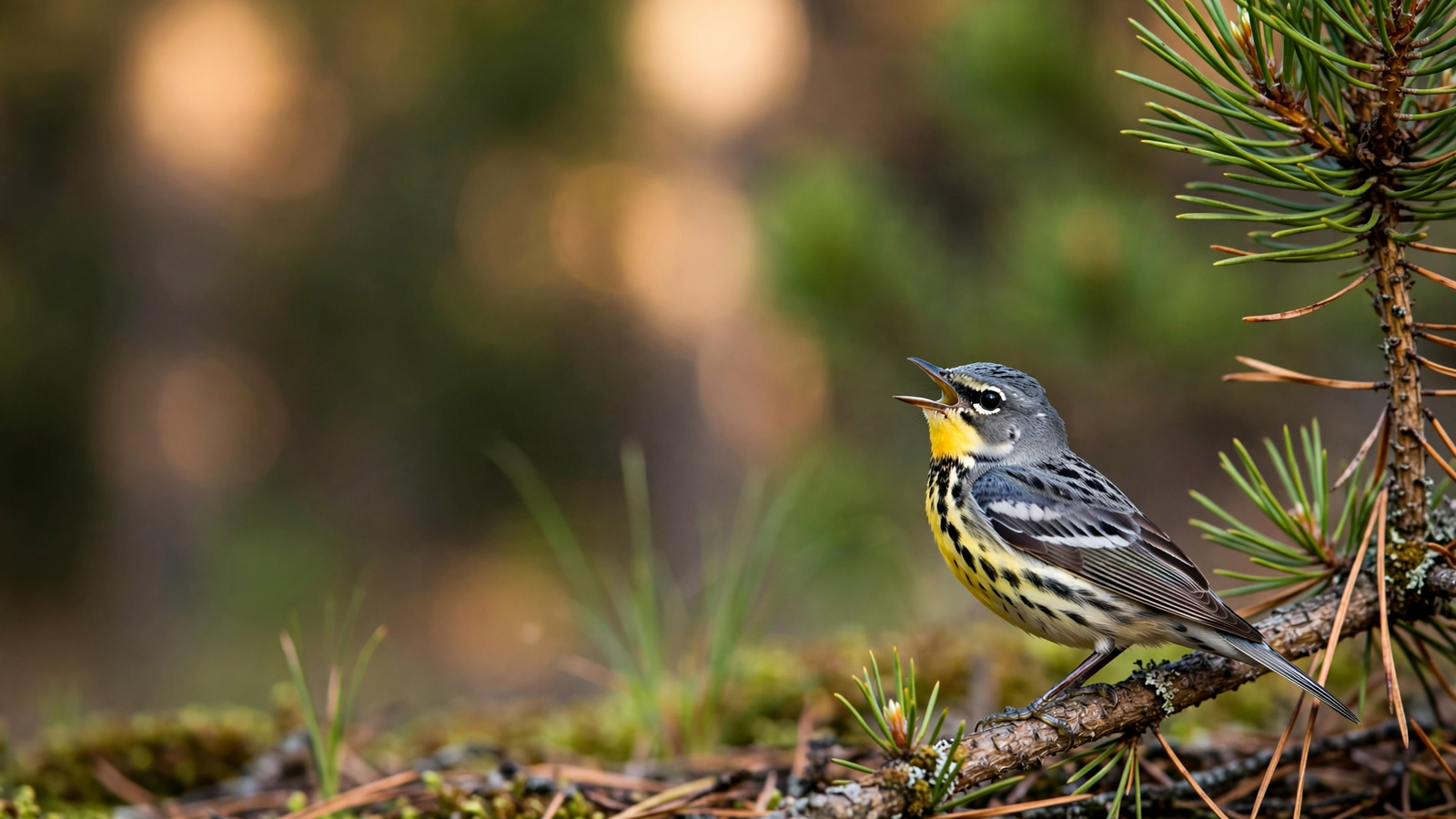
For much of the 20th century, the Kirtland’s warbler seemed to be running out of places to live. The small gray-and-yellow songbird nests almost exclusively in young jack pine forests—habitat that became increasingly scarce as natural wildfire patterns changed and forests matured.
Now, the bird’s story has taken a hopeful turn. In October 2024, the U.S. Fish and Wildlife Service removed the Kirtland’s warbler from the federal list of endangered and threatened species, concluding that the species had recovered enough to no longer require the protections of the Endangered Species Act.
A bird with very particular needs
Kirtland’s warblers breed primarily in Michigan, Wisconsin and Ontario, then migrate to the Bahamas for the winter. Their nesting habitat is unusually specific: dense stands of young jack pine, generally between five and 20 years old. As those trees grow taller and the forest canopy closes, the habitat becomes less suitable, and the birds move on.
Historically, wildfire helped create a shifting patchwork of young jack pine. As people suppressed fires and changed the landscape, those openings became less common. By the 1970s, the warbler’s breeding range had contracted sharply, and the species had one of the smallest distributions of any North American songbird.
That decline prompted federal protection in 1967, under the law that preceded today’s Endangered Species Act. Conservationists then began a long, highly targeted effort to recreate the conditions the birds needed.
Restoration built around the forest
Managers learned that protecting existing habitat was not enough. They also had to keep producing new young jack pine stands. In Michigan’s northern Lower Peninsula, state and federal agencies began planting jack pine, harvesting mature stands in carefully selected areas and using prescribed fire or mechanical treatment to prepare the ground for regeneration.
The work created a rotating supply of nesting habitat rather than a single, shrinking refuge. Biologists also monitored nests, tracked population changes and worked with landowners across the bird’s range. In Wisconsin, restoration expanded the number of suitable breeding areas, while conservation programs in the Bahamas helped protect important wintering habitat.
Captive rearing and releases played a role during the recovery effort as well. Conservation centers raised young birds for release in parts of the species’ historical range, helping establish additional breeding populations and reduce the risks of relying on one core area.
Recovery, with a responsibility to continue
The Fish and Wildlife Service’s decision reflects measurable progress. The warbler now occupies a broader range than it did when listed, and its population is large and stable enough to meet federal recovery criteria. The agency’s review also found that conservation partnerships had reduced the immediate risk of extinction.
Delisting does not mean the work is finished. The species will receive five years of post-delisting monitoring, and habitat management must continue because jack pine forests naturally age out of the warbler’s preferred condition. Climate change, severe weather, disease and changes in the Bahamas remain potential challenges.
Still, the Kirtland’s warbler offers a particularly encouraging conservation lesson. Its recovery did not depend on a single breakthrough. It came from matching a species’ needs to practical landscape management—and sustaining that work across generations.
In the forests of the Great Lakes, the reward is easy to recognize: a song once at risk of disappearing is becoming part of the ordinary sound of spring again.