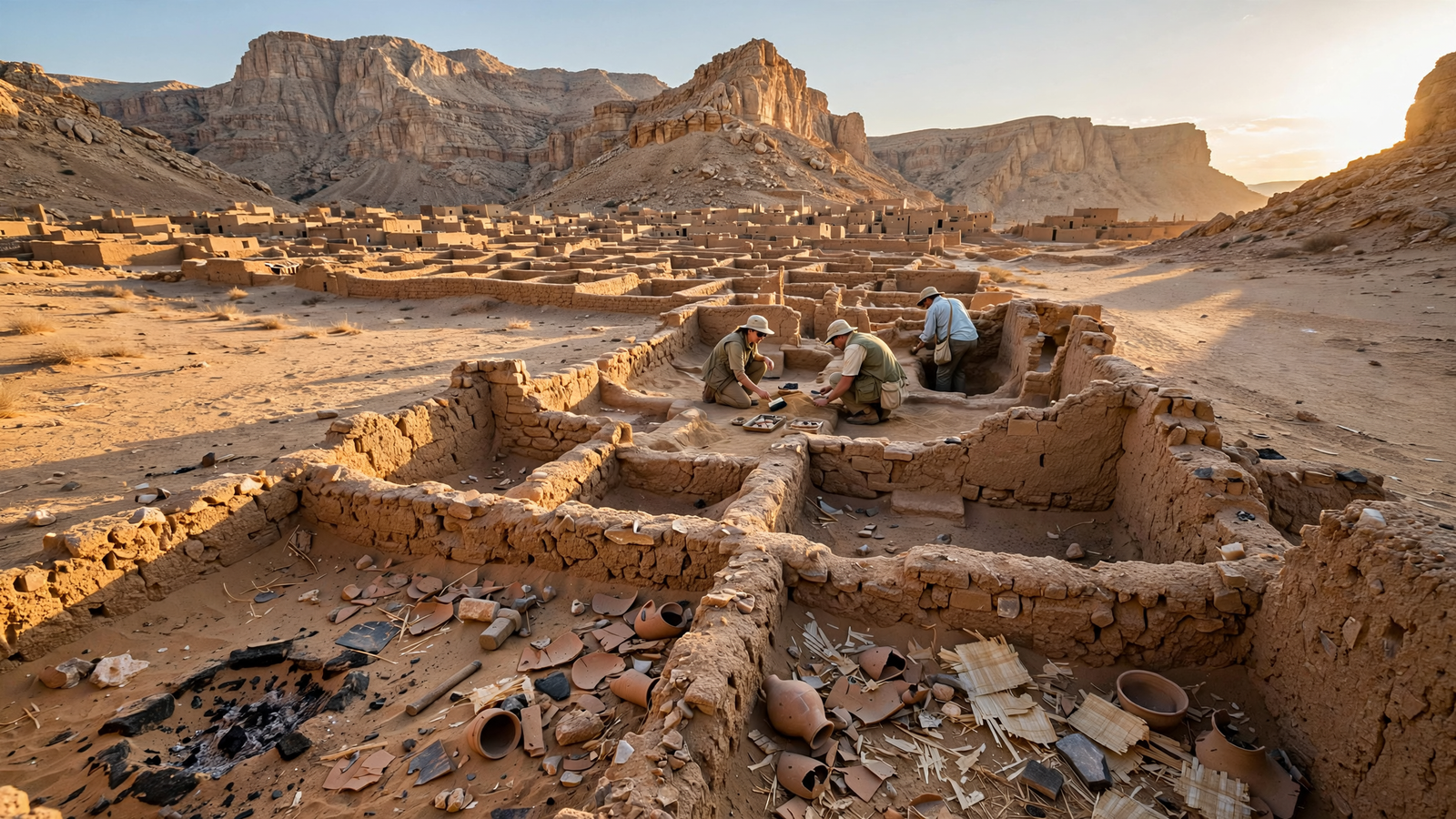
Not far from the grand tombs of Egypt’s Valley of the Kings stood a much smaller settlement: Deir el-Medina, a village built for the artisans who created and decorated royal burial places during the New Kingdom.
The tombs of pharaohs were designed to last for eternity. Deir el-Medina’s surviving records, however, preserve something more immediate: the practical details of ordinary life. They show how a specialized community worked, organized households, managed supplies and recorded disagreements more than 3,000 years ago.
A village of skilled workers
Deir el-Medina was not a typical farming village. Its residents included stonemasons, plasterers, painters and other specialists whose work took place in the nearby royal necropolis. Their homes were packed closely together, and the settlement contained houses, work areas, shrines and paths connecting the community to the desert landscape.
The workers were supported through an organized system of rations. Grain and beer formed important parts of the ancient Egyptian diet, while other supplies could include vegetables, fish, oil and fuel. Administrative records show that royal building projects depended not only on artistic skill but also on a steady flow of food and materials.
Notes written on broken pottery
Some of the most revealing evidence comes from ostraca: flakes of limestone or pieces of broken pottery used as inexpensive writing surfaces. The people of Deir el-Medina used them for letters, lists, school exercises, sketches, religious texts and short administrative notes.
These fragments bring history down to household scale. A note might concern a missing object, a request for supplies, an unpaid obligation or a family matter. Other documents preserve legal agreements and property arrangements. Together, they suggest a community where literacy was useful in daily business, even though access to writing was not evenly distributed across Egyptian society.
The records also contain evidence of absence from work. Illness, family responsibilities, religious observances and other circumstances could be entered into administrative accounts. Such notes do not describe a modern workplace, but they show that officials tracked the labor force closely and that workers’ lives could interrupt the demands of the tomb project.
When supplies failed
Deir el-Medina’s records also reveal the limits of royal organization. During the reign of Ramesses III, workers stopped work after their expected rations were delayed. The episode, recorded in documents commonly associated with the “strike” at Deir el-Medina, is often described as one of the earliest recorded labor protests in history.
Its importance is not only that workers protested. The surviving accounts show how dependent the community was on government distribution. A delayed delivery could affect every household, from the people who quarried stone to those who prepared food at home.
An unusually human archive
Much of ancient Egypt survives through monuments built for rulers and gods. Deir el-Medina offers a different perspective. Its houses, tools, household objects and written fragments do not represent every Egyptian, but they make the past more personal and more complicated.
Here, history is not only a story of pyramids and royal names. It is also a record of workers arranging supplies, children learning to write, families managing property and neighbors negotiating the pressures of a demanding job. The village beside the tombs reminds us that even the most monumental achievements depended on people whose everyday lives were rarely meant to become part of the monument.