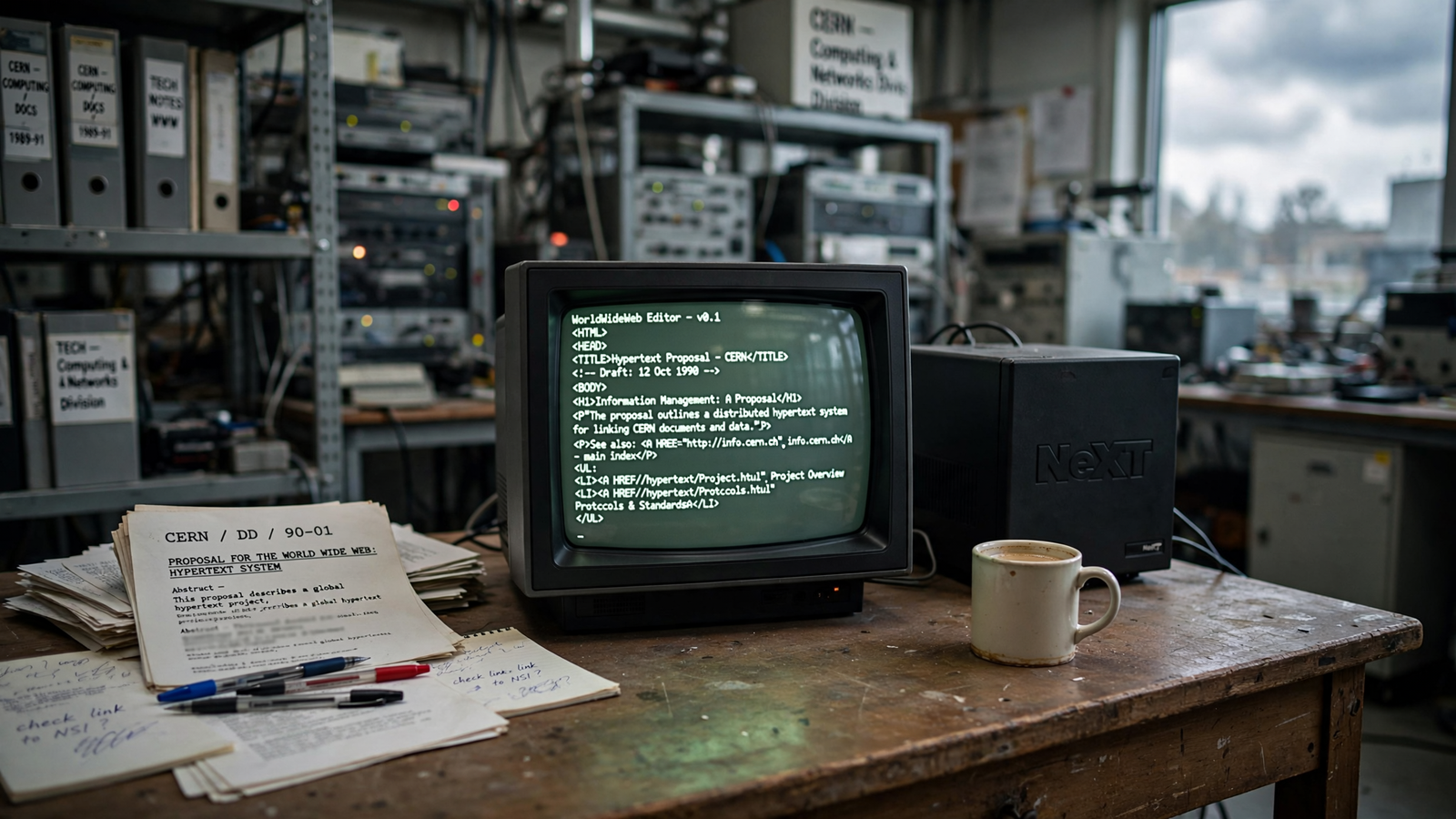
Before the Web, the internet already connected computers, but finding information across those networks was often difficult. Documents lived in separate systems, used different formats and required people to know where to look. The World Wide Web changed that by giving connected information a common language—and giving almost anyone a way to publish.
The idea began at CERN, the European particle-physics laboratory near Geneva. In March 1989, computer scientist Tim Berners-Lee circulated a proposal for a system that would help researchers share information across the laboratory’s many computers. CERN employed scientists from countries around the world, and Berners-Lee saw that a network of linked documents could make collaboration easier.
A simple system with powerful consequences
The Web was not the same thing as the internet. The internet provided the underlying network; the Web provided a way to organize and visit information on it. Berners-Lee’s design combined three key ideas: HTML, a language for structuring pages; HTTP, a method for requesting and delivering them; and URLs, addresses that identified where information could be found.
Those pieces worked together in a remarkably approachable way. A person could follow a link from one document to another without needing to understand the machinery moving data between distant computers. The link became the Web’s defining gesture: a small piece of text or an image could lead somewhere else in the growing information space.
By the end of 1990, Berners-Lee had created the first web server, the first browser and the first website at CERN. The early browser also served as an editor, allowing users not only to read pages but to create and modify them. The first site explained what the Web was and how others could use it.
From laboratory project to public resource
For the Web to grow beyond CERN, its tools had to be available to people who had never worked at the laboratory. In 1991, CERN made the software available to the wider internet community. Two years later, in April 1993, the organization released the Web’s underlying software into the public domain.
That decision mattered. Instead of becoming a proprietary service controlled by one company, the Web could be implemented, extended and connected by people around the world. Universities, governments, businesses, journalists and individual creators began building sites. The appearance of graphical browsers made the experience easier for newcomers, while search engines helped people navigate the expanding collection of pages.
In 1994, Berners-Lee founded the World Wide Web Consortium, or W3C, at the Massachusetts Institute of Technology. The consortium works with organizations internationally to develop open standards intended to keep the Web interoperable. Its work reflects the original ambition: a shared system in which different computers, browsers and networks can communicate.
An unfinished invention
The Web has become a foundation for education, commerce, public information, culture and personal expression. It has also brought difficult questions about privacy, accessibility, misinformation, security and who gets to participate. Those challenges do not erase the importance of the original design; they show how much the open platform has come to matter.
Berners-Lee’s breakthrough was not simply inventing a faster way to view documents. It was creating a public architecture in which information could be connected, discovered and shared across borders. More than three decades later, that basic act—clicking one link to reach another place—remains one of computing’s most influential ideas.