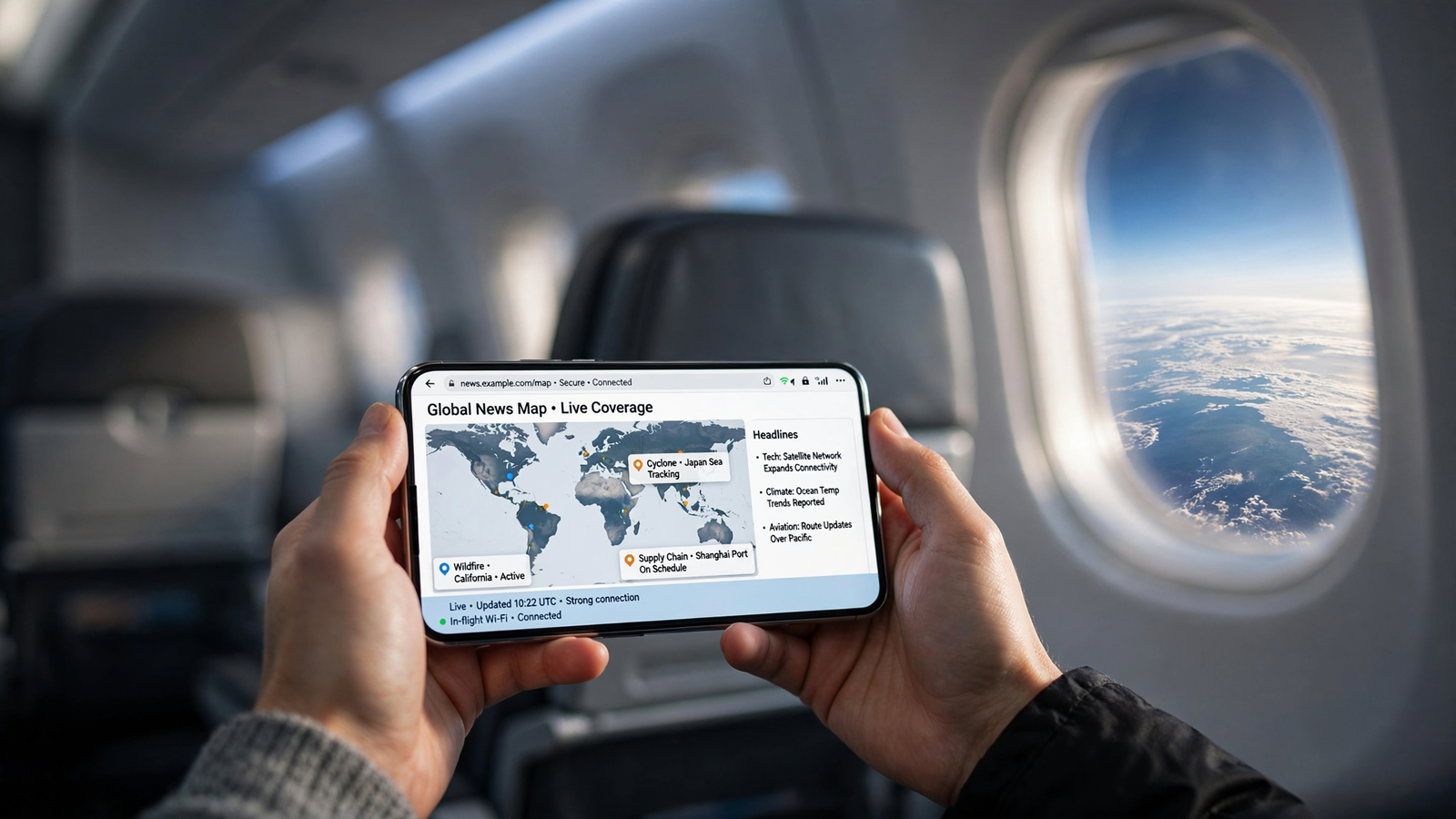
For years, airplane Wi-Fi has carried a reputation for being slow, expensive, or unreliable. That experience is beginning to change as airlines turn to a newer generation of satellite networks.
In February 2025, Hawaiian Airlines began offering free Starlink Wi-Fi on selected flights, becoming one of the first major U.S. carriers to bring the service into regular passenger operations. Alaska Airlines has also announced plans to install Starlink across its mainline fleet, putting satellite connectivity on a path toward becoming a standard feature rather than a premium extra.
A different kind of satellite connection
Traditional aircraft internet often relies on satellites in high geostationary orbits, roughly 22,000 miles above Earth. Those satellites can cover enormous areas, but the long distance between the aircraft and the spacecraft can contribute to delays and limited capacity.
Starlink uses a large network of satellites in low Earth orbit, much closer to the planet. Aircraft connect through specialized antennas mounted to the fuselage, and the network can hand a connection from one satellite to another as the plane travels.
The result is intended to feel more like a modern broadband connection on the ground. Hawaiian says passengers can use the service for activities such as browsing, messaging, streaming and other ordinary online tasks without paying an additional access fee.
Hawaiian puts the system into service
Hawaiian’s first Starlink-equipped aircraft entered passenger service in early 2025. The airline’s rollout began with its Airbus A321neo fleet, which operates many routes between Hawaii and the U.S. mainland. The carrier has said it plans to extend the technology to additional aircraft, including Airbus A330s.
That matters because Hawaii is separated from the mainland by thousands of miles of ocean. A dependable connection can make a long overwater flight feel less disconnected, while also giving passengers a more consistent way to communicate during the journey.
Service still depends on the aircraft and route. Passengers cannot assume that every Hawaiian flight has the system yet, and airline connectivity remains separate from the aircraft’s safety and navigation equipment. The improvement is mainly about the passenger experience: access to a faster, more useful internet connection while traveling at altitude.
A wider U.S. rollout is taking shape
Alaska Airlines announced in December 2024 that it had selected Starlink to provide free high-speed Wi-Fi across its mainline fleet. The carrier said installation would begin in 2025, with the first aircraft expected to enter service with the technology later in the year.
Alaska’s planned rollout would extend the experiment beyond a single airline and a Hawaii-focused network. Together, the two announcements show how satellite internet is becoming part of airline fleet planning, not simply an optional technology trial.
The broader shift will take time. Aircraft must be equipped individually, antennas need regulatory approval and installation schedules must fit into normal maintenance. But the direction is clear: airlines are competing not only on fares, schedules and seats, but also on how connected a passenger can remain after the cabin door closes.
For travelers, the most important change may be its simplicity. If the technology works as promised, connecting in the sky could eventually feel less like a special aviation perk and more like an ordinary part of getting online.