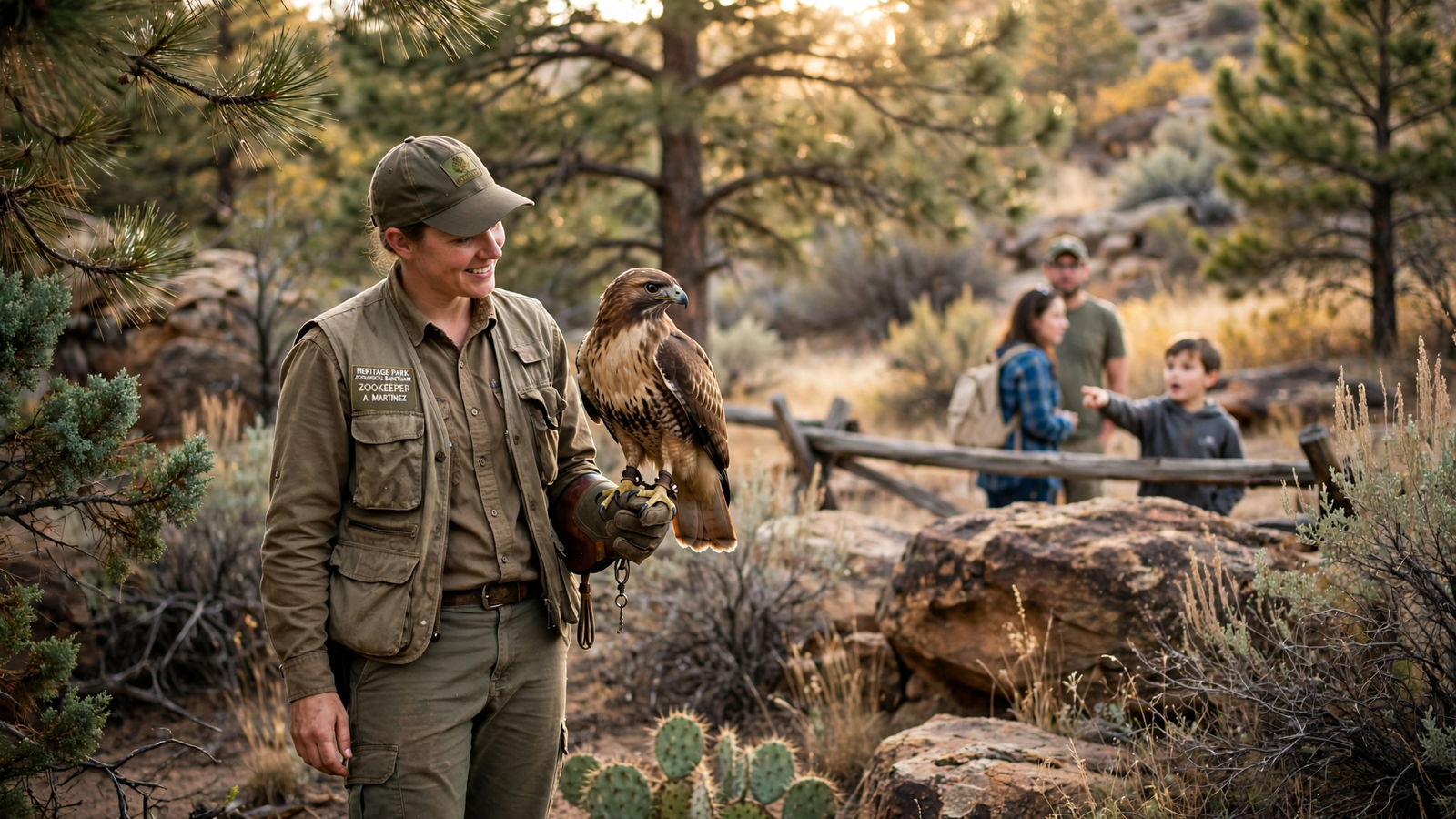
On the northern edge of Prescott, where the city begins to open toward the high-country landscape, a different kind of public place is at work. Heritage Park Zoological Sanctuary is not simply a collection of animal exhibits. It is a refuge, an educational institution and a daily reminder that wildlife conservation often begins with the individual animals people can see up close.
The sanctuary occupies a wooded setting within Prescott’s Heritage Park. Visitors come to see animals, but the place asks them to look more carefully at the circumstances behind each one. Some residents cannot safely return to the wild because of permanent injuries, human care, unsuitable captivity or other circumstances that make release impossible. The sanctuary provides long-term care while giving the public a way to learn about wildlife without treating the animals as entertainment alone.
A zoo with a sanctuary mission
Heritage Park Zoological Sanctuary describes its work as a combination of animal care, conservation education and support for wildlife preservation. That combination matters because the institution occupies a space between a traditional zoo and a wildlife rehabilitation center.
A rehabilitation center generally aims to return healthy native animals to the wild. A sanctuary, by contrast, may care for animals for the rest of their lives when release is not responsible or possible. The distinction is important. A permanent home can be the most humane outcome for an animal that has become dependent on people or would not survive independently.
The sanctuary’s setting also shapes the visitor experience. Prescott sits at roughly 5,300 feet above sea level, and its cooler, forested environment is different from the low-desert landscapes many people associate with Arizona. Within the park, the paths, trees and enclosures create a small transition zone between the developed city and the larger habitats of northern Arizona.
That setting allows the organization to introduce visitors to animals from several parts of the world while keeping a strong connection to regional wildlife. The educational message is not that every species belongs in the same landscape. It is that every species depends on a particular habitat, and that human decisions can determine whether those habitats remain viable.
Learning through real animals
Wildlife education can become abstract when it is limited to posters, statistics or distant photographs. At Heritage Park, the animals make the subject immediate. A visitor may arrive expecting a short family outing and leave thinking about habitat loss, illegal wildlife trade, human-wildlife conflict or the responsibilities that come with keeping wild animals in human care.
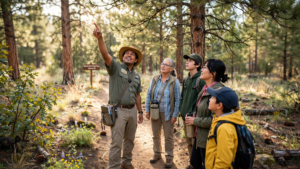
That kind of learning works best when it is grounded in accurate information. The sanctuary’s educational approach emphasizes natural history and animal welfare rather than presenting wildlife as a series of curiosities. Interpreters and exhibits can help explain where an animal comes from, what it eats, how it behaves and why its present circumstances require professional care.
For children, the experience offers an early introduction to observation. They can notice how an animal moves, rests, feeds or responds to its surroundings. For adults, the visit can be a useful corrective to the idea that seeing a wild animal automatically means understanding it. A close view is only the beginning; the larger lesson is the relationship between an animal and the world it needs.
A northern Arizona place with a wider focus
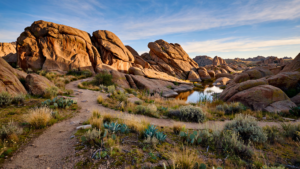
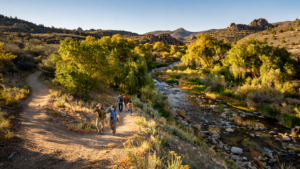
Prescott’s location gives the sanctuary a particularly useful regional role. Yavapai County contains a remarkable range of environments, from high-elevation forests and grasslands to desert valleys and riparian corridors. The county is also a meeting point for species and habitats associated with the Colorado Plateau, the Mojave Desert, the Sonoran Desert and the central Arizona uplands.
That ecological variety makes local conservation education especially valuable. People do not have to travel to a distant national park to begin learning about habitat. They can start with the animals and landscapes connected to their own county.
The sanctuary can also help visitors understand that conservation is not limited to animals that are rare or famous. Healthy ecosystems depend on many species, including those that receive little public attention. Learning to recognize the needs of predators, prey, birds, reptiles and small mammals can broaden the way people think about the land around Prescott.
The organization’s work fits into a larger network of wildlife care. Zoos and sanctuaries frequently cooperate with veterinarians, wildlife agencies, conservation groups and other accredited or professionally managed institutions. No single facility can protect every species or solve every threat. The practical work is shared across many organizations, with each one contributing care, expertise, public education or financial support.
Why permanent care matters
There is a temptation to measure conservation success only by releases into the wild. Returning animals to suitable habitat is an important goal when it can be done safely. But not every animal can follow that path.
Permanent-care sanctuaries make room for a more complicated reality. An animal may have been born in human care, sustained an injury, lost the skills needed to survive or come from a situation in which release would create risks for both the animal and the surrounding ecosystem. In those cases, responsible care means resisting the urge to make a symbolic release and instead providing a stable, carefully managed life.
That work is less dramatic than a rescue video or a release ceremony. It is also continuous. Food, veterinary attention, habitat maintenance, enrichment and careful observation are not one-time achievements. They are daily commitments.
By making that commitment visible, Heritage Park Zoological Sanctuary gives visitors a more realistic understanding of animal welfare. Conservation is not always a single heroic intervention. Often, it is a long sequence of ordinary tasks performed well.
A public place built around responsibility
Because it is located within Heritage Park, the sanctuary is part of a broader recreational landscape rather than an isolated attraction. Families can combine a visit with time outdoors, and local residents can return often enough to notice changes in the animals and the seasons.
That repeated contact is one of the strengths of a community-based institution. A one-time visit may create a memory. Regular visits can create familiarity, and familiarity can develop into concern. People who know the animals as individuals may become more interested in the habitats, laws and conservation programs that affect their wild counterparts.
The sanctuary also gives Prescott a place where recreation and responsibility meet. It is possible to spend a morning there as a family, a student, a volunteer or a curious resident while still engaging with serious questions about the future of wildlife. The experience does not require visitors to be experts. It asks them to pay attention.
The quiet value of a place like this
Across the country, many people encounter wildlife through screens: a documentary, a social-media clip or a news report about a threatened species. Those images can inspire interest, but a physical place adds another dimension. It creates time for observation and makes animal care part of the local civic landscape.
Heritage Park Zoological Sanctuary does that work on a human scale. It gives Yavapai County a place where the public can meet wildlife responsibly, where non-releasable animals can receive continuing care and where conservation is presented as something people can learn, support and practice close to home.
The sanctuary’s most important contribution may be the connection it builds between attention and action. A visitor who learns why an animal cannot return to the wild may become more thoughtful about keeping exotic pets. Someone who sees the complexity of habitat needs may become more careful about local development, outdoor recreation or wildlife encounters. A child who starts by asking an animal’s name may eventually ask what that animal needs to survive.
That is how a place becomes more than a destination. In Prescott, the sanctuary turns a visit to see animals into an invitation to understand them—and to recognize that caring for wildlife is not only a distant project carried out by specialists. It is a shared responsibility, rooted in the places where people live.