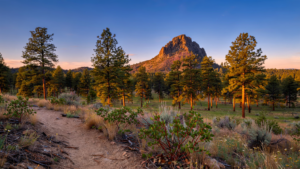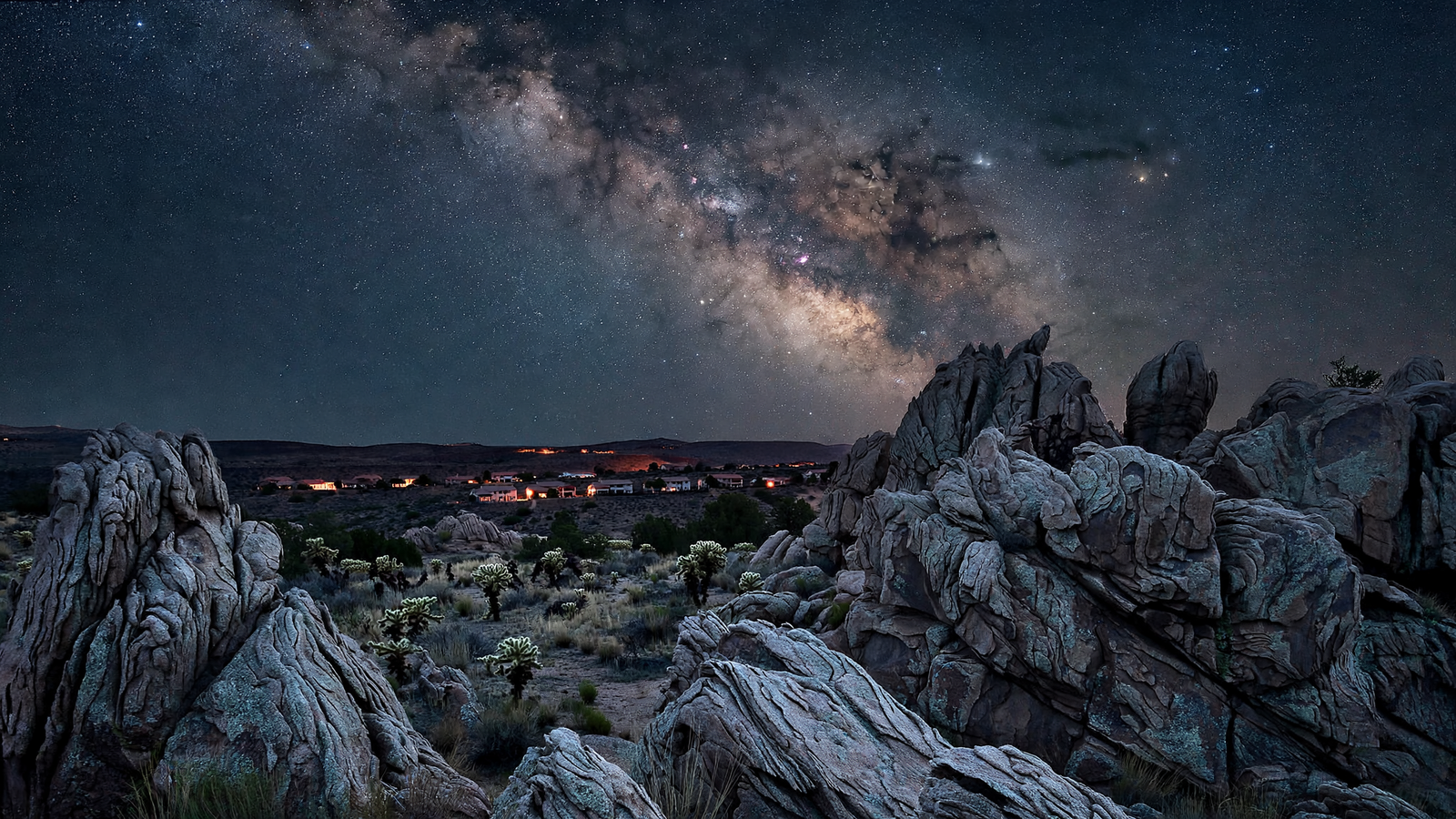
Prescott is easy to understand in daylight. Granite boulders rise above the roads, ponderosa pines gather around the hills, and the old courthouse anchors a downtown built for walking. But the city has another landscape, one that appears only after the sun goes down.
Above the rooftops and forested ridges is a broad Arizona sky, increasingly valuable in a country where artificial light is spreading into places that once grew naturally dark. In Prescott, protecting that darkness is becoming part of the conversation about what the city is—and what it wants to remain.
This is not a single construction project or a new attraction with a grand opening. It is a quieter civic development: the recognition that darkness can be an environmental resource, a public amenity and a reason people come to the high country in the first place.
A different kind of public landscape
Most city improvements are easy to see. A trail is paved, a park is renovated or a building is restored. Dark-sky protection works differently. Its success is measured partly by what does not happen: light that is not aimed into the sky, glare that does not spill across a roadway, and fixtures that do not turn a natural night into a permanent orange haze.
The International Dark-Sky Association describes light pollution as excessive or inappropriate artificial light. Its effects reach beyond astronomy. Poorly designed lighting can create glare, waste energy and disrupt wildlife that depends on the daily cycle of light and darkness.
That makes Prescott’s night sky more than a scenic backdrop. It is part of the ecological setting around the city, where nocturnal animals move through forests, washes and open country. It is also part of the experience of living in a mountain community rather than a much larger metropolitan area.
Prescott’s existing outdoor-lighting rules reflect that balance. The city regulates features such as glare, shielding and the direction of light, aiming to provide safety while limiting unnecessary illumination above the horizon. The result is not a city without lights. It is a city attempting to use them with more care.
Why the high country still has an advantage
Prescott sits at roughly 5,300 feet, surrounded by a landscape of forest, chaparral, granite and open desert. Its setting gives residents and visitors a better chance of seeing the night sky than they would in a dense urban region, although the view is not immune to growth.
Light pollution is regional. A bright source many miles away can affect the horizon, and the combined glow of homes, commercial properties, parking areas and roadways can gradually change the character of a place. Protecting the sky therefore depends on many ordinary decisions rather than one dramatic intervention.
A properly shielded fixture can illuminate a sidewalk without sending light upward. A warmer, lower-intensity lamp can provide visibility with less glare. Timers and controls can reduce lighting when a property is closed. None of these changes is spectacular on its own. Together, they can preserve more of the darkness that makes the region distinctive.
For a place such as Prescott, that distinction matters. The city’s appeal is tied to outdoor life: hiking before breakfast, camping under tall trees, watching storms build over the mountains and stepping outside on a clear evening to find the Milky Way. The night sky extends that outdoor identity after sunset.
A sky shared by residents, wildlife and visitors
National parks and public-land agencies increasingly treat dark skies as a resource that deserves active management. The National Park Service identifies natural darkness as important for wildlife, human health, cultural traditions and scientific observation. Parks conduct night-sky measurements, improve lighting and teach visitors how artificial light changes what they see.
Yavapai County’s public lands make that idea especially relevant. The Prescott National Forest surrounds the city with places where the transition from day to night remains visible. Campgrounds, trailheads and overlooks can offer an experience that is difficult to find in a heavily developed city: the feeling that the landscape continues beyond the reach of streetlights.
Darkness also supports animals that people rarely notice. Bats navigate and forage at night. Migrating birds can be drawn toward artificial light, sometimes away from safer routes. Insects gather around bright fixtures, changing feeding patterns and reducing the energy available to other species. Preserving darker corridors is one way to keep the nighttime ecosystem closer to its natural rhythm.
There is a human benefit as well. A dark sky slows the pace of a place. It invites people to look up rather than hurry through an illuminated environment. Families can learn the constellations, amateur astronomers can set up telescopes, and visitors can experience the simple surprise of seeing how many stars are normally hidden by urban glow.
Dark-sky work begins with ordinary choices
The most useful feature of Prescott’s approach is that it does not require every resident to become an astronomer. Dark-sky stewardship can begin with a light over a garage, a porch fixture or a business sign.
- Shield the light: Fixtures that direct illumination downward reduce glare and limit light escaping into the sky.
- Use only what is needed: Lower brightness can often provide adequate visibility without washing out nearby homes, trees or hillsides.
- Choose warmer light: Less-blue lighting generally creates less harsh glare and is considered more compatible with nighttime environments.
- Turn lights off when possible: Timers, motion sensors and closing schedules can reduce unnecessary illumination.
These are practical measures, but they also change how a community thinks about its surroundings. A light is no longer viewed only as a private decision. Its effects can reach neighbors, wildlife and anyone trying to see the landscape after dark.
Prescott’s next chapter is not only historic
Prescott often tells its story through visible heritage: the courthouse, the old commercial blocks, the rodeo tradition and the routes that once connected the mining camps of central Arizona. The night sky offers a newer kind of heritage—one that is not built by earlier generations but can be either preserved or gradually lost by the present one.
That makes dark-sky protection a useful complement to historic preservation. A historic street looks different under carefully controlled lighting than it does beneath a jumble of glare and competing signs. A trailhead feels more connected to the surrounding forest when the forest remains visible after sunset. A community’s sense of scale changes when the horizon is allowed to stay dark.
The work also fits Prescott’s broader identity as a place where urban life meets public land. Residents do not have to travel far to find trees, rock formations and open views. Protecting the darkness helps maintain that relationship during hours when many communities stop seeing their surroundings at all.
The value of leaving some things unchanged
There is a temptation to measure progress by how much a place adds: more amenities, more activity, more illumination and more access. Prescott’s night-sky effort points toward another kind of improvement—the deliberate decision to leave a natural condition in place.
Darkness is not empty. It is habitat, atmosphere and orientation. It gives the stars room to appear and gives people a clearer sense of the land beneath them. In Yavapai County, where the mountains and high desert remain close to town, that is a meaningful public asset.
Prescott does not need to become a museum of the night. It needs safe streets, active businesses and lighting that helps people move through the city. The opportunity is to make those things coexist with a sky that still feels like Arizona.
On a clear evening, the result can be almost invisible at first. A porch light shines downward. A parking lot grows dimmer after closing. A trailhead remains dark beyond its safety lighting. Then the sky begins to emerge: one star, then another, and finally the larger shape of a landscape that has been there all along.