On Gurley Street, in the middle of Prescott’s historic downtown, a theater has spent more than a century doing something that is easy to overlook and surprisingly difficult to preserve: bringing people together in the same room.
The Elks Opera House opened in 1905, when Prescott was still a young Arizona community and live theater was one of the principal ways a town encountered the wider world. Traveling performers, musicians, touring companies, lecturers, and local groups could all use a stage like this one. The building was entertainment venue, civic gathering place, and architectural statement at the same time.
Today, the Elks Opera House remains one of Prescott’s most recognizable downtown places. Its importance is not only that it is old. The theater matters because it continues to function as a theater. Performances, concerts, community events, and touring productions allow the building to be experienced as more than a preserved shell.
A theater for a growing Arizona town
Prescott was founded in the 1860s as the capital of the Arizona Territory and developed around a compact commercial center. By the beginning of the twentieth century, the town had banks, hotels, stores, restaurants, churches, and a growing appetite for organized entertainment.
The Elks Opera House was built during that period of civic ambition. The Benevolent and Protective Order of Elks played an important role in the project, and the building became associated with the organization’s presence in Prescott. Its location on Gurley Street placed it within the town’s central business district, close to the courthouse and the other institutions that shaped daily life.
The term “opera house” had a broader meaning in that era than it usually does now. Such buildings could host opera, vaudeville, drama, concerts, public meetings, lectures, dances, and traveling shows. A theater did not need to specialize in one art form to be culturally important. It needed to provide a reliable place where a community could see, hear, and share something together.
That flexibility helped opera houses become important parts of early American downtowns. They were among the few indoor spaces designed for large public audiences, and their programs could change from week to week. In Prescott, the Elks Opera House gave a frontier-era town a formal stage and a visible connection to national entertainment circuits.
What the building still reveals
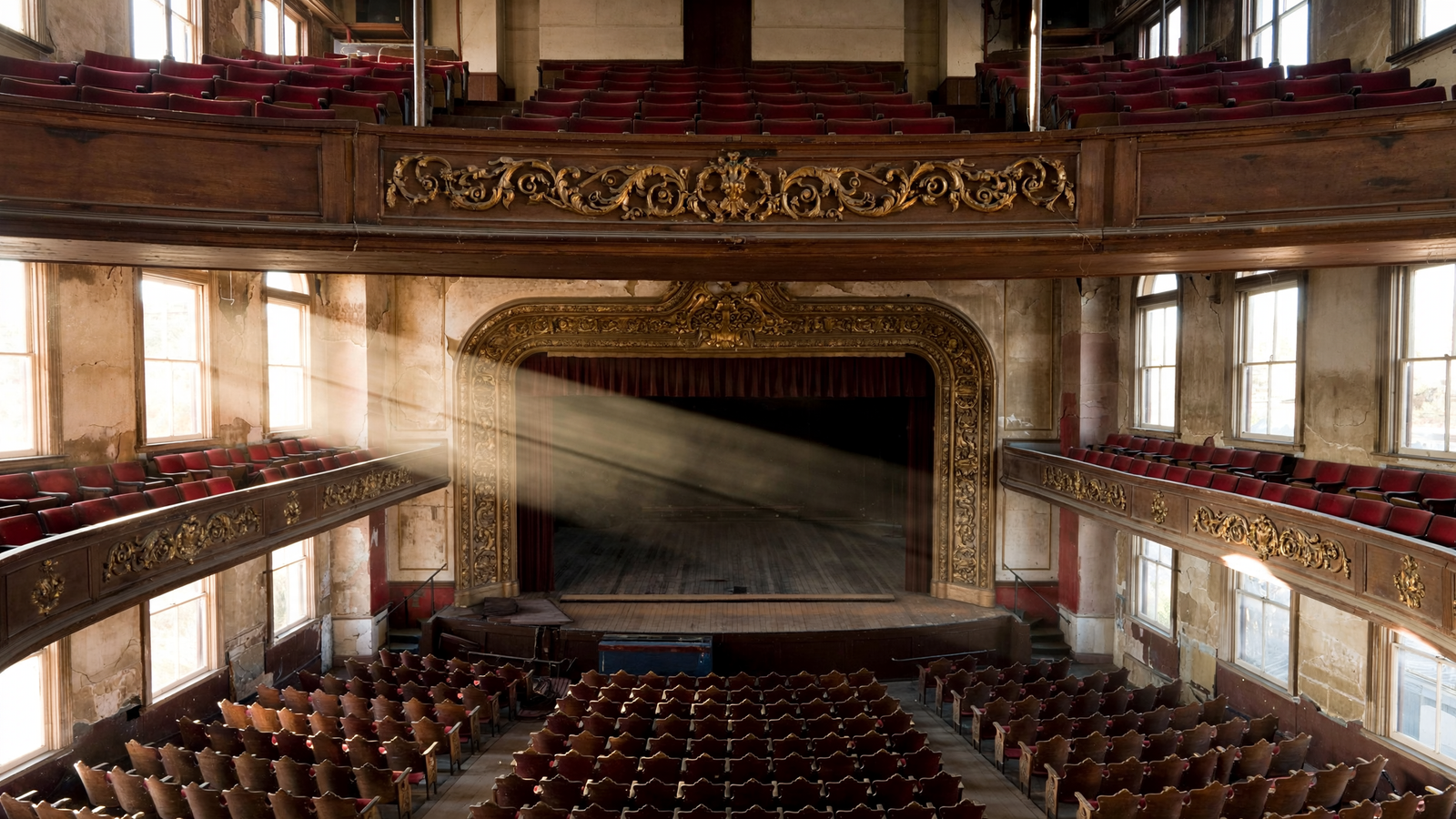
The theater’s architecture carries the confidence of its period. Its downtown façade is part of the historic streetscape, while the auditorium retains the arrangement that makes an old theater feel different from a modern performance hall: a defined stage, a room oriented toward a shared focal point, and layers of balconies and seating that place the audience inside the architecture.
Those details are not merely decorative. They tell the story of how public entertainment once worked. Before television, streaming services, and large suburban venues, the local theater was one of the places where a town experienced culture collectively. The room itself helped create the event.
Prescott’s historic downtown has survived multiple changes in technology, commerce, and transportation. The Elks Opera House is part of that larger survival story. Its surroundings have evolved, but the building remains legible as a theater. Visitors can still understand what it was designed to do simply by entering it.
That continuity is especially valuable in a city known for its historic character. Preservation can sometimes reduce a building to an exterior: a façade to photograph, a plaque to read, or a landmark to pass on the way to somewhere else. A working theater offers a different kind of preservation. It keeps the building’s original purpose visible through use.
From decline to renewal
Like many historic American theaters, the Elks Opera House did not move smoothly from its opening years into the present. Changes in entertainment, the rise of movie theaters, competition from television, and the economics of maintaining an aging building all placed pressure on traditional downtown venues.
The building’s later history included periods when its future was uncertain. Keeping a large historic auditorium safe and functional requires more than admiration. It requires repairs, fundraising, technical work, building-code compliance, and an audience willing to return.
Prescott’s restoration effort eventually gave the theater a new chance. Work in the early twenty-first century addressed the building’s physical condition and helped return it to regular public use. The restoration was not simply an attempt to recreate 1905. It was an effort to make a historic room capable of serving contemporary audiences while retaining the character that made it worth saving.
That distinction is important. A theater that is preserved but unusable becomes a museum of absence. A theater that is carefully adapted can continue to make new memories without erasing the old ones. The Elks Opera House belongs to the second category.
A stage shared by professionals and neighbors
The theater’s program today reflects the mixed role that opera houses have historically played. A visitor might attend a concert, comedy performance, theatrical production, film screening, lecture, or special community event. The exact schedule changes, but the underlying purpose remains familiar: the building gives people a reason to leave home and gather downtown.
That role creates a useful bridge between Prescott’s past and present. Historic buildings can sometimes feel connected mainly to tourism, while local residents experience them from the outside. A functioning performance calendar changes that relationship. Residents can return repeatedly, not just to look at the architecture but to participate in what happens there.
The theater also provides a smaller-scale alternative to the increasingly large and standardized venues common in modern entertainment. Its setting makes performances feel connected to the city around them. An evening at the Elks Opera House begins on a historic downtown street and ends in a room shaped by more than a hundred years of public use.
That intimacy is part of the appeal, but it is also part of the responsibility. Historic theaters must balance atmosphere with access, authenticity with safety, and preservation with the practical needs of performers and audiences. Keeping such a place alive is an ongoing process rather than a single restoration milestone.
Why a working theater matters to a place
The Elks Opera House helps explain why historic preservation is about more than saving attractive buildings. A landmark can serve as an anchor for the identity of a downtown. It can make the past visible without turning the entire city into a museum.
In Prescott, the theater contributes to that sense of continuity. The town’s history is often associated with territorial government, mining, ranching, fire, and the American West. The opera house adds another layer: the history of ordinary people seeking music, stories, spectacle, and company.
That may be one of the building’s most lasting contributions. It preserves not only the memory of important figures or dramatic events, but also the everyday cultural life of a community. People came to theaters to be entertained, certainly, but also to see one another and to take part in a shared public experience.
More than a century after its opening, the Elks Opera House still offers that experience. Its survival is a reminder that a place becomes historic not simply because it has endured, but because people continue to find meaning in using it.
In a rapidly changing entertainment landscape, that is a modest but powerful achievement. Prescott did not merely keep an old theater standing. It kept a public room open.