In the spring of 1974, farmers near the Chinese city of Xi’an began digging a well. They were looking for water. Instead, they found fragments of clay figures, bronze weapons and a buried secret that had remained underground for more than two thousand years.
The discovery became known as the Terracotta Army, a vast collection of life-sized soldiers, horses and chariots created for Qin Shi Huang, the ruler who unified much of China and became its first emperor. What began as an unexpected find in a dry field grew into one of the most important archaeological projects of the modern era.
A well that opened an imperial tomb complex
The first figures were found near Xiyang village, northeast of modern Xi’an, in March 1974. The farmers’ work exposed pieces of terracotta and evidence of a large underground structure. Archaeologists soon recognized that the fragments were not isolated objects. They belonged to a carefully arranged burial complex connected with the mausoleum of Qin Shi Huang, who died in 210 BCE.
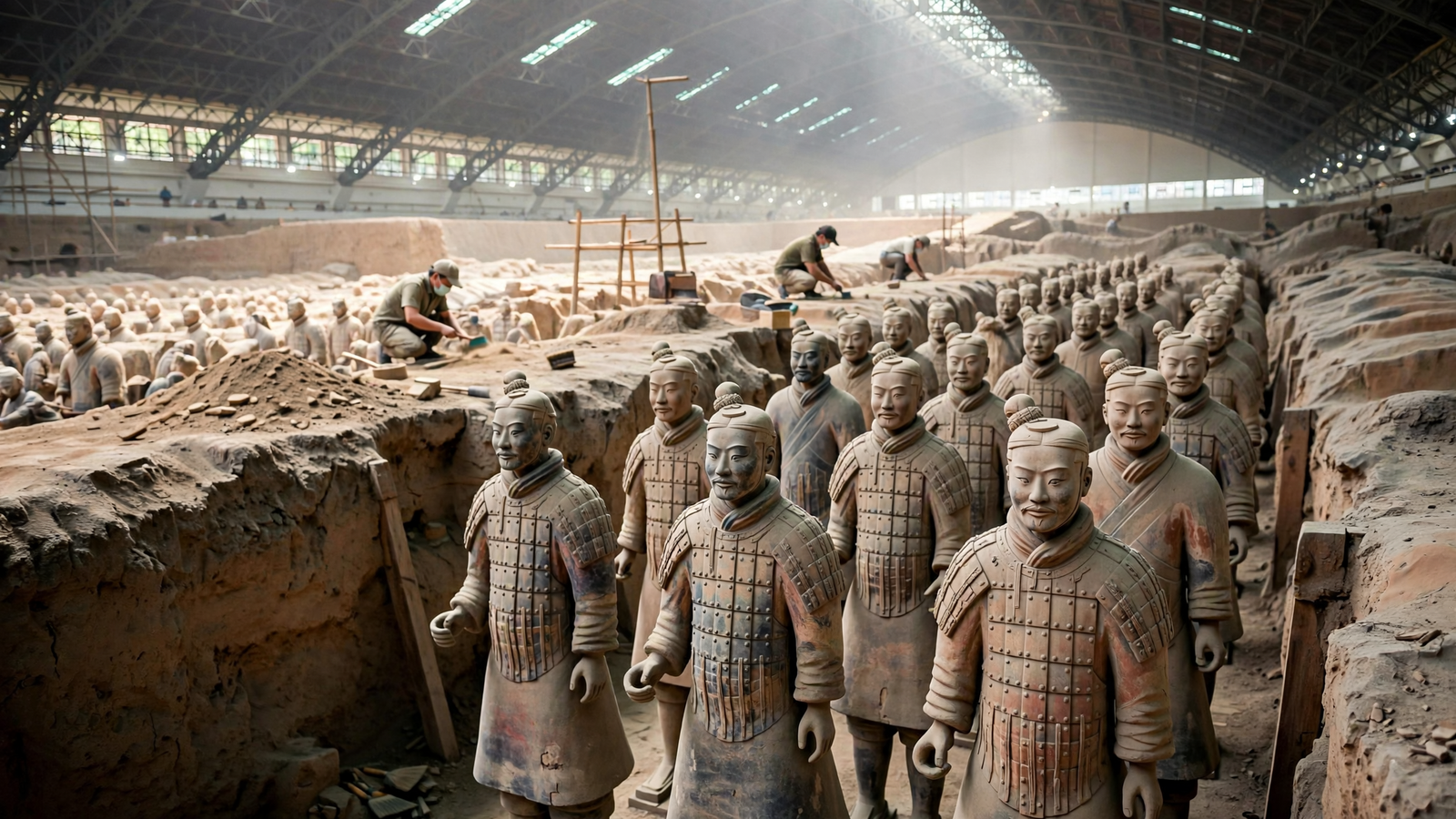
Excavations revealed large pits filled with armies of clay figures. The largest, commonly called Pit 1, contains long ranks of infantry, officers and horses arranged in military formations. Other pits contain additional soldiers, chariots and specialized figures. The figures were made in sections, assembled, finished by hand and originally painted in vivid colors.
The scale was extraordinary. UNESCO describes the mausoleum complex as including thousands of life-sized terracotta figures, along with horses, chariots and weapons. The figures are not identical copies. Their faces, hairstyles, clothing and postures vary, giving the army an unusual sense of individuality even though it was created for a ruler’s burial world.
The emperor who wanted an empire beyond death
Qin Shi Huang was born in 259 BCE and became king of Qin as a child. In 221 BCE, after a series of wars, he defeated the other major states of the Warring States period and established a unified imperial government. He standardized systems of writing, currency, weights and measures, while also imposing strict central control.
His mausoleum reflected both the power and anxiety of his reign. Ancient historical accounts describe an enormous underground burial landscape representing the emperor’s realm. The terracotta troops were part of that imagined world: an army intended to protect the ruler after death.
The main burial chamber has not been excavated. Archaeologists and heritage authorities have treated the unopened tomb with caution, partly because excavation technology must be able to preserve fragile materials and record the site without unnecessary damage. The decision means that the mausoleum still holds major unanswered questions, including how closely later written accounts describe the buried complex.
More than statues
The Terracotta Army is often presented as a collection of sculptures, but the pits also preserve evidence about organization, technology and military life during the Qin period. Bronze arrowheads and other weapons show the sophistication of ancient production. Chariots and harness fittings reveal how transport and warfare were represented in the emperor’s underground realm.
The arrangement of the figures suggests disciplined planning. Soldiers were placed according to rank and role, with commanders, infantry and cavalry occupying different positions. The pits therefore function as both a funerary monument and a record of how the Qin state imagined order: thousands of individuals transformed into a precise instrument of imperial power.
The figures also challenge the idea that ancient armies were represented only through symbolic images. Their size, equipment and varied features make them unusually direct witnesses to Qin artistic and political culture. Yet they are not portraits in the modern sense. Their individuality was created within a system designed to serve the emperor’s larger message of control and permanence.
Preserving a discovery for the future
Excavation has been a long, careful process. Many figures were found broken, and the work of documenting, reconstructing and conserving them continues. Their original pigments can be extremely fragile, fading rapidly when exposed to air and changes in humidity. Conservation has therefore become as important as excavation.
The site’s significance extends beyond the objects themselves. In 1987, UNESCO added the Mausoleum of the First Qin Emperor, including the terracotta figures, to the World Heritage List. The designation recognizes the complex as an exceptional expression of the first unified empire in Chinese history and a major achievement of ancient art and engineering.
The discovery also changed how the world understood archaeological chance. The farmers who began digging for a practical necessity did not set out to rewrite the history of ancient China. Their find showed how much can remain hidden beneath ordinary landscapes, and how a local discovery can become part of a shared global heritage.
A buried army with a wider lesson
Today, the Terracotta Army is not simply a spectacular archaeological site. It is a record of ambition, belief and state power. The figures were made to guard a dead emperor, but they have instead become messengers from a living civilization: evidence of how ancient workers organized enormous projects, how artists translated political ideas into physical form, and how later generations can recover meaning from the remains of the past.
The farmers were searching for water. What they found was a doorway into the Qin world. More than five decades after the discovery, the army still has work to do—not as an imperial guard, but as a source of questions that archaeology is only beginning to answer.