In the deep ocean, survival often depends on detecting a meal before the meal detects you. Light is scarce, food can be widely scattered, and a failed attack may waste energy an animal cannot easily replace.
The goblin shark has developed an answer that looks almost unreal: when prey comes within reach, its jaws can shoot forward from the head in a rapid, elastic snap. The movement turns a narrow-mouthed, slow-looking shark into a predator capable of striking through the darkness.
Mitsukurina owstoni is one of the least commonly encountered sharks known to science. It lives along continental slopes and in other deep-water habitats, where people rarely see it alive. Most records come from accidental captures by deep-sea fishing gear or from specimens brought to the surface.
A shark built for a world without sunlight
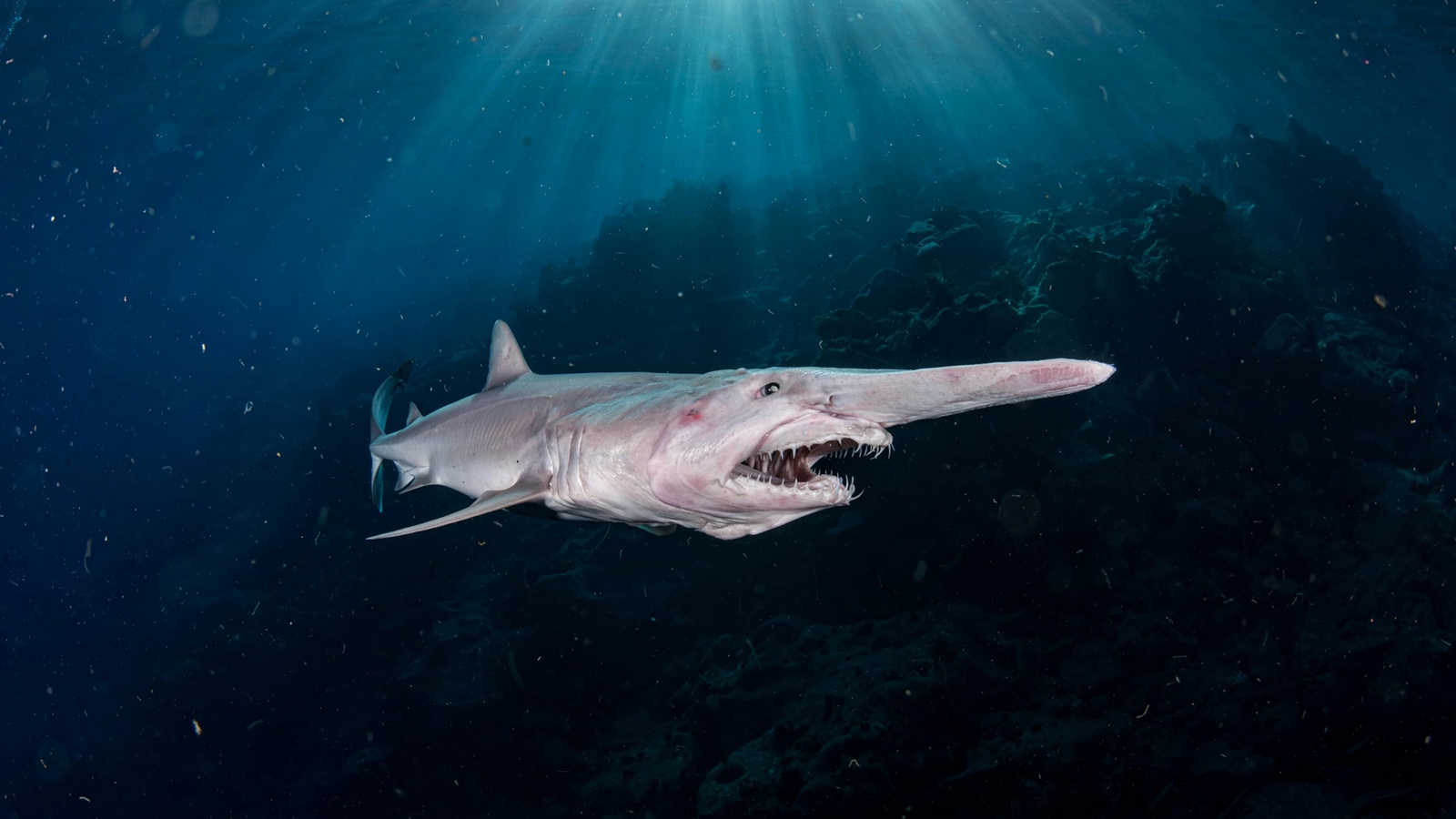
The goblin shark’s appearance is unusual even by deep-sea standards. Its snout is long and flattened, extending well beyond the mouth. The body is soft and relatively flabby compared with the streamlined shape of a fast-swimming open-water shark. Its fins are modest, and its tail is long and asymmetrical.
That design makes more sense when viewed in context. Goblin sharks are not thought to be high-speed pursuit hunters. They occupy a dark, cold environment where conserving energy is important and where prey may appear unexpectedly from almost any direction.
The extended snout is covered with sensory organs called ampullae of Lorenzini. These organs detect weak electrical signals produced by the muscles and nervous systems of nearby animals. In the deep sea, where vision becomes less useful, electroreception can help a predator locate prey that is hidden, still, or difficult to see.
The shark’s eyes are small, but they are not useless. Some goblin sharks have been observed with a reflective layer behind the retina, a feature that can help an animal make better use of limited light. Still, the snout and its sensory equipment appear to be central to the shark’s hunting strategy.
The jaw that turns the shark into a spring
The goblin shark’s most famous feature is its jaw. At rest, the mouth sits beneath the long snout and gives the animal a strangely unfinished appearance. During feeding, however, the upper and lower jaws can extend dramatically forward.
Researchers studying preserved specimens and high-speed video have shown that the movement is not simply the shark opening its mouth wider. The jaw apparatus is connected to tissues and muscles that allow it to project outward, creating a sudden reach. The teeth then close around the prey before the jaws retract.
This mechanism is sometimes compared with a slingshot. The comparison is useful, but it can also make the animal seem more explosive than it probably is in ordinary life. Goblin sharks are not known for racing through the water like great whites or makos. Their advantage is surprise and reach: the prey may be close enough to capture before it has time to react.
The teeth are narrow and needle-like, especially toward the front of the mouth. Such teeth are well suited to gripping soft-bodied prey. Goblin sharks are known to eat fish, squid and crustaceans, although scientists still have limited information about their everyday diet because direct observations are rare.
Why the shark looks pink
Photographs of goblin sharks often show a vivid pink or reddish animal. That color is not necessarily a bright living signal. The shark’s skin is relatively translucent, and blood vessels beneath the surface can show through. After the animal is brought into the air, changes in the tissues and blood can make the color appear even more pronounced.
In the dim environment where goblin sharks live, camouflage does not have to work in the same way it does near the surface. A muted or translucent body can be less visible in the scattered blue light of deep water. The shark’s coloring is therefore another reminder that its strange appearance is shaped by a habitat humans rarely experience directly.
An animal from an old branch of the shark family
The goblin shark is the only living species in the family Mitsukurinidae. Fossil relatives show that this lineage has deep roots in shark evolution, extending back into the Cretaceous period. That long history is why the species is often described as primitive or as a “living fossil.”
Those labels need care. A living animal is not frozen in time, and the goblin shark has continued evolving like every other species. Its ancestors survived changing oceans, climates and ecosystems. The more useful point is that the shark preserves a body plan unlike that of most modern sharks and provides scientists with a living example of an ancient family line.
The species was formally described in the early twentieth century after a specimen from Japanese waters reached researchers. Its scientific name honors Kakichi Mitsukuri, a Japanese zoologist, and Alan Owston, an English naturalist and collector who worked in Japan.
Rare to see, difficult to study
Goblin sharks have been reported from widely separated parts of the Atlantic, Pacific and Indian oceans. They are generally associated with deep water, often along continental margins, but the exact depth range varies among records. Some have been found relatively close to shore where underwater terrain drops sharply; others have come from much deeper locations.
Because the shark is rarely observed in its natural environment, many questions remain open. Scientists know little about its social behavior, courtship, population size or precise life span. Even its swimming style is difficult to study. A handful of remotely operated vehicle encounters have offered glimpses, but they are not enough to describe the species’ full routine.
Most documented goblin sharks have been caught as bycatch in fisheries targeting other deep-water species. That creates a scientific opportunity and a conservation concern at the same time. Researchers may learn from a specimen that would otherwise be unknown, but deep-sea animals can be especially vulnerable to disturbance because they often grow slowly, mature late or reproduce at low rates.
The available evidence does not suggest that goblin sharks are dangerous to people. Their habitat lies far outside ordinary swimming areas, and there is no established pattern of attacks. Their threatening appearance is mostly a consequence of anatomy adapted for a world humans almost never enter.
What the goblin shark reveals about the deep
It is tempting to treat the goblin shark as an evolutionary oddity, a creature that seems to have wandered out of a monster movie. But its features are not random. The long snout samples the water for electrical signals. The pale, flexible body helps support a low-energy lifestyle. The projecting jaw solves the problem of capturing prey in darkness without a high-speed chase.
That combination makes the shark valuable to science beyond its shock value. It shows how evolution can reshape a familiar body plan for an extreme environment. A shark does not need to be fast, muscular or brightly colored to be successful. In the deep ocean, a sensitive snout and a precisely timed jaw may matter more.
The goblin shark also illustrates how incomplete our picture of the ocean remains. Humans have mapped large areas of the seafloor and developed remarkable cameras, sensors and submersibles, yet much of deep-water life is still known from brief encounters and damaged specimens. Each sighting can add information about where the animal lives, how it moves and what pressures it may face.
For now, the goblin shark remains an elusive resident of the continental slopes: an ancient lineage still operating in the dark, carrying its own electric detectors and a spring-loaded feeding system into a place where ordinary rules of appearance do not apply.