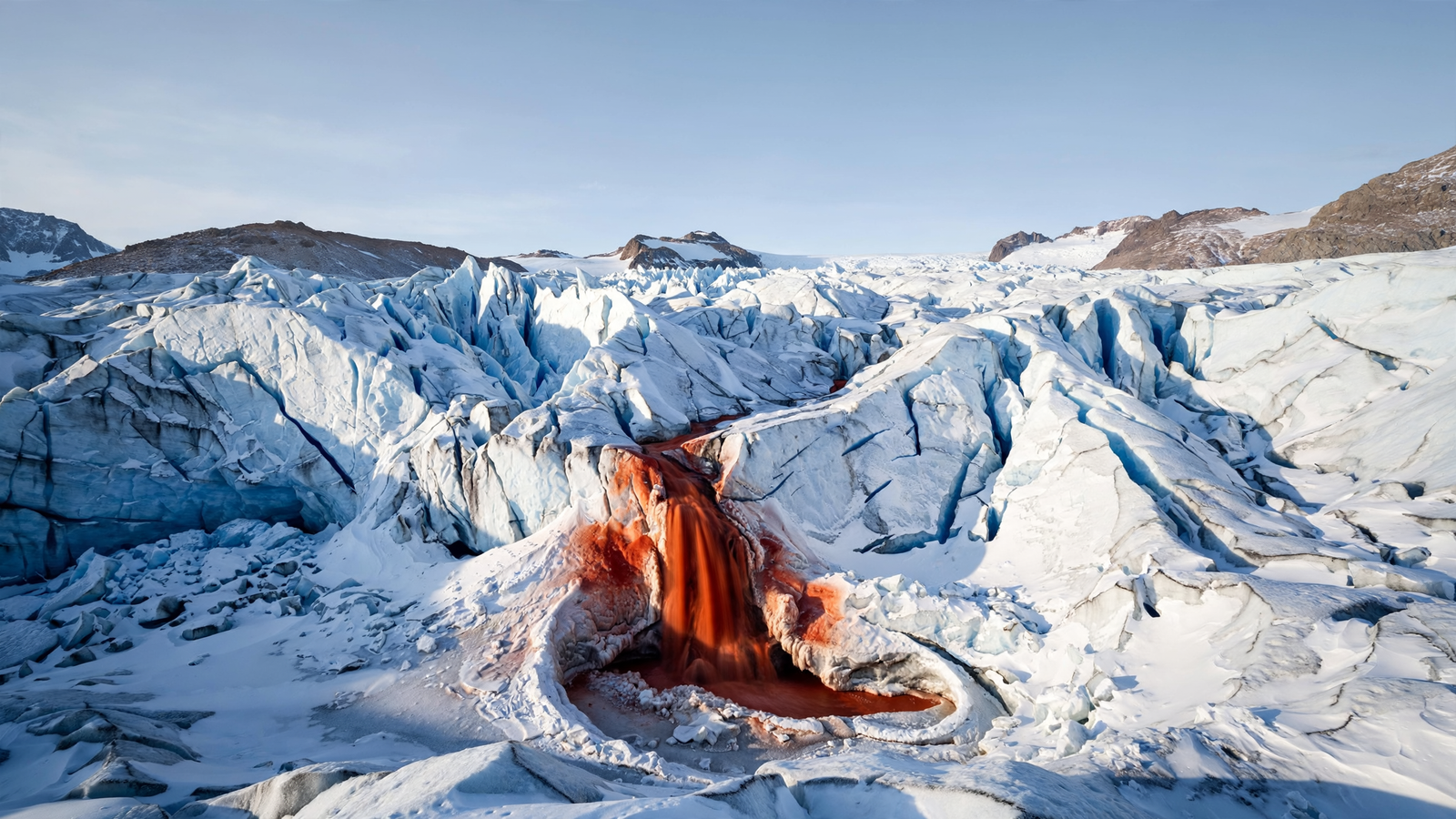
At the edge of Antarctica’s Taylor Glacier, a dark red stain spills across a wall of blue-white ice. It looks less like a waterfall than a wound in the landscape. The name—Blood Falls—only strengthens the impression.
But the water is not blood, and the red color is not a sign of anything supernatural. It is the visible result of a hidden system involving salty water, iron minerals, an ancient network beneath the glacier, and microorganisms living without sunlight.
Blood Falls is one of the strangest natural features in the McMurdo Dry Valleys, a polar desert where precipitation is scarce, temperatures are severe, and exposed rock and ice stretch across a landscape that can resemble the surface of another planet.
A waterfall in a frozen desert
Taylor Glacier descends toward Lake Bonney in Victoria Land, part of Antarctica’s McMurdo Dry Valleys. The region is among the driest places on Earth. Katabatic winds sweep down from the high interior, removing surface snow, while the surrounding mountains help keep much of the area isolated from the continent’s larger ice sheet.
Blood Falls appears where water from beneath or within the glacier reaches the surface and emerges onto the ice near the edge of Taylor Glacier. Instead of forming a clear stream, it spreads slowly through cracks and across the glacier face. The flow is relatively small, but its color makes it impossible to miss.
The waterfall was first documented during an Australian-led Antarctic expedition in 1911. Geologist Griffith Taylor, after whom the glacier is named, observed the unusual red feature. Early explanations suggested that red algae might be responsible. Later research showed that the color came from iron-rich water, not algae.
Why the water turns red
The water feeding Blood Falls is unusually salty and contains dissolved iron. When that water reaches the air, the iron reacts with oxygen. The chemical process is similar in broad terms to the rusting of metal: iron is oxidized, producing reddish and orange iron compounds.
That transformation happens at the boundary between the hidden water and the atmosphere. Below the glacier, the water can remain relatively clear because it is isolated from oxygen. Once it emerges, the chemistry changes. The result is a rusty-colored flow that stains the ice.
The color is not always exactly the same. Depending on lighting, the amount of water, and how the minerals are distributed, Blood Falls can appear deep red, orange, brown, or even nearly black. Photographs often intensify the contrast between the oxidized water and the surrounding snow and ice, but the underlying phenomenon is real.
Where did the salty water come from?
One of the most important discoveries about Blood Falls is that its water is not simply ordinary meltwater running off the glacier. Scientists have found evidence that the brine is connected to a larger, ancient reservoir beneath the ice.
Researchers believe seawater entered the Taylor Valley long ago, when the geography of the region was different and marine water reached farther inland. As the valley changed and ice advanced, some of that seawater became trapped beneath the glacier. Over time, evaporation and freezing concentrated its salts.
That history helps explain why the water remains liquid in such a cold environment. Salt lowers the freezing point of water, and the brine beneath Taylor Glacier is much saltier than seawater. Pressure from the overlying ice also affects the underground system.
The precise size and shape of the brine network are difficult to map. Scientists have used airborne radar, electrical measurements, chemical analysis, and direct sampling to investigate it. Their results indicate that liquid water extends farther beneath the glacier than the visible waterfall alone would suggest.
Life without sunlight
Blood Falls is remarkable not only because of its color, but also because of the life associated with its water. Microorganisms have been found in the brine beneath Taylor Glacier, where sunlight does not penetrate and oxygen is limited.
These microbes do not depend on the kind of photosynthesis that supports most familiar ecosystems. Instead, they obtain energy through chemical reactions involving compounds such as sulfur and iron. In simple terms, they draw energy from geology.
This kind of metabolism is called chemolithotrophy, a term describing organisms that use inorganic substances as part of their energy systems. Such organisms are especially important to scientists because they show how life can persist in environments that appear almost completely inhospitable.
The microbial community beneath Taylor Glacier is not a miniature forest or a thriving reef. It is sparse and adapted to extreme conditions. Yet its existence expands the range of places where scientists must consider the possibility of life—and it offers a natural laboratory for studying ecosystems cut off from sunlight for long periods.
An Antarctic window into other worlds
The McMurdo Dry Valleys are often used as an analogue for Mars. The comparison is not exact: Earth’s atmosphere, gravity, geology, and biological history are very different from those of Mars. Still, the valleys provide a useful setting for testing instruments and ideas about how life might survive in cold, dry environments.
Blood Falls is particularly valuable because it combines several conditions that interest planetary scientists: extreme cold, isolation, salty water, iron-rich minerals, and microbial activity. The system shows that a surface that looks frozen and empty can conceal chemically active water beneath it.
Scientists have also considered what similar environments might look like on icy worlds elsewhere in the solar system. Moons such as Europa and Enceladus are believed to contain subsurface oceans, although no life has been confirmed there. Blood Falls does not prove that extraterrestrial life exists. It does show how biology can exploit chemical energy in a dark, cold environment when liquid water is available.
The mystery was solved without making the place ordinary
Natural wonders often lose some of their appeal when their explanations are found. Blood Falls has done the opposite. Learning that its color comes from iron-rich brine makes the feature more extraordinary, not less.
The waterfall is the visible end of a story that begins beneath a glacier. Ancient seawater became trapped in the ground. Salts helped keep it liquid. Iron changed color when the brine met the air. Microbes survived in the darkness by using chemical energy. A landscape that appears frozen solid turned out to contain a hidden, living system.
That is the central surprise of Blood Falls: the red water is not evidence of something dramatic happening at the surface. It is a small opening into a much larger world below it.
In Antarctica, where ice dominates the view, the most important activity may be taking place out of sight. Blood Falls reminds us that even the coldest landscapes can hold movement, chemistry, history, and life.