Long before a phone could capture a photograph in an instant, taking a picture required equipment, preparation, and a certain amount of confidence. Cameras were expensive, film was specialized, and developing a picture was often the work of someone else.
Then advertising began to tell a different story. A camera could be light enough to carry, simple enough for a beginner, and welcome at the beach, on a walk, or during a family outing. In the public imagination, that promise came to life through one of advertising’s most recognizable figures: the Kodak Girl.
She was not a single fictional character with a fixed biography. Across decades of posters, magazine pages, postcards, and advertisements, she appeared as a succession of young women holding Kodak cameras, enjoying travel, recording friends, or preserving an ordinary day. Her appearance changed with fashion and social expectations, but her basic message remained remarkably consistent: photography was no longer reserved for professionals.
A camera company discovers a new audience
George Eastman’s Eastman Kodak Company helped change photography by concentrating on convenience. In 1888, Kodak introduced a camera loaded with film and promoted it with the famous line, “You press the button, we do the rest.” The customer took the pictures, then sent the camera back to Kodak, where the company developed the film, printed the photographs, and returned the camera ready for another roll.
The system was not entirely effortless, but it moved the difficult chemical work away from the consumer. That mattered. Photography could begin to function less like a technical craft and more like a service available to a broad public.
Kodak’s early advertising presented the camera as a tool for recording experience rather than merely producing a technically perfect image. Children, holidays, pets, landscapes, and family gatherings all became legitimate subjects. The company was selling a new habit: look around, press the button, and keep a piece of the moment.
That approach also required a new kind of customer. Kodak needed people who did not think of themselves as photographers. The company’s advertising had to reassure them that they could participate without mastering lenses, exposure calculations, or darkroom chemistry.
The Kodak Girl steps into the picture
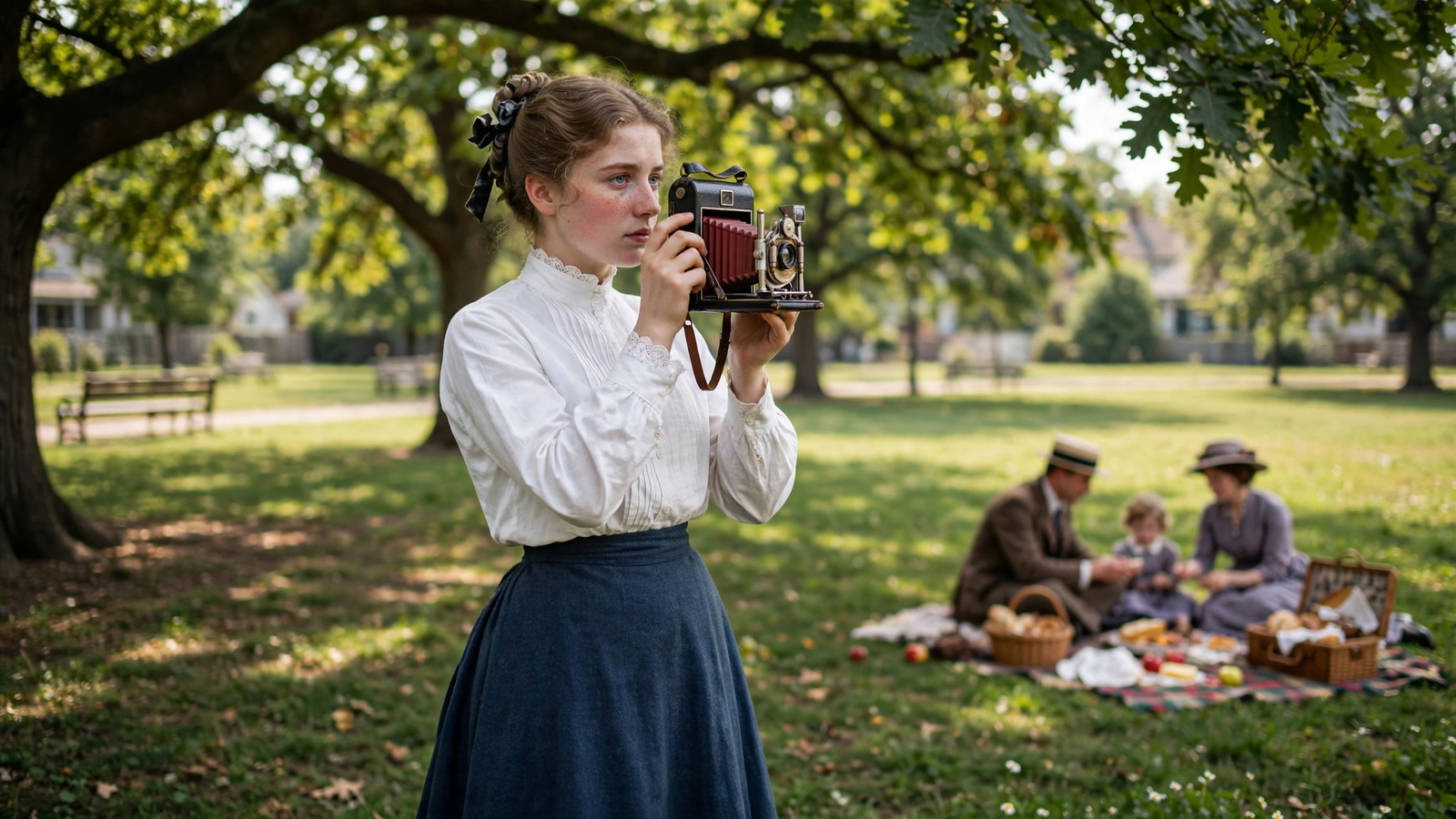
The Kodak Girl emerged in the 1890s, when illustrated advertising was becoming a powerful part of consumer culture. She appeared in images that connected photography with movement and leisure. Often dressed in fashionable clothing and shown outdoors, she carried a Kodak camera as naturally as she might carry a handbag or parasol.
Her importance came from the combination of product demonstration and aspiration. The camera was visible, but it did not dominate the scene. The Kodak Girl was usually presented as someone already enjoying the world: walking, traveling, spending time near water, or sharing an experience with companions. The camera made those activities more memorable without making them seem technical.
This was a subtle but influential shift in advertising. Rather than focusing only on the machine, Kodak showed what life with the machine might feel like. The product became associated with confidence, curiosity, sociability, and independence.
The image also helped establish photography as part of women’s everyday culture. At a time when many advertisements still confined women to domestic roles, the Kodak Girl was frequently placed outside the home. She traveled, explored, observed, and made records of her own experience. The image was idealized, and its subjects were usually presented within the era’s narrow standards of beauty and respectability, but it nevertheless suggested that women could be active users of technology.
From technical invention to social ritual
Kodak’s advertising did more than make cameras appear easy to use. It helped define when and why people should take pictures.
A photograph could mark a holiday, a picnic, a birthday, a new outfit, a day at the shore, or a visit to a new city. The act of taking the picture became part of the event itself. People did not only want a record afterward; they increasingly expected certain moments to be photographed as they happened.
The Kodak Girl was useful because she modeled this behavior. She showed that a camera belonged in the middle of life, not in a specialist’s studio. She also suggested that the photographer could be part of the social scene rather than standing apart from it.
That idea remains familiar today. A person taking photographs at a family gathering is rarely viewed as an outsider or a professional observer. The camera has become part of the way people participate in occasions. Kodak did not create every aspect of that behavior by itself, but its advertising helped normalize it for a mass audience.
The Brownie makes the promise broader
In 1900, Kodak introduced the Brownie camera, a small box camera sold for one dollar. Its low price and straightforward design expanded the company’s reach, especially among children and families. Kodak’s film-processing system made ownership more accessible, while the Brownie’s advertising presented photography as a pastime ordinary people could learn.
The Brownie did not replace the Kodak Girl, but it reinforced the world she represented. Photography belonged on the road, at the park, and in the hands of people who had never considered themselves artists or technicians.
There was an important business strategy underneath the friendliness. A camera sale could lead to years of film purchases and processing fees. Every newly photographed birthday or vacation created demand for another roll. Kodak was building an ecosystem around repeated use, not simply selling a single piece of equipment.
That model anticipated a familiar principle of modern consumer technology: the most successful product is often the one that becomes part of a routine. Kodak encouraged people to see photography as an ongoing practice, one sustained by future occasions still waiting to be recorded.
A changing woman in a changing century
The Kodak Girl evolved as the twentieth century progressed. Her clothes, hairstyles, surroundings, and camera models changed. In some advertisements she appeared elegant and composed; in others she looked more casual, athletic, or adventurous. The figure could be adapted to different generations without losing her essential role.
That flexibility made her unusually durable. She was less a character than a visual language. When Kodak wanted to associate photography with travel, she traveled. When it wanted to emphasize family life, she appeared with children or relatives. When photography became more compact and immediate, her pose became more spontaneous.
Her image also reflected the limits of the advertising world that created her. Most versions presented a polished, predominantly white, middle-class ideal. The advertisements often treated leisure as broadly available even though travel, consumer goods, and free time were distributed unequally. Like many commercial icons, she represented an aspiration more than a complete picture of society.
Still, the camera she held carried a meaning that extended beyond the advertisement’s idealized surface. It suggested that ordinary people could document their own lives. Photography was not only something done by studios, newspapers, or wealthy travelers. It could belong to families, schoolchildren, tourists, and friends.
Why the image lasted
The Kodak Girl endured because she connected a complicated technology with an uncomplicated human desire: to remember.
A camera can be described through shutter speeds, film sizes, lenses, and chemical processes. None of those details, however, explains why people want photographs. Kodak’s advertising placed the emotional reason before the technical one. A camera mattered because it could hold on to a day that would otherwise pass.
That message was particularly powerful in an era when photographs were physical objects. A picture could be placed in an album, mailed to a relative, framed on a wall, or tucked into a drawer. It could be revisited years later by people who were not present when it was taken. The photograph was not just evidence that an event happened; it became part of a family’s material memory.
Today, photography is nearly frictionless. Images can be captured, edited, shared, and stored without film or a trip to a processing counter. Yet the underlying impulse has changed very little. People still photograph meals, journeys, celebrations, pets, landscapes, and one another because they want the present to remain available to the future.
The Kodak Girl helped make that impulse commercially legible. She turned the camera from an intimidating object into a companion. Her world was carefully staged, but the habit she promoted became real on an enormous scale.
Advertising’s lasting snapshot
The Kodak Girl is remembered not because she had a complicated story, but because she helped give millions of people a new story about themselves. They could be observers. They could be travelers. They could preserve family history. They could make pictures without waiting for permission from a professional.
Her legacy is therefore larger than a single advertising campaign. She belongs to the history of how technology enters daily life: first as an invention, then as a service, and finally as a habit that feels almost natural.
Every time someone raises a camera to save an ordinary moment, the old Kodak promise is still present in a modern form. The world is there. The button is ready. And the memory, once made, may outlast the day that produced it.