In many kitchens, Pyrex is not treated like an invention. It is simply there: a measuring cup with red markings, a casserole dish passed between generations, or a clear bowl that makes leftovers easy to identify. Its ordinary appearance is part of the story. Pyrex became successful by making a piece of scientific glass feel like a natural part of home life.
That transformation began with a practical problem. Glass was useful in the kitchen because it was clean, transparent, and easy to wash. But ordinary glass could crack or shatter when exposed to sudden changes in temperature. A dish taken from a hot oven and set on a cold surface was not merely at risk of breaking; it could become a dangerous scatter of fragments.
Pyrex offered a different possibility: glass designed to tolerate heat. Its rise reflected more than a new material. It showed how American manufacturers, advertisers, and homemakers were beginning to imagine the kitchen as a place where convenience, precision, and science could work together.
From railroad lanterns to the oven
The story began at Corning Glass Works in New York, a company better known for industrial glass than for baking dishes. In the early twentieth century, Corning researchers developed heat-resistant glass for demanding uses, including railroad lantern globes. The material was designed to withstand the rapid temperature changes that could cause conventional glass to fail.
One version of this glass was called Nonex. It belonged to a family of borosilicate glasses, whose chemical composition gave them a lower tendency to expand and contract dramatically when heated or cooled. That property made them useful wherever glass had to endure thermal stress.
The route from industrial equipment to domestic cookware was not automatic. It depended on someone recognizing that the same quality that protected a lantern might also help a household prepare dinner.
Corning’s Jesse Littleton is widely credited with testing the idea at home. According to accounts preserved by the Corning Museum of Glass, Littleton brought a cut-down glass battery jar home and used it for baking. His wife, Bessie, helped demonstrate the domestic usefulness of the material by preparing food in it.
The experiment mattered because it changed the question. Instead of asking whether glass belonged in the oven, the company could ask what kind of glassware a household would want if oven use were safe and dependable.
A new kind of kitchen tool
Corning introduced Pyrex ovenware in 1915. The name connected the product to the company’s earlier heat-resistant glass while also sounding approachable and memorable. The first products were not merely laboratory containers with a new label. They were shaped and presented as cookware: pie plates, baking dishes, and other forms suited to familiar household recipes.
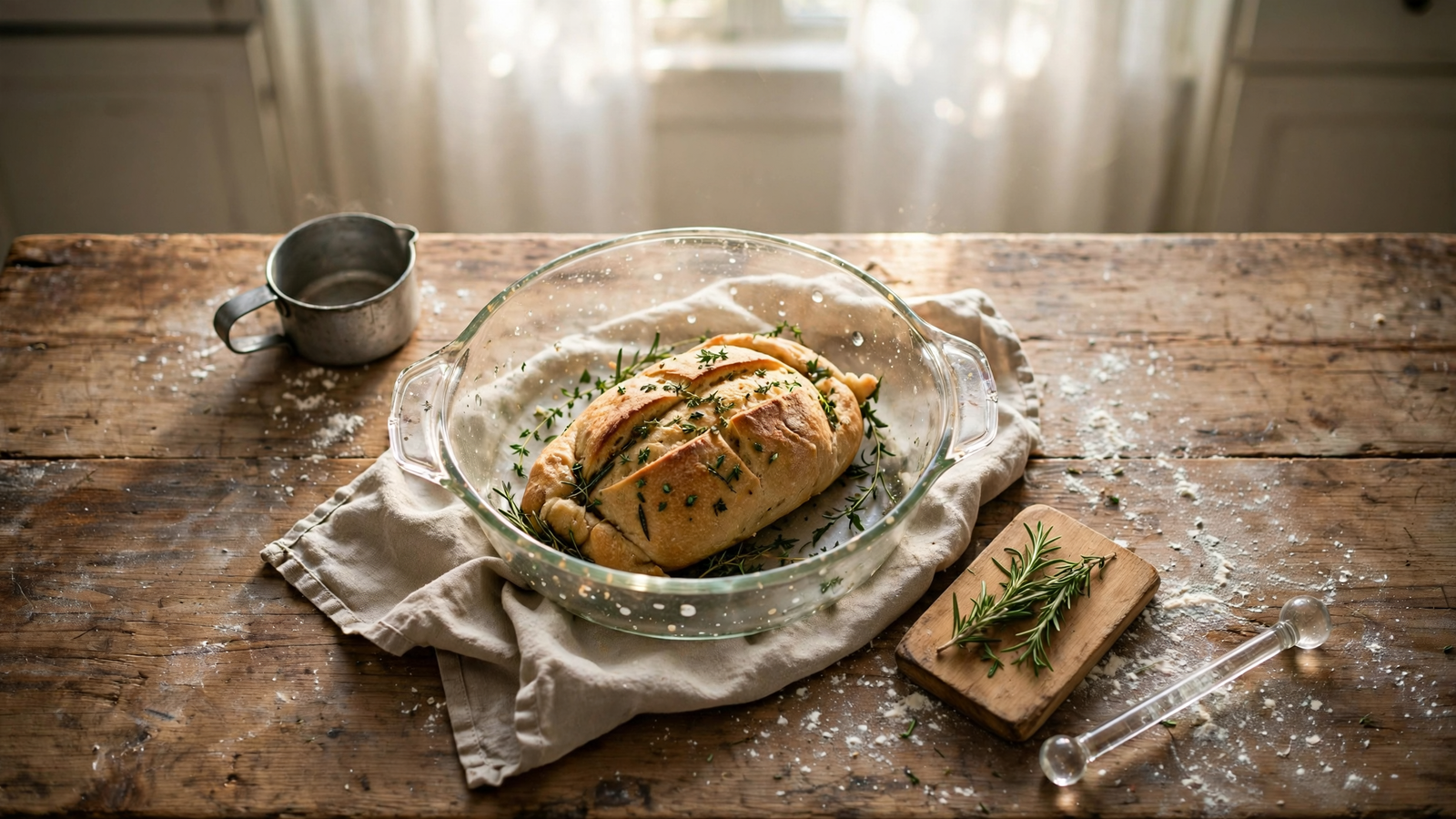
Transparency gave the new dishes an immediate advantage. A cook could see the browning crust, the rising cake, or the bubbling sauce without opening the oven. The same dish could move from oven to table, reducing the need to transfer food into a serving bowl. It could then be washed and used again.
Those details sound modest today, but they addressed several everyday frustrations at once. A transparent dish made cooking easier to monitor. A durable material reduced the worry associated with heating glass. A serving dish that could also be a baking dish saved time, space, and cleanup.
Pyrex also fit the changing language of domestic instruction. Early twentieth-century American kitchens were increasingly influenced by standard measurements, tested recipes, home economics education, and the belief that household work could be made more efficient through careful design. A measuring cup marked with clear graduations turned an ingredient into a quantity that could be checked. A baking dish that tolerated heat made the oven feel more predictable.
The kitchen becomes a place for applied science
Pyrex did not invent modern cooking, and it did not make kitchen work effortless. But it helped popularize the idea that scientific materials belonged in ordinary homes.
That idea was especially important in an era when manufacturers were trying to persuade consumers that household products could improve daily life. Advertising often presented the modern kitchen as a clean, rational, well-organized environment. New appliances promised to save labor; standardized cookware promised repeatable results; measuring tools promised control.
Pyrex occupied a useful middle ground. It was advanced enough to be described in terms of chemistry and heat resistance, yet familiar enough to be handled without specialized training. It did not ask the cook to understand borosilicate glass. It only had to perform when placed in the oven.
The material’s transparency also carried a cultural message. Unlike opaque metal pans, glass allowed the cook to observe the food itself. The dish became a window into the process. In a period when domestic science encouraged observation and measurement, that visibility made the cookware feel modern.
More than one famous dish
Over time, Pyrex became associated with a wide range of kitchen tasks. Oven dishes were joined by measuring cups, mixing bowls, storage containers, and serving pieces. The brand’s familiar forms helped create a practical system: measure ingredients, mix them, bake them, store the leftovers, and reheat them in vessels that belonged to the same visual world.
That system mattered in homes where kitchen space was limited and household budgets required products to serve several purposes. A bowl that could withstand heat and repeated washing was more useful than a fragile serving piece reserved for special occasions. A measuring cup that could be read from the side was both a cooking tool and a small lesson in standardization.
Pyrex also became part of the material culture of family memory. Its objects were durable enough to remain in use for decades, and their plainness made them easy to overlook. A particular bowl might be associated with holiday baking, a parent’s kitchen, or the first meals prepared in a new apartment. The brand entered domestic history not through grand design, but through repetition.
The important distinction between old and new glass
One reason Pyrex continues to attract attention is that the name has been used for different kinds of glass in different markets and periods. Early Pyrex products in the United States were associated with borosilicate glass. Later American production moved toward tempered soda-lime glass, a different formulation strengthened through heat treatment.
Both types can be useful and durable, but they do not respond to thermal change in exactly the same way. The long-standing advice for any glass bakeware remains sensible: avoid sudden temperature changes, inspect pieces for chips or cracks, and follow the manufacturer’s instructions.
This distinction does not erase Pyrex’s achievement. It makes the history more interesting. The brand was never only one unchanging material. It was a continuing attempt to balance performance, cost, manufacturing, and the expectations of home cooks.
Why Pyrex endured
Many household inventions promise convenience. Far fewer become part of the background of everyday life. Pyrex endured because its advantages were visible without being showy.
It saved a step. It let cooks see what was happening. It offered a reusable alternative to disposable or single-purpose containers. It made a technical property—resistance to thermal shock—useful at the scale of a family meal.
Its success also depended on trust. Every time a dish went into a hot oven and came out intact, the material proved itself. Every time a measuring cup helped a recipe work, the brand became a little more familiar. Reliability turned a specialized glass into a household habit.
That may be the most American part of the Pyrex story: the movement of an industrial innovation into the center of ordinary life. The material was developed for demanding technical conditions, but its lasting reputation was built around casseroles, cakes, leftovers, and Sunday dinners.
Pyrex changed the kitchen not by making cooking disappear, but by making certain parts of it more observable, repeatable, and manageable. In the process, it gave a scientific invention the most intimate destination imaginable: the family table.