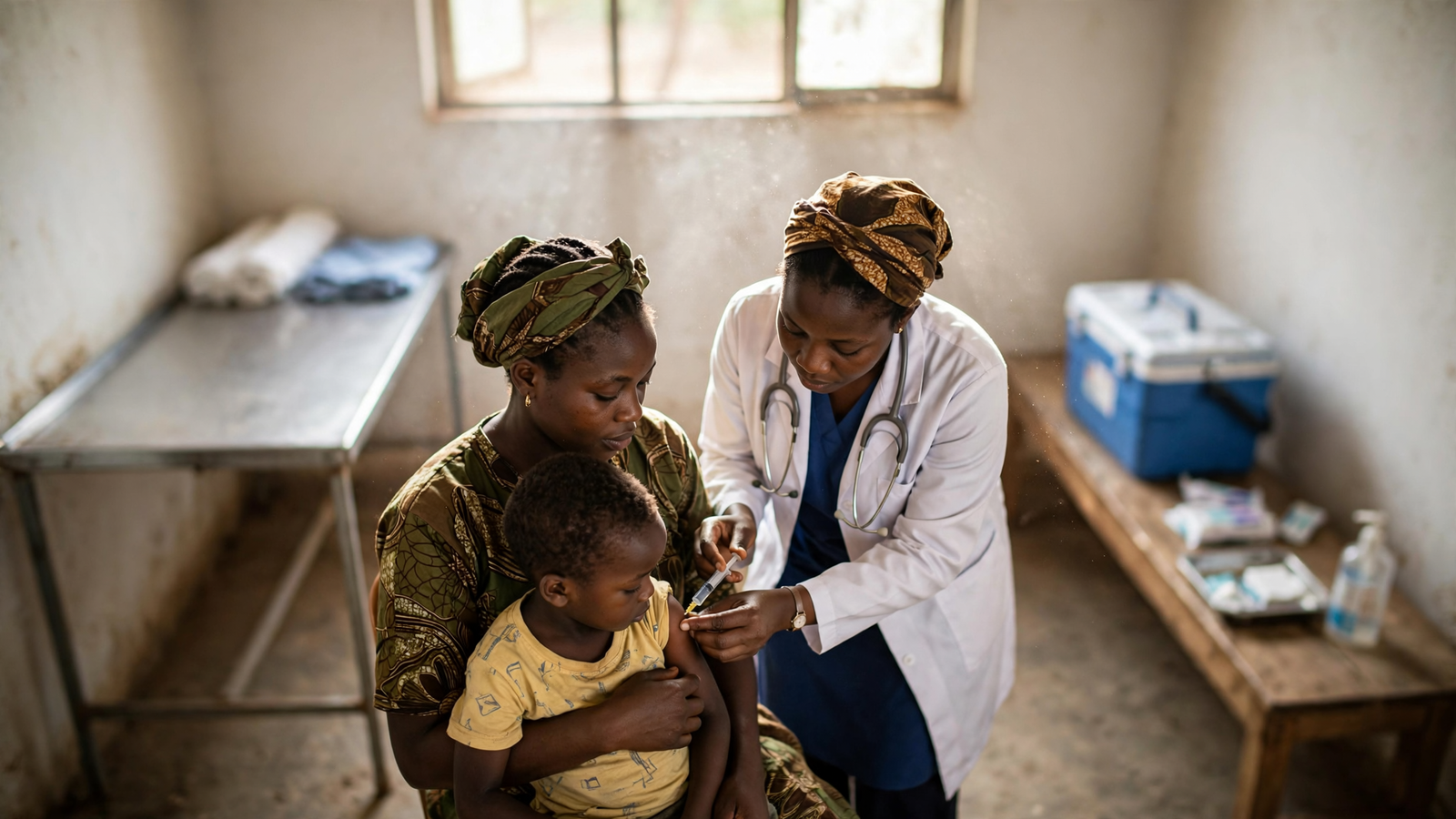
For much of the world, malaria is a disease people know mainly from maps, history books, or travel advisories. Across large parts of Africa, however, it remains a routine danger of childhood: a fever that can become a medical emergency, a mosquito bite that can carry consequences for an entire family.
That reality is beginning to change. After more than a century of failed attempts and scientific dead ends, the world now has two malaria vaccines recommended by the World Health Organization. They are not perfect vaccines, and they do not make bed nets, rapid diagnosis, medicines, or mosquito-control programs unnecessary. But they represent something malaria researchers had never been able to offer before: a practical additional layer of protection that can be delivered through childhood immunization systems.
The development is important not because one injection has defeated malaria. It has not. It matters because prevention is moving from the laboratory into ordinary health services—and because the first countries using these vaccines are helping answer the difficult questions of scale, supply, timing, and access.
A disease that still shapes childhood
Malaria is caused by parasites transmitted mainly through the bites of infected Anopheles mosquitoes. Several malaria parasites infect humans, but Plasmodium falciparum is the most dangerous and is widespread in sub-Saharan Africa.
Young children are especially vulnerable because they have not yet developed substantial immunity. The illness may begin with fever, chills, headache, or weakness, then progress to severe anemia, breathing problems, seizures, impaired consciousness, or death. Pregnant people are also at elevated risk.
The disease burden is concentrated in Africa. According to the WHO World Malaria Report, the region accounted for the overwhelming majority of malaria cases and deaths worldwide in recent years. Progress has been uneven: insecticide-treated nets, indoor spraying, improved testing, and effective medicines have saved millions of lives, but resistance to insecticides and drugs, climate patterns, fragile health systems, and limited funding continue to complicate control efforts.
A vaccine therefore has to do more than work in a controlled trial. It has to fit into the real lives of families and the real capacity of clinics—often in places where health workers already manage multiple childhood diseases with limited staff and supplies.
The first vaccine crossed a historic line
In October 2021, WHO recommended the widespread use of RTS,S/AS01, the first malaria vaccine to complete the organization’s review process and receive a recommendation for use in children. The recommendation followed results from a large pilot program in Ghana, Kenya, and Malawi involving hundreds of thousands of children.
RTS,S targets a protein found on the surface of the P. falciparum parasite during the stage when it first enters the human body. The vaccine trains the immune system to recognize that parasite before it can establish a serious infection in the liver and bloodstream.
Its protection is partial, not absolute. In the phase 3 trial, the vaccine reduced clinical malaria by roughly four in ten cases over a four-year follow-up period and reduced severe malaria by about three in ten. Those figures may sound modest compared with the protection expected from some familiar vaccines, but malaria is transmitted repeatedly, and even a partly effective vaccine can prevent a large number of dangerous infections when given to children in high-risk areas.
The pilot program also produced an important practical finding: the vaccine could be delivered through existing childhood vaccination services. WHO reported that the program reached more than two-thirds of eligible children in the participating areas, while the introduction was associated with a substantial reduction in severe malaria among vaccinated children. The pilot did not show the safety concerns that had initially required especially careful monitoring, including fears that vaccination might increase mortality among girls or cause a dangerous imbalance in protection.
That evidence helped turn a scientific achievement into a public-health recommendation.
A second vaccine expands the possibilities
Two years later, in October 2023, WHO recommended a second malaria vaccine: R21/Matrix-M. Developed through research involving the University of Oxford and manufactured by the Serum Institute of India, R21 uses a malaria protein target related to the one used by RTS,S, paired with Novavax’s Matrix-M adjuvant.
The second vaccine matters for more than scientific variety. Having two products can increase supply and make large-scale immunization more feasible. A single manufacturer or product would leave national programs more exposed to production limits, delivery delays, or price pressures.
Clinical trial results for R21 have varied by setting and follow-up period, but studies have shown meaningful protection against clinical malaria in young children. In areas with strongly seasonal transmission, efficacy was about 75 percent during the first year after vaccination in one trial; in areas with transmission throughout the year, the result was lower. Researchers continue to follow children to understand how protection changes over time and how booster doses affect it.
WHO’s recommendation does not mean every country must use the same vaccine or schedule. National programs have to consider transmission patterns, the age at which children face the greatest risk, existing immunization visits, seasonal malaria campaigns, supply, and cost.
From recommendation to routine care
The most visible shift came in January 2024, when Cameroon became the first country to introduce malaria vaccination into its routine childhood immunization program. The country began offering RTS,S to children in selected areas, with the aim of expanding protection through the ordinary public-health system rather than relying only on a short-term research campaign.
That distinction is crucial. A pilot can bring additional staff, special monitoring, and concentrated attention to a limited number of sites. Routine immunization asks a harder question: can the vaccine become part of the dependable sequence of care that families already use for measles, polio, tuberculosis, and other childhood diseases?
Other African countries have since begun or planned malaria vaccine introductions, with support from organizations including Gavi, the Vaccine Alliance, UNICEF, WHO, and national health ministries. The first phase is being shaped by supply. Demand is much larger than the initial number of available doses, so countries have had to prioritize areas with the highest malaria burden and determine how to use the vaccines while supplies grow.
Manufacturing capacity is improving. The arrival of R21 gives purchasing programs another source of doses, while global financing mechanisms help lower the barrier for countries that could not otherwise afford a new vaccine. The practical work is just as important as the laboratory work: cold-chain planning, health-worker training, community information, record keeping, adverse-event monitoring, and systems for reaching children who miss routine appointments.
Why the vaccine is not a stand-alone solution
Malaria prevention works best as a combination. Insecticide-treated bed nets reduce nighttime exposure to mosquitoes. Indoor residual spraying can kill mosquitoes resting on walls. Rapid tests and effective antimalarial drugs help prevent uncomplicated infections from becoming severe. In some locations, seasonal malaria chemoprevention gives children medicines during the months when transmission is highest.
The vaccines add to that toolkit. They do not replace it.
This is partly because vaccine protection is incomplete and may decline over time. It is also because malaria transmission differs dramatically from one place to another. A child in a region with intense seasonal transmission may need a different schedule from a child in an area where mosquitoes transmit malaria throughout the year. Health authorities must also watch for changes in parasite populations, mosquito behavior, insecticide resistance, and the possibility that protection could be less effective in groups underrepresented in trials.
These limitations are not evidence of failure. They are the reason public-health scientists describe the vaccines as an additional tool rather than a single technological answer.
A milestone measured in lives, not headlines
The malaria vaccine story has taken so long because the parasite is an unusually complicated target. Unlike a virus with a relatively consistent structure, the malaria parasite changes form during its life cycle and has evolved ways to evade the human immune system. Researchers have had to identify a vulnerable stage, create a vaccine that produces a useful immune response, and then show that response can protect children in places where exposure is constant.
The result is a rare kind of medical progress: incremental, imperfect, and potentially transformative when delivered at population scale.
Success will not be measured only by vaccine efficacy in a trial. It will be measured by whether children receive all recommended doses, whether families can reach clinics, whether health workers can identify and respond to rare adverse events, whether vaccine programs maintain public trust, and whether malaria deaths fall when vaccination is combined with existing measures.
Those questions remain open. So does the long-term future of malaria control. But the world has crossed a meaningful threshold. For the first time, health ministries in malaria-endemic countries can place a vaccine in the same prevention conversation as bed nets and mosquito control.
That is not the end of malaria. It is something more useful: a new opportunity to make childhood safer in the places where a mosquito-borne infection has shaped daily life for generations.