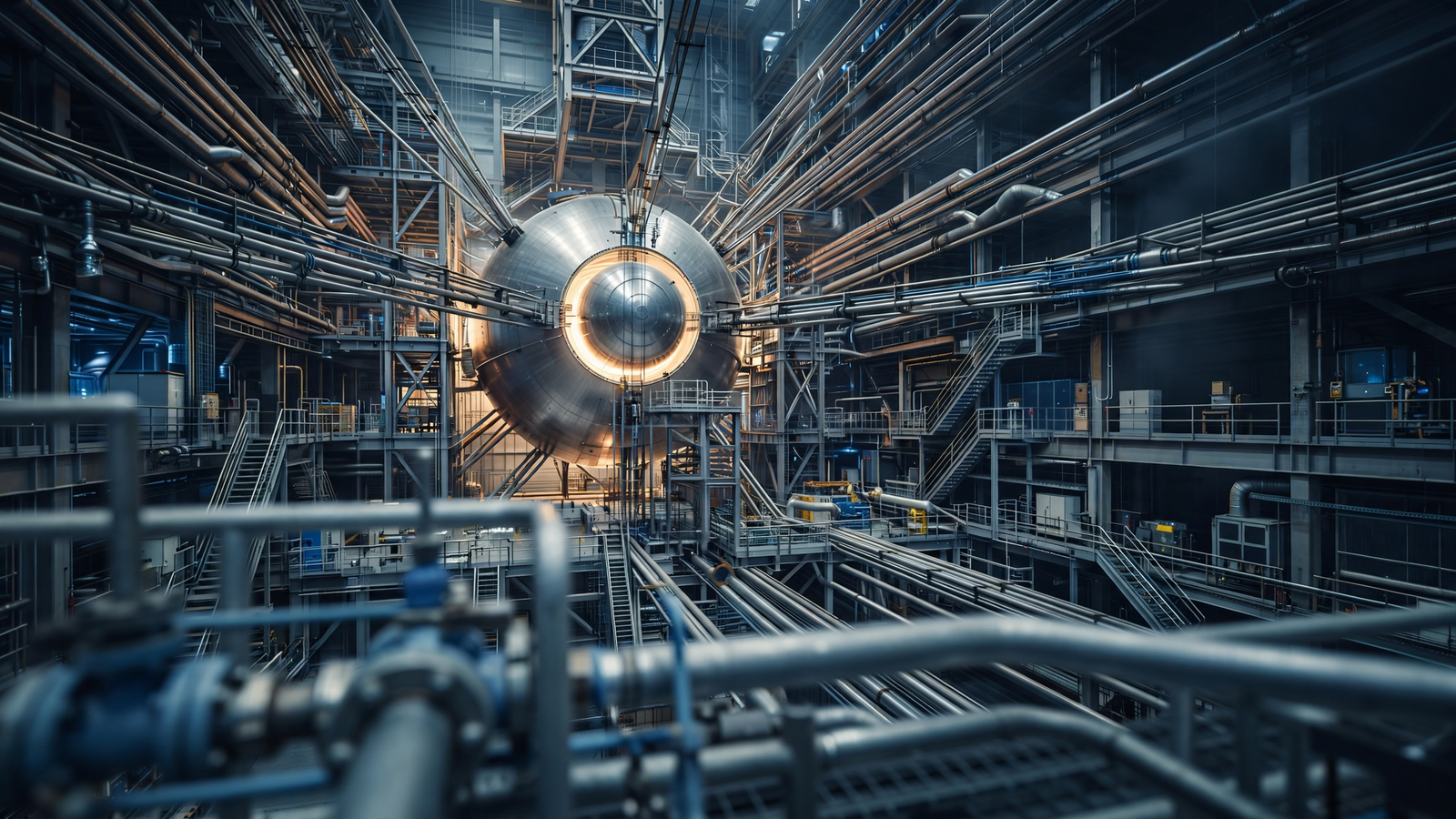
For decades, fusion energy lived in the space between promise and proof. The physics was understood. The potential was enormous. If scientists could persuade light atomic nuclei to join under extreme heat and pressure, the reaction could release energy without the long-lived carbon emissions associated with fossil fuels. For related reading, see Jacob Lawrence’s Migration Series: How 60 Paintings Made a National Journey Visible.
The difficulty was making the reaction produce more energy than the experiment consumed.
That changed at the National Ignition Facility, or NIF, at Lawrence Livermore National Laboratory in California. On December 5, 2022, researchers directed nearly 200 giant laser beams at a tiny fuel capsule and produced a fusion reaction that released more energy than the laser energy delivered to the capsule. The result, announced by the U.S. Department of Energy days later, was the first laboratory demonstration of fusion ignition.
It was not yet a power plant. It did not send electricity to the grid. But it was a genuine scientific milestone: a controlled fusion experiment had crossed a threshold that researchers had pursued for generations.
A star-making process in a laboratory
Fusion is the process that powers the Sun and other stars. In a star’s core, enormous gravity compresses hydrogen nuclei until they collide and merge. A small amount of mass becomes energy in the process.
On Earth, scientists cannot reproduce the Sun’s gravitational pressure. Instead, they use different techniques to create the conditions needed for fusion. NIF uses a method called inertial confinement fusion. Its lasers do not heat the fuel directly in the way a conventional heater would. They strike the inside of a small cylindrical chamber, generating X-rays that compress a peppercorn-sized capsule containing hydrogen isotopes.
The capsule’s fuel is made primarily of deuterium and tritium, two forms of hydrogen. Under the intense pressure created by the implosion, the fuel becomes hot and dense enough for some of its nuclei to fuse. The resulting helium nuclei and fast-moving neutrons carry energy into the surrounding fuel, helping sustain the reaction for a brief moment.
That self-heating effect is central to ignition. A fusion experiment can produce reactions without reaching ignition, but an ignited target receives enough energy from the fusion products to continue burning through much of its fuel. The distinction is important: the goal is not merely to make fusion happen, but to make the reaction amplify itself inside the target.
The experiment that crossed the line
During the December 2022 shot, NIF’s laser system delivered 2.05 megajoules of energy to the target. The fusion reaction produced approximately 3.15 megajoules, according to the Department of Energy and Lawrence Livermore National Laboratory.
That comparison refers to the energy reaching the target, not the total electricity used by the facility to operate the lasers. The full system consumes substantially more energy than the laser pulse delivers. This is why the experiment should be understood as a demonstration of target-level ignition rather than proof that a commercially practical fusion generator already exists.
Even with that qualification, the result was significant. The experiment showed that the fuel capsule could become hot enough and compressed enough for fusion-generated particles to heat the fuel more strongly than the incoming laser energy did.
Researchers repeated the achievement. In July 2023, the laboratory reported a second experiment that produced 3.15 megajoules from 2.05 megajoules delivered to the target. Additional experiments later produced still higher fusion yields. In February 2024, Lawrence Livermore reported a record shot that generated 5.2 megajoules of fusion energy from a target struck by 2.05 megajoules of laser energy.
Those results matter because ignition is not useful if it occurs only once by accident. Repetition gives scientists a way to study which conditions made the successful shots possible and how to improve the consistency of the process.
Why the target is so difficult
NIF’s target chamber is enormous compared with the fuel capsule at its center. The facility’s 192 laser beams must arrive with extraordinary precision, delivering energy in a carefully shaped pulse. The capsule must be nearly spherical, with a surface smooth enough that tiny imperfections do not disrupt the implosion.
When the capsule collapses, the fuel must remain compressed long enough for fusion reactions to spread. Any asymmetry can allow the hot material to escape before the reaction produces its maximum yield. Scientists therefore work on many problems at once: laser timing, energy distribution, capsule manufacturing, target geometry, plasma behavior and the physics of instabilities that can interfere with compression.
The successful NIF shots were the product of years of incremental improvements rather than a single sudden invention. Researchers refined the laser pulse, improved target fabrication and learned how to make the implosion more symmetrical. The facility was originally built for the National Nuclear Security Administration’s stockpile stewardship mission, which uses advanced experiments and simulations to study the condition of nuclear weapons without underground testing. Fusion research became an important scientific use of the same extraordinary capabilities.
A breakthrough with a carefully defined meaning
“Fusion ignition” can sound like the same thing as practical fusion power, but the two are separated by major engineering challenges.
NIF fires a single experimental shot at a time. A future power plant would need to produce repeated fusion pulses, likely many times per second, while manufacturing and positioning targets at high speed. It would need to capture the energy carried by fusion neutrons, convert that heat into electricity and protect its components from intense radiation. The lasers would also need to become far more efficient.
At NIF, the energy gain is measured at the target. A power plant would have to achieve a much larger gain across the entire facility, including the electricity required to operate the lasers, cooling systems, target factory and other equipment.
Those obstacles do not erase the achievement. They clarify it. The NIF result answered one of fusion science’s most important questions: can a laboratory target be compressed into a regime where the fusion reaction begins to heat itself more strongly than the original laser input? The answer is yes.
What the result opens up
The immediate value of ignition is scientific. Researchers now have a new experimental regime in which the fusion fuel’s own energy plays a dominant role. That allows them to test models of burning plasmas under conditions that had previously been difficult or impossible to reach on Earth.
The findings may also help scientists improve inertial fusion designs. A future system might use more efficient drivers, different target shapes or new methods for delivering fuel. NIF is not designed as a commercial reactor, but its experiments can reveal which physical problems must be solved by any future inertial-fusion approach.
Fusion research also continues along other paths. Facilities such as tokamaks and stellarators use magnetic fields to hold extremely hot plasma for longer periods. These approaches face their own engineering challenges, but they share a broad goal with NIF: creating a controlled process that can release fusion energy repeatedly and economically.
The energy transition will not be solved by one laboratory result. Renewable power, energy storage, efficiency, transmission and existing low-carbon technologies all remain important. Fusion, if it becomes practical, would be another tool rather than a replacement for every other solution.
The value of crossing a threshold
Scientific progress often arrives before the technology built from it. The first successful flight was not a modern airline. The first computer network was not the internet as people use it today. In the same way, NIF’s ignition experiment is not a fusion power station.
Its importance lies in making a once-theoretical condition observable and repeatable in a laboratory. The experiment gave researchers a new place to work from: not an imagined future of fusion, but a demonstrated physical result with measurements, imperfections and engineering questions attached to it.
That is what makes the National Ignition Facility’s achievement worth remembering. It did not finish the journey to fusion energy. It proved that one of the journey’s most difficult milestones can be reached—and then reached again.
Use: Primary government announcement of the December 5, 2022 ignition experiment and its measured energy output.
Use: Technical background on NIF, inertial confinement fusion, the laser system, and subsequent experimental work.
Use: Reporting on the February 2024 repeat experiment and its higher fusion yield.
Use: Peer-reviewed account of the physical achievement of fusion ignition and the conditions of the experiment.
U.S. Department of Energy — DOE National Laboratory Makes History by Achieving Fusion Ignition — https://www.energy.gov/articles/doe-national-laboratory-makes-history-achieving-fusion-ignition — Primary government announcement of the December 5, 2022 ignition experiment and its measured energy output.
Lawrence Livermore National Laboratory — National Ignition Facility & Photon Science — https://lasers.llnl.gov/ — Technical background on NIF, inertial confinement fusion, the laser system, and subsequent experimental work.
Lawrence Livermore National Laboratory — NIF Experiment Puts 5.2 MJ of Fusion Energy in the Target Chamber — https://www.llnl.gov/article/50161/nif-experiment-puts-52-mj-fusion-energy-target-chamber — Reporting on the February 2024 repeat experiment and its higher fusion yield.
Nature — Experimental achievement of ignition — https://www.nature.com/articles/s41586-023-06746-8 — Peer-reviewed account of the physical achievement of fusion ignition and the conditions of the experiment.