In the forests of eastern Europe, a large animal is once again moving through the trees with the slow confidence of something that belongs there.
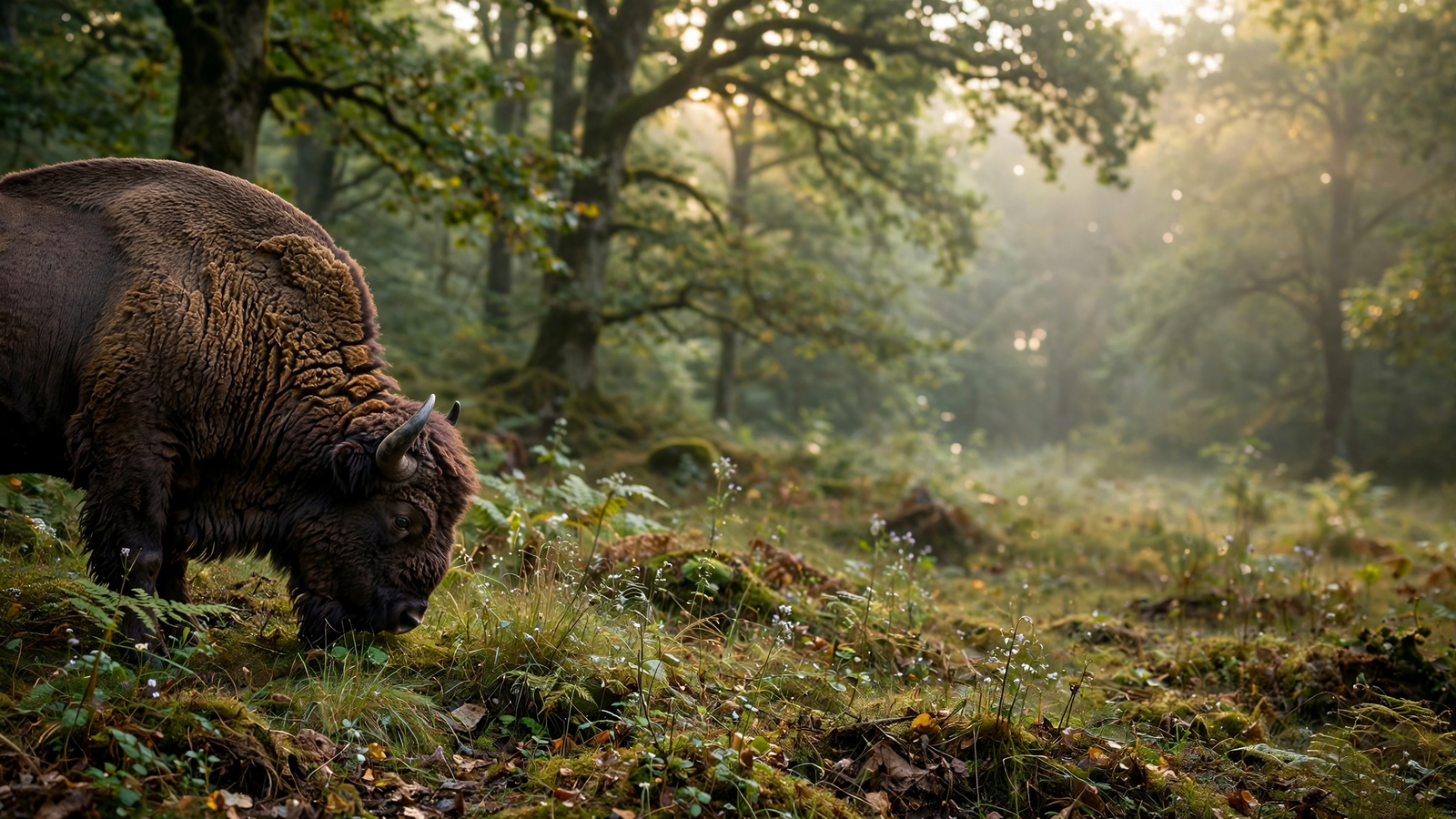
The European bison, or wisent, is Europe’s heaviest land mammal. Its broad shoulders, dark coat, and small curved horns give it an imposing presence, but its return is one of conservation’s more hopeful stories. The species was once eliminated from the wild. Today, herds roam in protected landscapes and newly established habitats across several countries.
This recovery did not happen quickly. It depended on zoos, scientists, forest managers, governments, and local communities preserving a small captive population, recording every animal’s ancestry, and gradually returning bison to places where they had disappeared.
A giant that nearly vanished
European bison once lived across much of the continent, from western Europe to Russia. They occupied a range of habitats, including broadleaf forests, mixed woodlands, and open areas that allowed them to graze. Hunting, habitat loss, and political upheaval steadily reduced their numbers.
By the early twentieth century, the wild population had collapsed. The last known wild bison in the Białowieża Forest, on the modern Poland-Belarus border, were killed in the aftermath of the First World War. A separate population in the Caucasus also disappeared in the 1920s.
For a time, the species survived only in captivity. That made the European bison an unusual conservation challenge: protecting a living animal was no longer enough. Conservationists had to rebuild a wild population from a very narrow genetic base. For related reading, see The Tool Library: How Borrowing a Drill Can Make Home Repair Feel Possible.
Breeding records became a conservation tool
The rescue effort relied on unusually careful record-keeping. The European Bison Pedigree Book, established in 1923, tracked individual animals and their descendants. This allowed breeders to avoid pairing closely related animals whenever possible and to understand which lineages could contribute to a healthier future population.
The surviving animals were not genetically identical. Conservation programs distinguished between the lowland line, descended from animals associated with the Białowieża population, and other lines that included ancestry from the Caucasus. Because so few animals remained, every breeding decision mattered.
According to the International Union for Conservation of Nature, the modern population descends from a small number of founders. The lowland population in particular was rebuilt from a remarkably narrow genetic base. That history continues to shape how wildlife managers monitor health, reproduction, and movement today.
From enclosures back to forests
The first reintroductions began in the 1950s, when bison were released into the Białowieża Forest. The location was symbolically important, but it was also practical: the forest still contained large areas of suitable habitat and had a long history as a refuge for wildlife.
From there, reintroduction programs expanded. Bison were moved into forests, reserves, and larger natural landscapes in countries including Poland, Belarus, Lithuania, Romania, Slovakia, Ukraine, Russia, Germany, Spain, and the Netherlands. Some herds were founded from animals in zoos or breeding centers; others grew from existing populations.
The process is more complicated than simply opening a gate. Animals must be selected for transport, checked for disease, acclimatized to unfamiliar surroundings, and monitored after release. Managers also need to understand how a herd uses its habitat and how it interacts with farms, roads, forests, and other wildlife.
A comeback measured in more than numbers
Population estimates vary according to whether they count only free-ranging animals or also include bison living in enclosed reserves. The European Bison Conservation Center and other conservation organizations now document thousands of animals across Europe, including growing wild and semi-wild herds. For related reading, see The Smithsonian Folklife Festival: How Living Traditions Found a Place on the National Mall.
The IUCN changed the species’ global conservation classification from Vulnerable to Near Threatened in 2020, reflecting the improvement in its status. That change does not mean the work is finished. A species can recover from the edge of extinction and still remain dependent on careful management.
Many herds are small and isolated. Limited genetic diversity remains a concern, and disease outbreaks can spread quickly through concentrated populations. Some bison also move beyond protected areas, where they may encounter roads, crops, or communities that have little experience living alongside them.
Why the bison matters to a living landscape
The European bison is not only a symbol of successful breeding. It is also a large herbivore capable of changing the places where it lives.
By grazing grasses and shrubs, browsing young trees, trampling vegetation, and opening small clearings, bison create a shifting pattern of dense and open habitat. Those changes can benefit insects, birds, plants, and other animals. Their presence helps preserve ecological processes that are difficult to reproduce through machinery or deliberate habitat work alone.
That does not make bison a universal solution. Forests need many kinds of animals, and their effects depend on local conditions. But restoring a large native herbivore can add complexity to an ecosystem that has been missing an important participant for generations. For related reading, see Wyoming’s Wildlife Crossings Are Giving Mule Deer a Safer Road Home.
The return is becoming a shared project
One of the most encouraging aspects of the bison’s recovery is its geography. The story is no longer limited to a single famous forest. New herds and conservation projects connect institutions across national borders, while local groups work on education, monitoring, and coexistence.
In Germany, bison have returned to parts of their former range after centuries away. In the Carpathian region, conservationists are working to connect protected landscapes. In the Netherlands and other western European countries, carefully managed herds are helping test how the animals can live in landscapes shaped by modern agriculture and recreation.
Each release is modest compared with the species’ former range. Together, however, these projects represent a change in direction: Europe is not merely protecting the last survivors of an old world. It is making room for the return of an animal that can help shape a new one.
A reason for patient optimism
The European bison’s recovery offers no simple formula. It began with a population so small that extinction seemed almost inevitable. It required decades of patient breeding, international records, habitat protection, and carefully managed releases.
But that patience produced something tangible. A species that had vanished from the wild is once again part of Europe’s forests and grasslands. Its return shows that conservation success is sometimes less about a dramatic rescue than about maintaining attention long enough for a fragile possibility to become a living population.
The bison is still watched, counted, and managed. That is not a weakness in the story. It is the reason the story continues.
Use: Conservation status, historical decline, population recovery, and ongoing threats.
Use: Reintroduction history, population monitoring, breeding coordination, and current conservation work.
Use: International pedigree-recording system and the management of the species’ limited genetic base.
Use: Context on the species’ recovery, habitat, and European rewilding efforts.