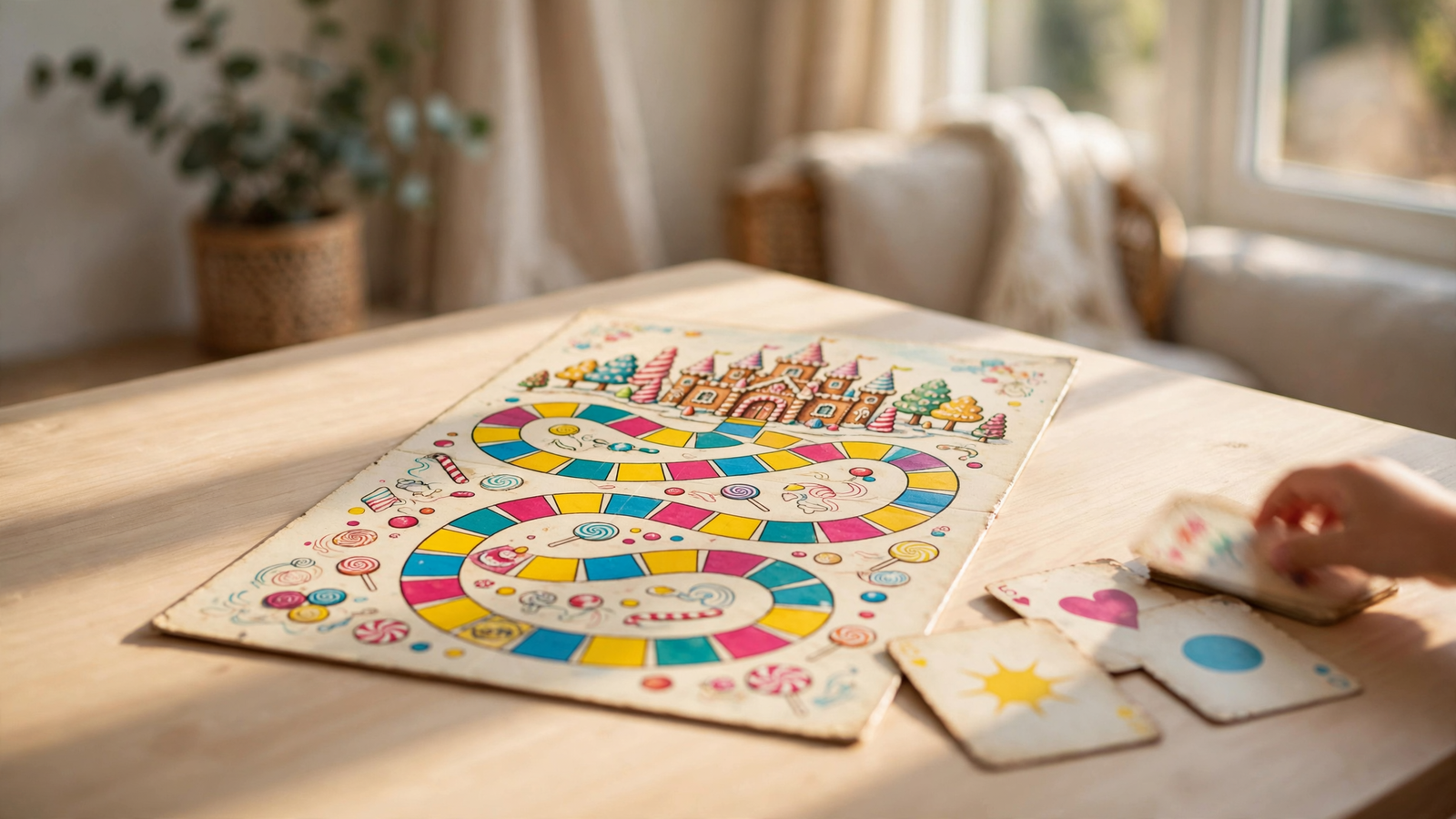
Long before family game night became a streaming-era tradition, a brightly colored board offered children a different kind of escape. In Candy Land, players moved from one fantastical stop to another—through Peppermint Forest, along Gumdrop Mountain, and toward the Candy Castle—by drawing cards and matching colors.
The rules were simple enough for a young child to understand almost immediately. There was no need to read a long question, calculate a score, or learn a complicated strategy. Players drew a card, found the matching color or picture on the board, and moved ahead. The winner was the first player to reach the final space.
A Game Designed for Inclusion
That simplicity was not accidental. Candy Land was created in the late 1940s by Eleanor Abbott, a San Diego teacher who was recovering from polio. According to the Strong National Museum of Play, Abbott designed the game with children in mind who were also recovering in the hospital. A game based on colors and pictures could welcome players who were too young to read or who had limited mobility.
In that sense, Candy Land did something more important than provide a distraction. It made participation possible without demanding physical movement around a room. Every player began with the same chance, and the board supplied a complete world of its own: candy landscapes, cheerful characters, shortcuts, setbacks, and a destination that felt like a storybook ending.
Milton Bradley published the game in 1949. The timing helped it find a place in the expanding postwar market for children’s toys and family entertainment. American households were buying more manufactured leisure goods, while board games offered an affordable way for parents and children to gather around the same table.
Why the Colors Mattered
Candy Land’s design turned learning into play without announcing itself as an educational exercise. Children practiced recognizing colors, taking turns, following a sequence, and accepting the unpredictable results of a card draw. Adults could explain the rules in minutes, while children could start playing almost immediately.
The board also gave the game a distinctive visual identity. Its winding path did not resemble a road, map, or racetrack. It was a journey through an imaginary American candy dream, filled with names and images that made the act of moving a playing piece feel like entering a miniature world.
That visual language has changed over the decades. Characters, artwork, packaging, and licensed editions have been updated for new generations, but the central mechanism has remained recognizable: match a color, move forward, and hope the next card brings you closer to the castle.
A Small Ritual With a Long Life
Candy Land has never depended on expert players or elaborate equipment. Its lasting appeal comes from lowering the threshold for joining in. A preschooler can play beside an older sibling. A parent can introduce it in one sitting. A child who has never played a board game can understand the goal before the first turn is over.
That may be why Candy Land occupies such a durable place in American toy history. It is not remembered because it offered the deepest strategy. It is remembered because it made the shared table feel welcoming—and because, for generations of children, a handful of colored cards was enough to open a door into a sweeter world.