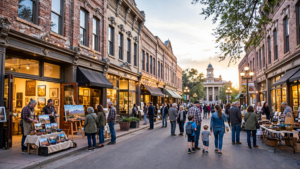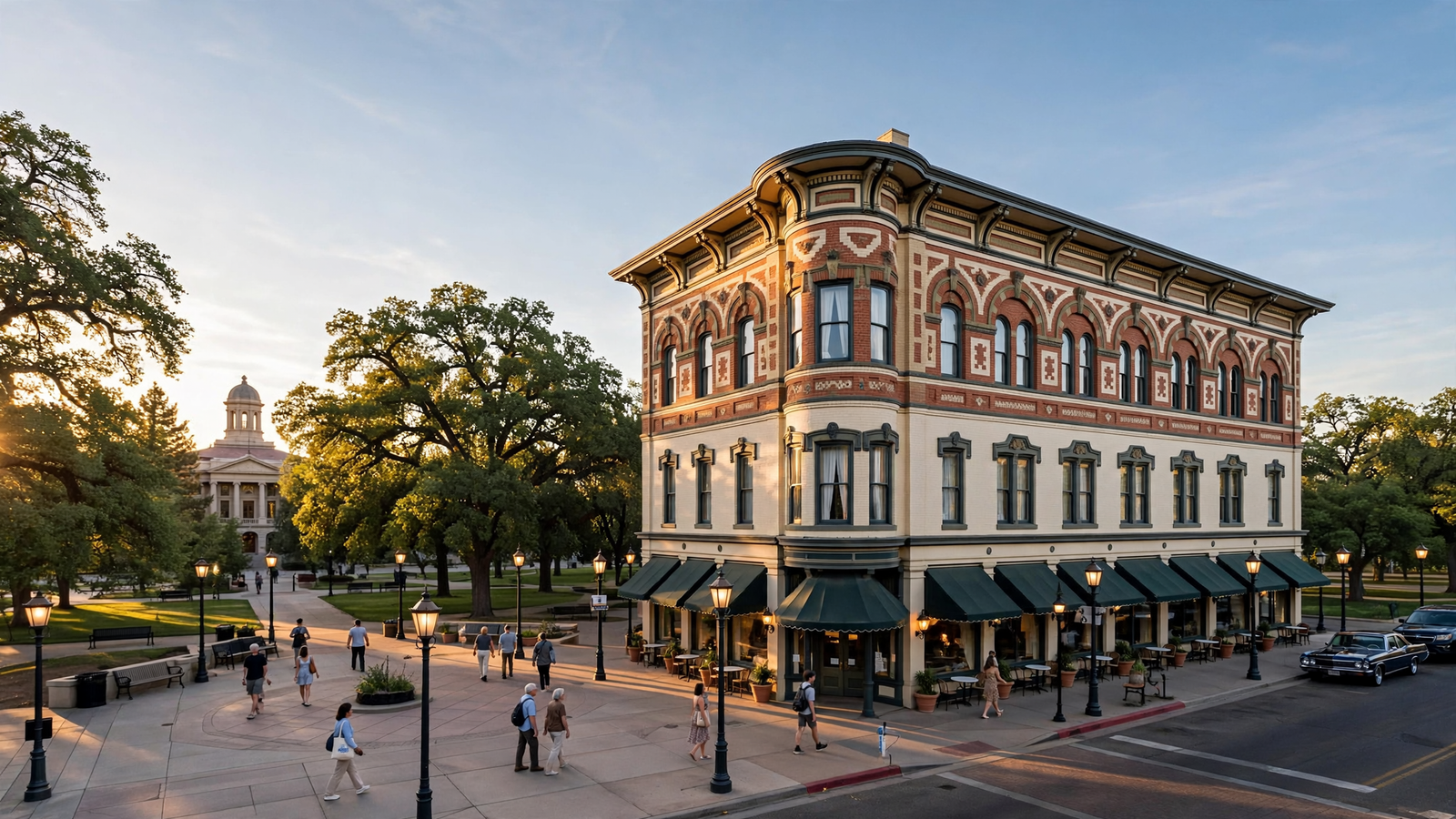
On Prescott’s Courthouse Plaza, where the day can begin with coffee and end with music drifting across the square, one building has been part of the scene for more than a century.
Hotel St. Michael is not the tallest structure in town, nor the most dramatic. Its importance is quieter. It is a working hotel in a historic building, a place where visitors still arrive with luggage, residents still pass through for meals or errands, and downtown life continues around an address that has witnessed Prescott’s transformation from territorial capital to mountain community.
That combination—old architecture, everyday use, and a location at the center of public life—makes the hotel more than a preserved relic. It is an example of how a historic place can remain useful without becoming frozen in time.
A building shaped by Prescott’s downtown recovery
Hotel St. Michael was built in 1901, a moment when Prescott was rebuilding and redefining itself. The city had suffered a devastating downtown fire in 1900. Much of the commercial core had been constructed from wood, and the destruction accelerated a shift toward more durable brick and masonry buildings.
The hotel emerged during that period of change. Its construction reflected the practical needs of a growing community: Prescott needed places for travelers to stay, businesses to operate, and civic life to gather. The building also represented a broader transition in Arizona history. By the beginning of the twentieth century, Prescott was no longer simply a frontier outpost. It was developing the institutions, commercial blocks, and public spaces associated with a permanent town.
Placed directly on Courthouse Plaza, the hotel benefited from one of Prescott’s most important urban arrangements. The square was not merely a scenic patch of grass. It was the center around which government, commerce, transportation, entertainment, and social life gathered. A hotel facing that space could serve many kinds of people at once: travelers, officials, merchants, performers, workers, and local families.
Why location matters
Historic buildings often survive because they are beautiful. They survive longer, however, when they remain connected to daily life.
Hotel St. Michael sits within the part of Prescott where the city is easiest to understand on foot. From its corner, a visitor can reach the courthouse grounds, historic commercial buildings, restaurants, shops, galleries, and the streets associated with the city’s early business district. The hotel is not an isolated attraction that requires a special trip. It is part of the route people already take through downtown.
That setting gives the building a role beyond lodging. It works as a threshold between the plaza and the surrounding business district. A person entering the hotel is moving into a historic interior; a person stepping outside is immediately back in the public life of the square. The two experiences reinforce each other.
This is one reason downtown preservation can feel different from the preservation of a remote historic site. A museum asks visitors to look backward. A living downtown asks them to notice the past while doing something ordinary—buying lunch, meeting a friend, walking to an event, or finding a place to stay.
The value of an ordinary historic place
Prescott has no shortage of celebrated landmarks. Its courthouse grounds, old saloons, theaters, museums, and historic neighborhoods all help tell the story of the city. Hotel St. Michael contributes a different kind of evidence.
Hotels record movement. They are places where the outside world enters a community. Over the decades, guests bring new accents, expectations, occupations, and reasons for traveling. A hotel therefore reflects not just local history but the connections between a town and everywhere beyond it.
In Prescott’s early years, those connections were especially important. The city’s economy depended on government, mining, ranching, retail, transportation, and tourism. A central hotel could accommodate people arriving for business, legal matters, public events, or simple travel through northern Arizona. Its position beside the courthouse made it especially visible to people whose business brought them downtown.
Today, the reasons for visiting are different, but the basic civic function remains recognizable. Travelers come to experience Prescott’s historic center, attend community events, explore nearby public lands, or spend time in a mountain town whose identity is closely tied to its past. The hotel remains part of that arrival experience.
Preservation without turning back the clock
Keeping a historic building in use is rarely as simple as maintaining its exterior. Older structures must accommodate modern expectations for safety, plumbing, heating, electrical systems, accessibility, and comfort. They also have to compete with newer buildings designed around contemporary standards.
The challenge is not to make an old building pretend to be new. It is to allow the building to function today while retaining the features that give it meaning.
That balance can be seen in the way Hotel St. Michael remains recognizable as a historic downtown building while continuing to operate as a hotel. Its survival is not based only on architectural admiration. It depends on a practical relationship between preservation and use.
This is an important lesson for communities with historic commercial districts. A building that can support a business, cultural activity, residence, or public gathering place has a better chance of remaining part of the living city. Preservation becomes less about sealing a structure in a particular year and more about giving it a future.
A companion to the plaza
Hotel St. Michael is best understood alongside Courthouse Plaza rather than apart from it. The plaza provides the open space; the hotel provides an architectural edge. One is landscaped and public, the other enclosed and privately operated, but together they create the kind of urban room that gives a downtown its character.
The relationship is especially noticeable during Prescott’s events and seasonal gatherings. When people fill the square, historic buildings become a backdrop, shelter, orientation point, and part of the event itself. The architecture is not decoration placed behind civic life. It helps shape the way civic life happens.
On quieter days, the relationship is subtler. The plaza offers a place to pause, while the hotel helps define the scale of the surrounding streets. Windows, entrances, signs, and shaded edges make the square feel inhabited. The result is a downtown that feels less like a collection of preserved facades and more like a neighborhood with a long memory.
What Hotel St. Michael adds to Prescott’s story
The hotel does not tell Prescott’s entire history, and it should not have to. Its contribution is more specific: it shows how a historic building can remain connected to the rhythms that originally made downtown matter.
It speaks to the city’s rebuilding after the 1900 fire, its growth as a commercial and civic center, and its continuing role as a destination in the Bradshaw Mountains. It also shows why preservation is most successful when people can encounter history naturally rather than only through formal interpretation.
A visitor may enter because of the building’s age, the plaza’s atmosphere, or the convenience of its location. But the larger experience comes from the overlap of all three. The hotel is historic because of when it was built. It is meaningful because of where it stands. And it remains relevant because people still use it.
That is the quiet achievement of Hotel St. Michael. More than 120 years after its construction, it continues to do the work of a downtown landmark: welcoming people, framing a public space, and giving Prescott’s present a direct connection to its past.