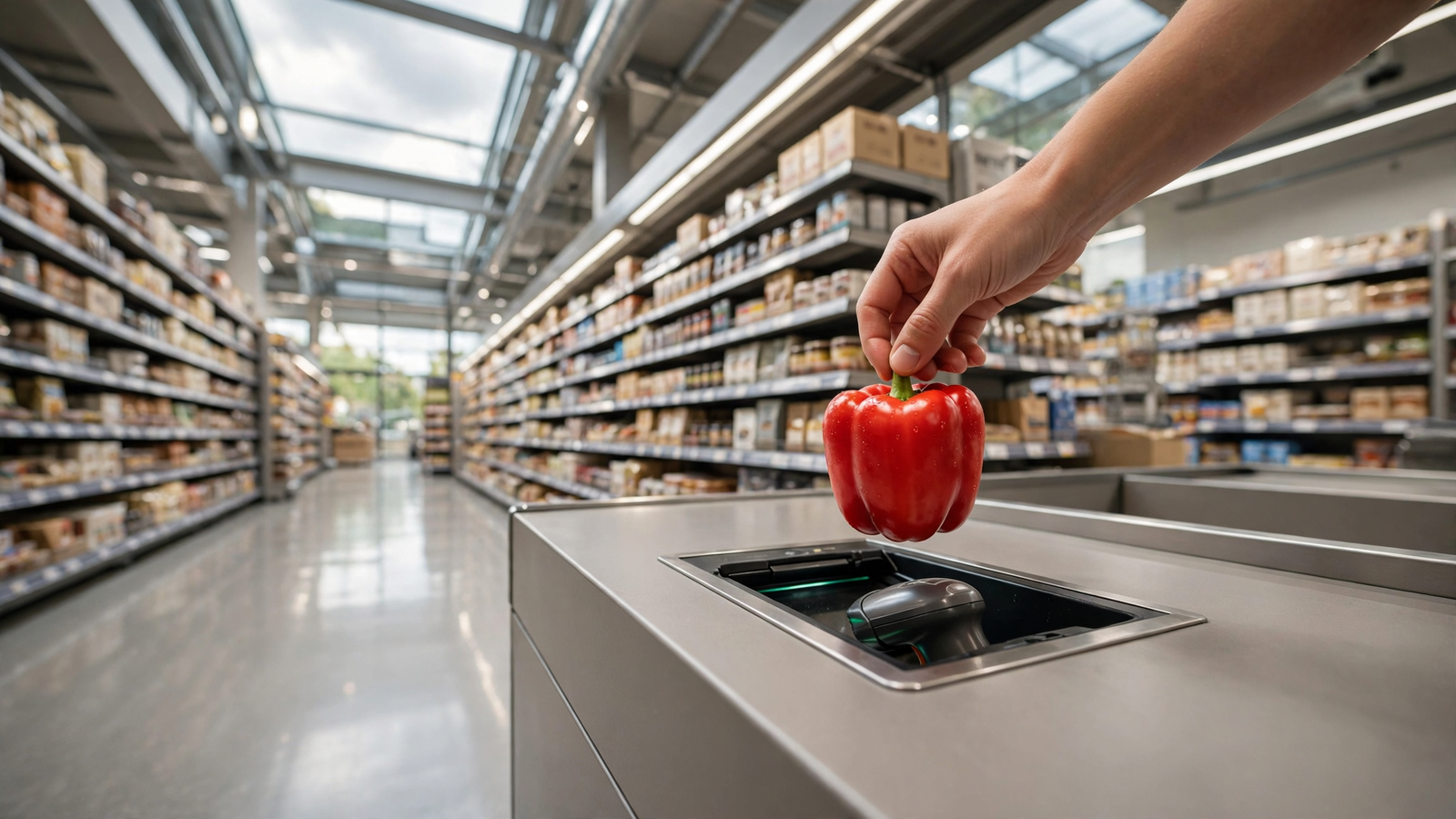
Every time a cashier scans a product, a small piece of history passes beneath the red light. The barcode is easy to overlook because it has become part of the background of modern life. Yet its story connects a chance idea, postwar computing, supermarket experimentation and the gradual remaking of an ordinary task: buying groceries.
The original problem was not really about stripes. In the late 1940s, Bernard Silver, a graduate student at Drexel University, heard that a food company wanted a faster way to identify products at checkout. Silver discussed the idea with his friend Norman Woodland, who began thinking about how information might be represented visually and read automatically.
Woodland later recalled drawing lines in the sand to explore the concept. The pair first imagined a circular design based partly on Morse code, with rings that could be read in different directions. Their 1952 U.S. patent described this “article classification” system, along with a linear version that looked more like the familiar bars used today.
The invention arrived before the technology needed to make it practical. Early scanners were expensive and difficult to use, while computers capable of processing the information were not yet common in stores. The patent therefore spent years as an intriguing solution to a problem that supermarkets could not yet solve economically.
From idea to industry standard
The breakthrough came when grocery companies began looking for a common product-identification system. A standardized code would allow manufacturers, distributors and retailers to use the same language rather than creating separate systems for every store or product line.
In 1973, the U.S. grocery industry selected the Universal Product Code, or UPC. IBM engineer George Laurer led the development of the symbol that became the standard. It was not a simple copy of Woodland and Silver’s original design, but it built on the larger idea that a printed pattern could carry a product number and be read by a machine.
The first retail scan took place on June 26, 1974, at a Marsh Supermarket in Troy, Ohio. The item was a 10-pack of Wrigley’s Juicy Fruit chewing gum. The gum was chosen partly because its packaging could accommodate the new symbol, and the pack is now preserved by the Smithsonian’s National Museum of American History.
A new rhythm for everyday shopping
At first, shoppers did not know whether the system would succeed. But the barcode gradually became useful far beyond faster checkout. It helped stores maintain inventory records, identify products during recalls, reduce pricing errors and understand which goods were moving through their shelves.
The change was also cultural. Before barcodes, many prices had to be marked directly on products or entered manually at the register. Afterward, the checkout became connected to a larger information system linking the shelf, the warehouse and the retailer’s records.
Barcodes did not eliminate human work, and they did not make shopping effortless. They did something quieter: they turned an object’s printed label into a machine-readable identity. That modest shift helped supermarkets operate at a scale their earlier paper systems could not easily support.
Today, newer formats such as two-dimensional codes are expanding what product labels can contain. But the familiar lines remain a reminder that some of the most influential inventions are not dramatic machines. Sometimes they are small marks designed to make an ordinary moment move a little more smoothly.