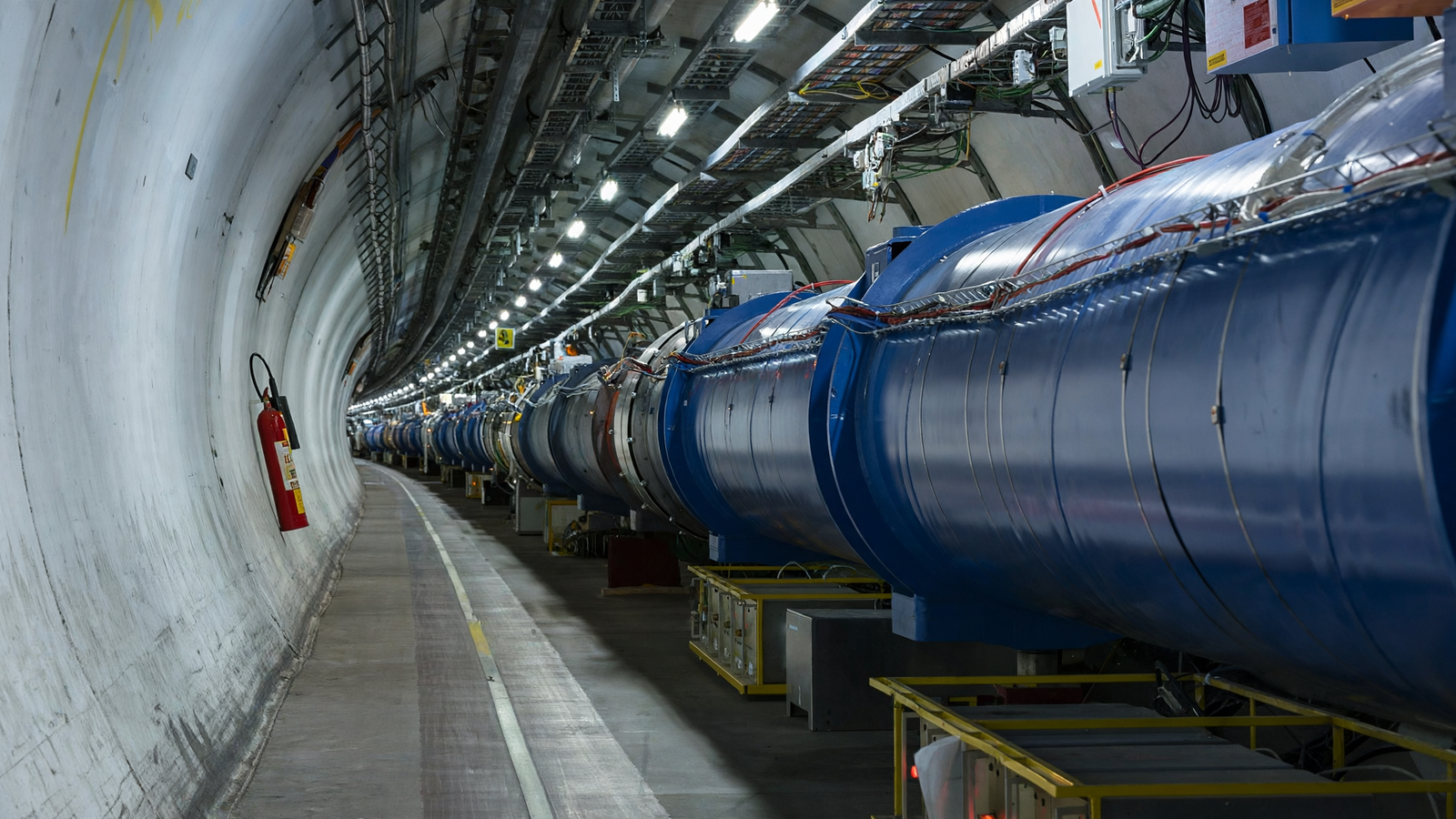
Under fields and villages near the French-Swiss border, an extraordinary machine follows a vast underground circle. Inside its 27-kilometre tunnel, beams of protons travel at almost the speed of light in opposite directions. When engineers guide those beams into collisions, the resulting spray of particles gives physicists a way to investigate matter at its most fundamental level.
This is the Large Hadron Collider, or LHC, operated by CERN, the European Organization for Nuclear Research. It is often described through its discoveries, especially the 2012 observation of the Higgs boson. But the collider is also one of the most ambitious engineering systems ever assembled: a machine that depends on extreme cold, an almost perfect vacuum, hairbreadth alignment and thousands of interlocking components working together.
A circular laboratory beneath the ground
The LHC occupies a tunnel originally built for CERN’s Large Electron-Positron Collider. Its underground location provides a stable environment and helps shield the surrounding area from the machine’s operations. The ring crosses the border between Switzerland and France, passing beneath the countryside in a loop roughly 100 metres below the surface.
That size is not incidental. A particle moving at enormous energy does not easily bend. The LHC’s engineers needed a long path so powerful magnets could curve the beams gradually rather than forcing them through a sharp turn. The result is a circular track large enough to encircle a city, but precise enough to keep two pencil-thin beams on course.
Magnets that operate near absolute zero
The collider’s main bending magnets are superconducting dipoles. CERN says the machine uses 1,232 of them, each measuring about 15 metres long. Their job is to create magnetic fields strong enough to steer high-energy protons around the ring.
Superconductivity is essential because ordinary electrical resistance would turn too much energy into heat. The LHC’s magnets are cooled with superfluid helium to approximately 1.9 kelvin—colder than outer space. At that temperature, the cables can carry very large currents with almost no electrical resistance, producing the magnetic fields required for the accelerator.
Maintaining that cold is itself a major engineering challenge. The accelerator is divided into cryogenic sectors, and the cooling system must keep thousands of tonnes of equipment at extremely low temperatures while the machine is operated, inspected and periodically upgraded. The LHC is not simply a ring of magnets; it is also a giant refrigeration plant, power system and control network.
Two beams, one vacuum
Two proton beams travel in opposite directions through separate beam pipes. The pipes must be extraordinarily clean and empty. Any stray gas molecule could interfere with a beam, so the LHC uses an ultra-high vacuum comparable to conditions found in space.
The beams are not continuous streams like light from a lamp. They are arranged into groups called bunches. Each bunch contains many protons, but the beam itself is carefully shaped and focused. Superconducting quadrupole magnets act like lenses, squeezing the beams so they can be brought together at the collider’s four major experiments: ATLAS, CMS, ALICE and LHCb.
At the collision points, the beams cross inside enormous detectors. These instruments record the paths, energies and identities of particles produced in the collisions. The detectors are layered machines, combining tracking systems, calorimeters and particle-identification equipment. Their electronic systems must sort useful collision data from a torrent of signals arriving millions of times each second.
The engineering behind a famous discovery
The LHC began circulating its first beam in September 2008. After commissioning and repairs, it began delivering collisions for experiments. In July 2012, the ATLAS and CMS collaborations announced the observation of a new particle consistent with the Higgs boson, a long-sought particle associated with the mechanism that gives many elementary particles their mass.
The discovery was a scientific milestone, but it also demonstrated what the machine had been built to do. The Higgs boson was not observed by looking at a single collision. It emerged as a statistical pattern across vast quantities of data, with independent experiments reaching compatible conclusions. The accelerator had to create the conditions; the detectors had to capture the evidence; and computing networks around the world had to process it.
A machine designed to improve
The LHC has never been a finished object in the ordinary sense. CERN shuts it down in long intervals so engineers can inspect components, strengthen connections, improve beam control and upgrade the experiments. Each operating period is known as a run, and later runs have reached higher collision energies than the first.
During Run 3, which began in 2022, the collider operated at a record centre-of-mass energy of 13.6 trillion electronvolts. That number describes the combined energy available when the two counter-rotating proton beams collide. Higher energy and more collisions allow researchers to test the Standard Model of particle physics more precisely and search for phenomena it does not explain.
The work is not only about making the beams more energetic. Engineers must also protect the magnets and detectors from accidental beam losses. A high-energy beam carries substantial stored energy, so collimators are positioned to remove stray particles and absorb controlled losses. The machine’s protection systems can dump the beam when conditions become unsafe.
Why the collider matters beyond particle physics
The LHC illustrates a broader lesson about modern engineering: some machines are built not to manufacture a product, but to make a question experimentally possible. Its components draw on superconductivity, cryogenics, vacuum technology, radio-frequency acceleration, precision surveying, data engineering and large-scale collaboration.
Its benefits are also distributed beyond the tunnel. CERN’s research environment has contributed to advances in detector technology, medical imaging, radiation therapy, superconducting systems and scientific computing. The World Wide Web itself was created at CERN in 1989 to help researchers share information—an earlier development that belongs to the laboratory’s wider technological legacy, not to the LHC alone.
The collider’s greatest achievement may be the way it turns impossibly small events into measurable knowledge. Protons invisible to the naked eye are guided around a ring spanning kilometres, cooled by helium colder than deep space, focused by powerful magnets and brought together inside detectors built by international teams. From that carefully engineered choreography, scientists can examine the rules that shape the visible universe.
That is the LHC’s quiet wonder: its scale is enormous, but its purpose is intimate. By building a machine large enough to control the smallest known constituents of matter, engineers have given humanity another way to ask what everything is made of—and how the universe works underneath the surface.