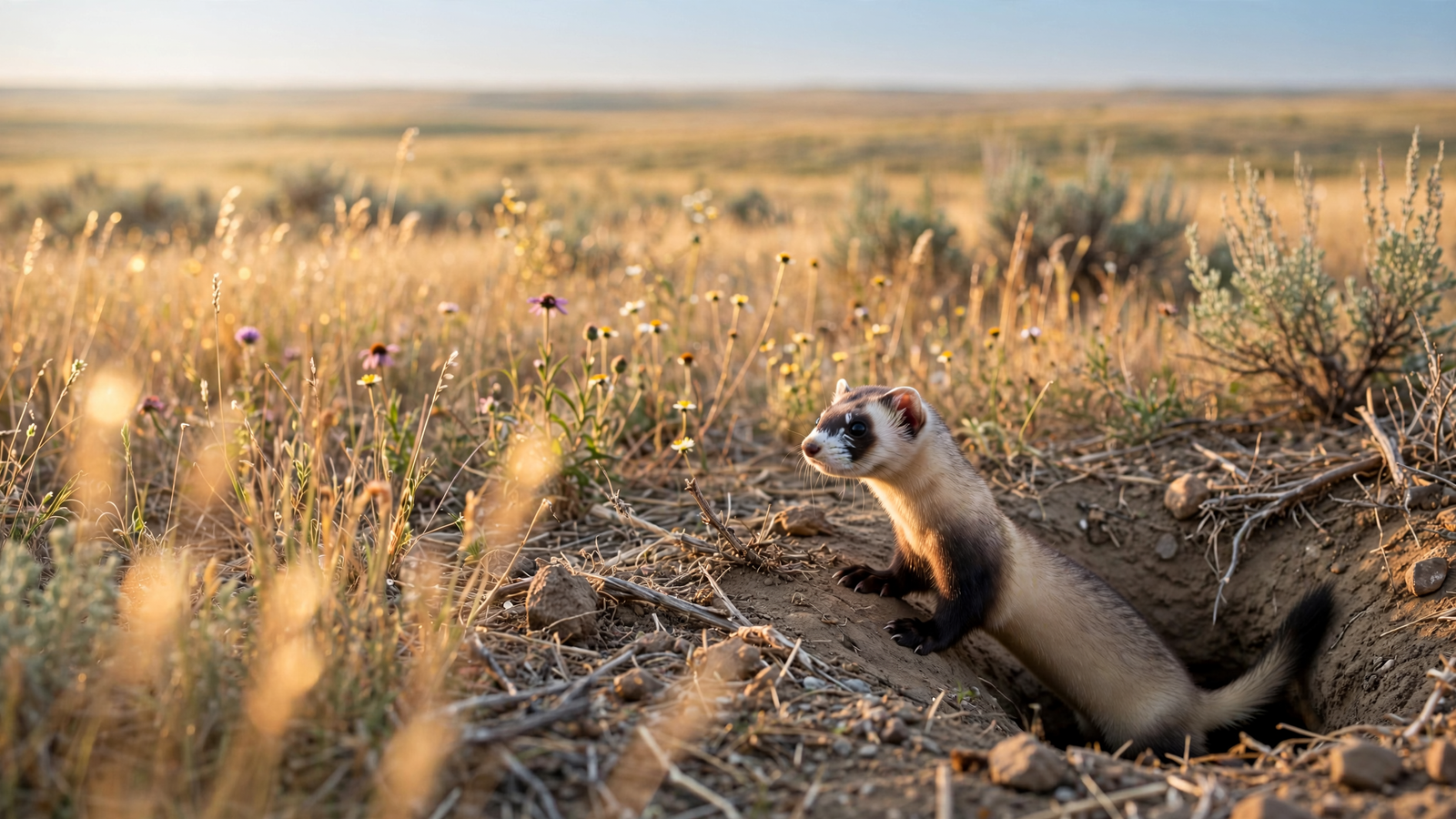
On the Great Plains, a small predator is becoming a symbol of what conservation can accomplish when recovery takes more than one approach.
The black-footed ferret is North America’s only native ferret species. It is also one of the continent’s most endangered mammals. For decades, biologists believed the animal had disappeared from the wild until a surviving population was discovered near Meeteetse, Wyoming, in 1981.
That discovery gave conservationists a chance to act. Today, black-footed ferrets are being raised in specialized facilities and returned to prairie landscapes where their historic prey, the prairie dog, still lives. The effort has also become a remarkable experiment in conservation genetics.
A species tied to the prairie
Black-footed ferrets depend heavily on prairie dog colonies. Prairie dogs provide both food and shelter: ferrets hunt them and often use their underground burrows as dens. When prairie dog populations decline because of habitat loss, disease, or poisoning, ferrets lose the foundation of their habitat as well.
Conservation therefore involves more than releasing individual animals. It requires protecting grasslands, maintaining prairie dog colonies, monitoring disease, and building a healthy captive-breeding population. Federal agencies, zoos, tribes, private landowners, and conservation groups have all contributed to that work.
The U.S. Fish and Wildlife Service says black-footed ferrets have been reintroduced at numerous sites across the Great Plains and Intermountain West. The animals remain endangered, but the existence of multiple managed populations is a major change from the period when the species was thought to be gone.
Genetic help from an animal that died decades ago
In 2020, researchers announced the birth of Elizabeth Ann, the first cloned black-footed ferret and the first cloned endangered animal in the United States. Her genetic material came from a female ferret named Willa, which died in 1988.
Willa’s cells had been preserved in the “Frozen Zoo” at the San Diego Zoo Wildlife Alliance. Genetic analysis showed that she carried several times more unique genetic variation than the average living black-footed ferret. That made her valuable not because cloning can replace habitat restoration, but because it may return lost genetic diversity to a species whose living population descended from a relatively small number of founders.
Elizabeth Ann’s birth did not mark the end of the ferret’s recovery challenge. A cloned animal still needs to survive, reproduce, and contribute to a carefully managed population. But the experiment demonstrated that genetic material stored for decades could potentially become part of a living conservation program.
Progress measured in possibilities
The black-footed ferret’s story is not a simple comeback. The species remains vulnerable, and prairie ecosystems continue to face pressure. Yet its recovery shows how conservation can combine field science, captive care, disease management, habitat protection, and new reproductive technologies.
Every ferret returned to the prairie represents a practical achievement. Every preserved cell may hold another option for the future. For a species once presumed extinct, having more options is itself a reason for hope.