Few vehicles have traveled so far from their original purpose as the Jeep. Designed for military work, the small four-wheel-drive vehicle became a farmer’s helper, a trail companion, a work truck, and eventually a familiar part of everyday American life.
Its story began in 1940, when the U.S. Army sought a light reconnaissance vehicle that could move across rough ground, carry equipment, and be produced quickly. The requirements were demanding: the vehicle needed four-wheel drive, a short wheelbase, useful ground clearance, and a simple design that soldiers could understand and maintain.
American Bantam Car Company produced the first prototype in an extraordinarily short period. Willys-Overland and Ford later developed competing versions, and the Army ultimately standardized the design around Willys’ model while drawing on production from all three companies. During World War II, American factories built more than 600,000 of these compact vehicles.
A machine designed to be useful
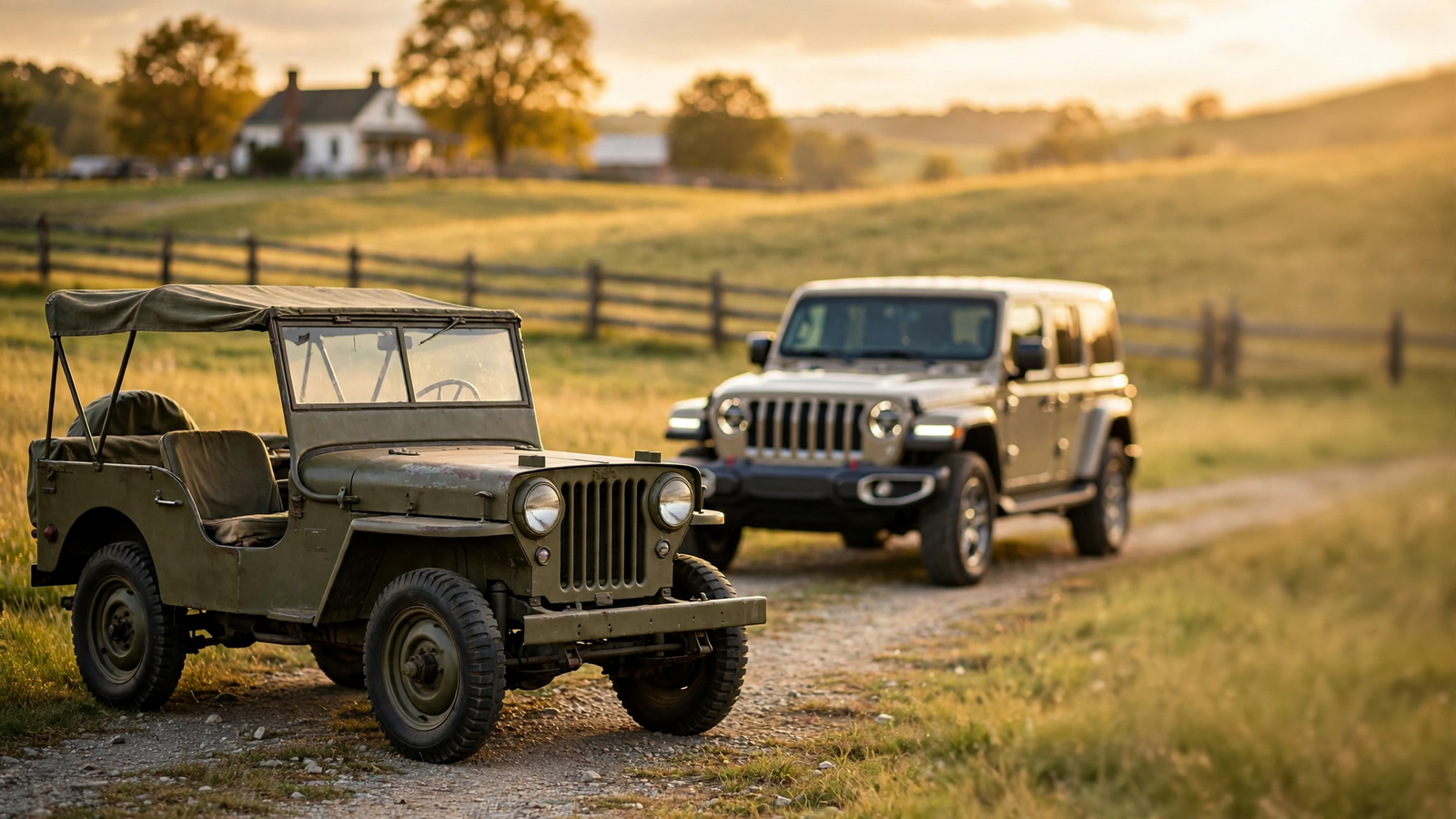
The Jeep was not created for comfort. Its flat body, fold-down windshield, exposed hinges, and simple controls reflected a single priority: get people and supplies where they needed to go. It could serve as a reconnaissance vehicle, carry ammunition, tow equipment, transport officers, or move across terrain that challenged ordinary cars and trucks.
That versatility made it valuable far beyond a single assignment. Soldiers used Jeeps as mobile radios, ambulances, staff cars, and improvised transport. Photographs from the war helped turn the vehicle into a visual symbol of American mobility and industrial production.
Its nickname has a less certain history. Several explanations have been proposed, including a connection to “Eugene the Jeep,” a fantastical creature from the Popeye comic strip, and military slang for new or specialized equipment. No single explanation has been conclusively accepted, but the short name proved memorable.
From military surplus to civilian life
After the war, the vehicle’s possibilities became clear to civilians. Willys introduced the CJ-2A in 1945, presenting it as a civilian version for farms, construction sites, rural transportation, and other practical work. The Jeep could cross muddy fields, carry tools, and reach places that ordinary passenger cars could not.
That usefulness helped it find a second life in peacetime America. It appeared on ranches and at job sites, but it also appealed to people who wanted access to the outdoors. Over time, the vehicle’s utilitarian identity expanded into something more recreational: a way to reach campsites, fishing spots, mountain roads, and beaches.
The transformation also shaped the broader idea of the sport-utility vehicle. Long before SUVs became a dominant category, the Jeep established a formula that remains familiar: a relatively compact body, four-wheel drive, an upright view of the road, and the promise of going beyond paved streets.
An enduring American design
The Jeep’s importance is not simply that it won a military contract or survived into civilian production. It demonstrated how a focused design can adapt across generations. A vehicle built for wartime logistics became part of agricultural work, recreation, popular culture, and the history of American manufacturing.
Its lasting appeal comes from that visible sense of purpose. The Jeep looks like a machine built to do something—and its journey from battlefield tool to everyday icon shows how strongly practical design can shape a culture’s imagination.