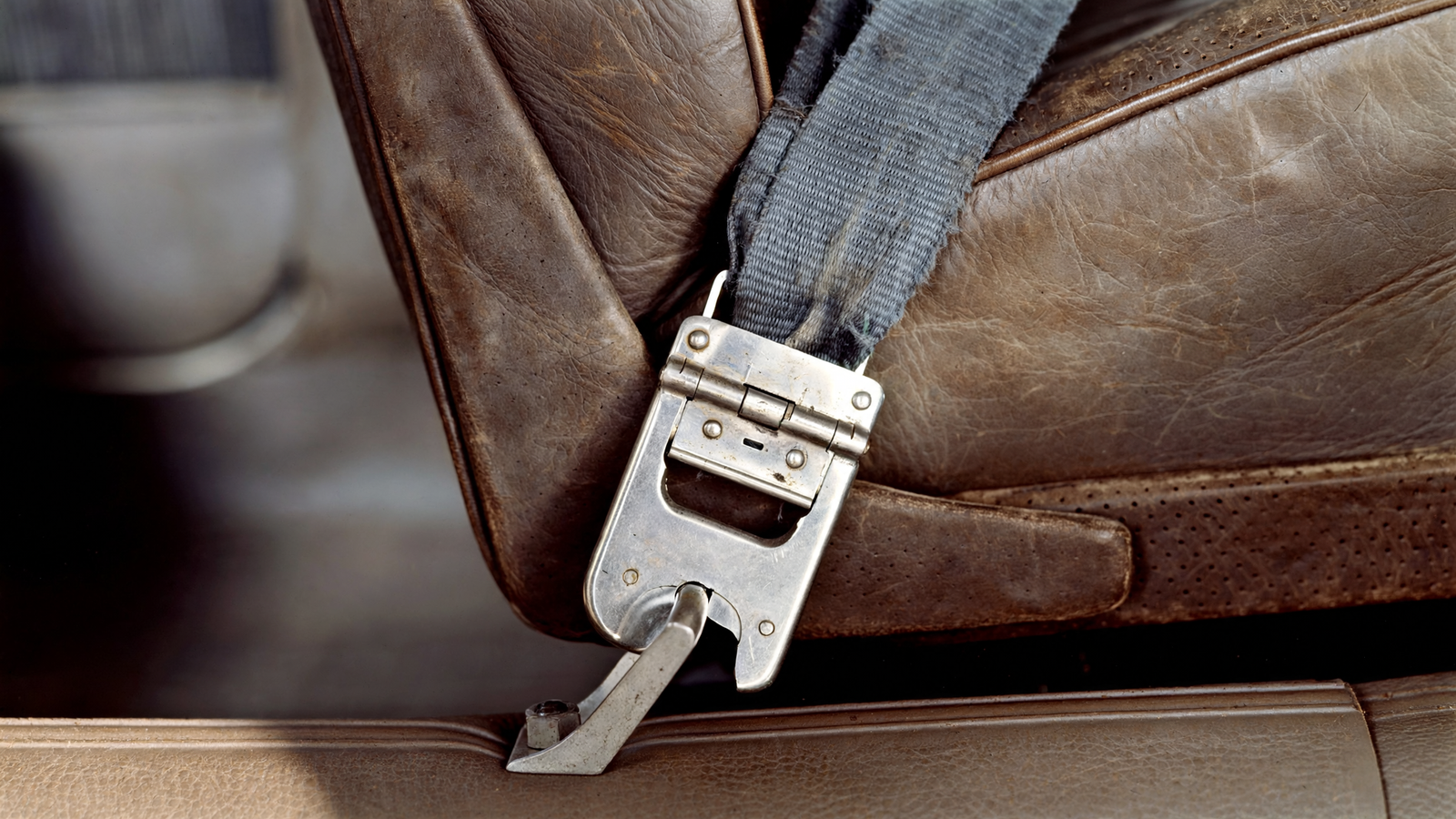
Some inventions announce themselves with noise: a new engine, a faster train, a rocket leaving the ground. Others become part of daily life so completely that people hardly notice them. The three-point seat belt belongs to the second category.
Today, reaching for the belt before starting a car is an ordinary gesture in much of the world. But the familiar combination of a lap belt and a diagonal shoulder strap was once a major departure from automotive convention. Its story is a reminder that progress in transportation is not always about speed. Sometimes it is about giving the human body a better chance when speed suddenly stops.
A safer shape for a dangerous moment
Earlier seat belts generally used a single strap across the lap. That could help restrain a person, but it did not adequately control the upper body during a serious crash. A better design needed to spread forces across stronger parts of the body while keeping the occupant from being thrown forward or out of the vehicle.
Swedish engineer Nils Bohlin developed that solution while working for Volvo. In 1959, the automaker introduced the three-point belt in its cars, combining a lap belt with a strap that crossed the chest. The arrangement was designed to be simple enough for people to use quickly and comfortably, while holding the torso and hips in position.
The design was not merely clever; it was practical. A safety device that is difficult to fasten, uncomfortable to wear or confusing to adjust is unlikely to protect people consistently. Bohlin’s belt worked with the ordinary movement of getting into a car, then became crucial in the brief, violent instant of a collision.
A patent shared for public safety
Volvo made an unusually consequential decision with the invention. Rather than keeping the technology exclusive, the company made the patent available to other automakers. That choice helped the three-point belt spread beyond one brand and one country.
Its influence grew as safety agencies, researchers and governments accumulated evidence about vehicle crashes. In the United States, federal vehicle standards helped make seat belts standard equipment in new cars. Over time, belt reminders, pretensioners and load limiters improved the basic idea, but the essential geometry remained recognizable.
The development also changed the public understanding of automotive safety. Cars were no longer judged only by how they handled, accelerated or looked. The interior became a protective system, with belts, airbags, head restraints and stronger passenger compartments working together.
The most familiar safety technology
The seat belt’s importance is partly visible in statistics, but its deeper achievement is cultural. It turned a piece of engineering into a nearly universal habit. Drivers and passengers across generations have learned that entering a vehicle includes one small act of preparation.
That habit matters because crashes are unpredictable. Careful driving reduces risk, but it cannot eliminate the actions of other drivers, sudden mechanical failures or changing road conditions. A belt does not prevent a collision; it helps preserve the space between a person and the vehicle’s most dangerous forces when one occurs.
More than six decades after Volvo introduced Bohlin’s design, the three-point belt remains a quiet symbol of useful innovation. It did not make the automobile faster or more glamorous. It made the ordinary journey more survivable—and then became so familiar that millions of people use it without thinking about the engineering behind the click.