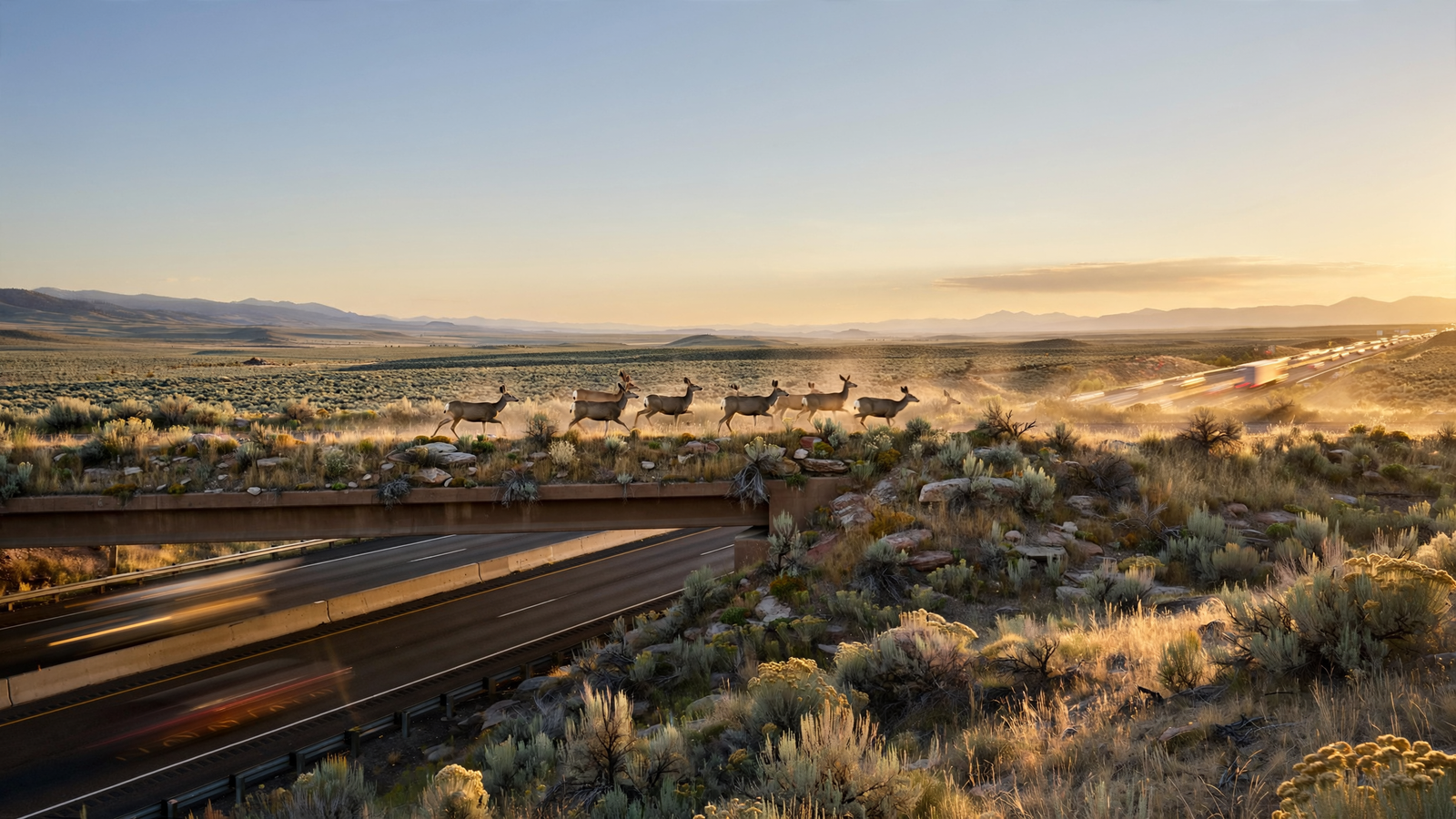
Every spring, thousands of mule deer begin moving north through western Wyoming, following a route shaped by generations of animals and the seasonal availability of food. The journey is one of the longest documented mule deer migrations in the lower 48 states—and for years, one of its most difficult stretches was a busy highway near Pinedale.
The solution was not to fence wildlife out. It was to help them cross.
At Trapper’s Point, the Wyoming Department of Transportation built two broad wildlife overpasses and six underpasses along U.S. Highway 191 and U.S. Highway 189. The crossings, completed in 2012, connect the surrounding range while directing deer away from traffic. Fencing guides animals toward the structures, turning a dangerous road corridor into a safer passage.
A migration route with deep roots
The Sublette mule deer herd travels between winter range in the Red Desert and summer habitat near the Hoback Basin. Wyoming’s Migration Initiative at the University of Wyoming has documented portions of the route stretching roughly 150 miles.
Migration is not simply a matter of moving from one point to another. Deer follow familiar paths that reflect the landscape’s valleys, ridgelines, forage and water. When a road cuts across that route, the animals still need to reach the other side. Without a safe crossing, they may wait at the roadside, attempt to cross between vehicles or avoid important habitat altogether.
That makes wildlife crossings more than traffic-safety projects. They are a way to preserve an ecological pattern that existed long before the highway.
Evidence that the crossings work
Wyoming transportation officials report that wildlife-vehicle collisions in the Trapper’s Point corridor fell by about 81 percent after the fencing and crossings were installed. Monitoring has also shown mule deer using both the overpasses and underpasses during their seasonal movements.
The overpasses are especially visible: broad, earth-covered bridges designed to resemble the surrounding terrain. Underpasses provide additional routes for deer and other animals, while the fencing helps prevent them from wandering onto the pavement before they reach a crossing.
For drivers, fewer collisions mean safer travel and lower costs. For wildlife, the benefit is more fundamental: animals can continue moving between seasonal habitats without having to gamble against highway traffic.
A model for coexistence
Wildlife crossings do not solve every challenge facing mule deer. Habitat development, drought, severe winters and changing conditions can all affect migration. But the Trapper’s Point project demonstrates what can happen when transportation planning begins with an understanding of how animals actually use the land.
Its influence reaches beyond one herd. Wyoming has continued investing in wildlife-migration research and roadside improvements, while other states have built or studied similar crossings for deer, elk, pronghorn, bears and other species.
The most hopeful part of the story is also the simplest: a highway did not have to mean the end of an ancient route. With careful design, a modern road can make room for an older journey—and allow people and wildlife to travel through the same landscape more safely.