Prescott’s most important water projects are not always the ones residents see.
There may be no dramatic reservoir view, no new trailhead, and no obvious landmark to photograph. Instead, the work often happens after water has already passed through homes and businesses—inside treatment plants, underground pipes, storage facilities, and carefully managed irrigation systems.
That quieter system is reclaimed water: wastewater that has been treated to a standard that allows it to be used again for approved purposes. In a high-desert city where every dependable source matters, reclaimed water gives Prescott another way to manage its limited supply.
The idea is simple, but its importance is growing. Water used once does not necessarily have to leave the community forever. After treatment and testing, some of it can return to the city’s working landscape rather than being used only once and discharged.
A second life for water
Prescott’s water system operates in a landscape shaped by low rainfall, hot summers, rapid growth, and long-term pressure on groundwater. Those conditions make conservation more than a household habit. They make water reuse part of the city’s basic infrastructure.
The city’s water and wastewater programs describe reclaimed water as a resource that can serve approved irrigation and other nonpotable uses. That distinction matters. Reclaimed water is not a substitute for drinking-water treatment, and it is not available for every purpose. It is instead a carefully controlled supply for uses that do not require potable water.
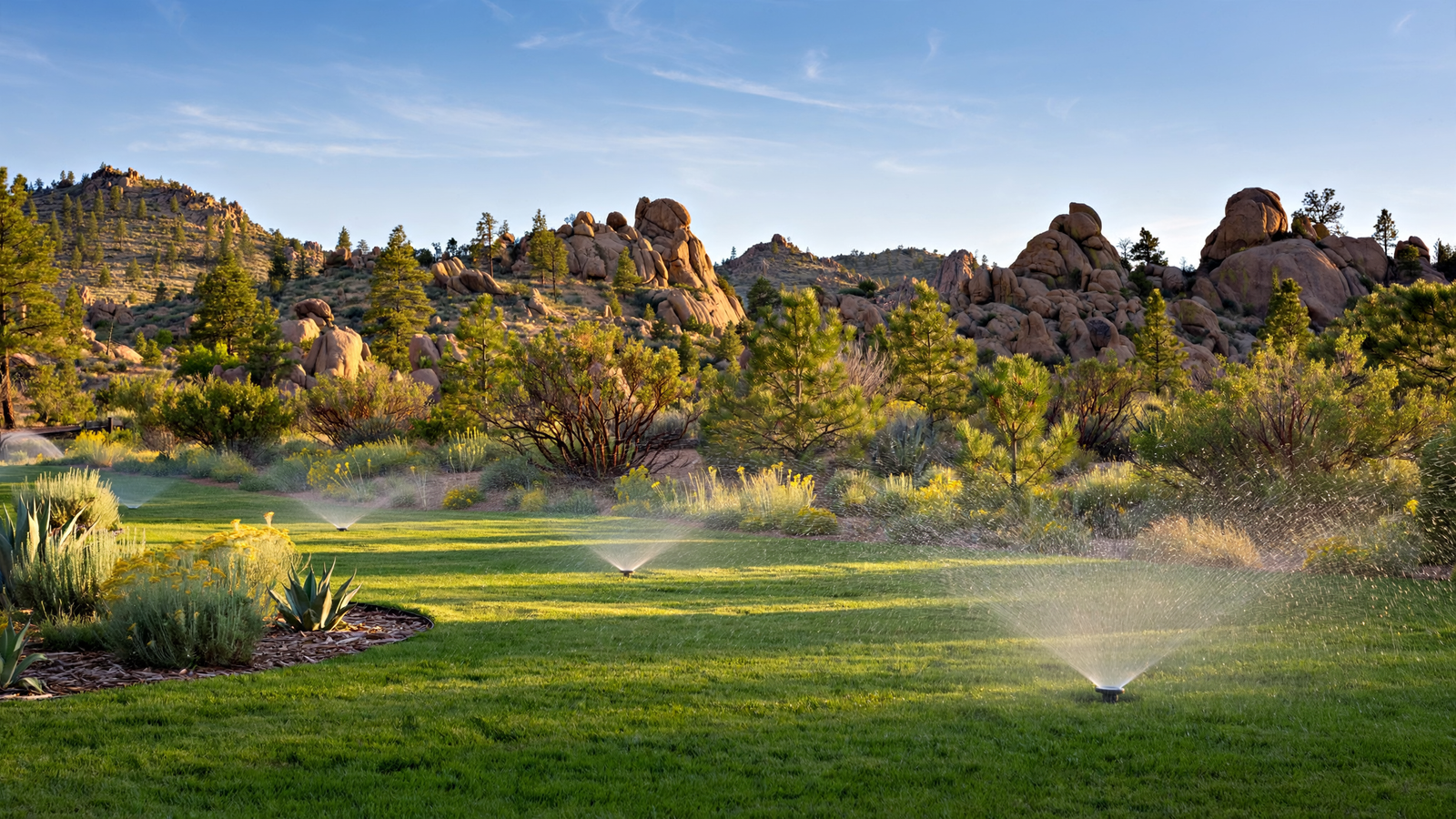
In practice, that can mean helping maintain public landscapes, parks, medians, golf-course areas, and other settings where water is needed but drinking-water quality is unnecessary. Using reclaimed water in those places can reduce demand on higher-quality supplies.
The result is easy to overlook. A lawn or planted public space may look ordinary, even though the water supporting it has taken a very different path from the water flowing from a household tap.
Why reuse matters in Prescott
Prescott is part of Arizona’s broader water story, but the city’s circumstances are distinctly local. Its elevation and mountain setting give it a different climate from the state’s desert valleys, yet the community still faces the central challenge of the Southwest: water supplies must serve homes, businesses, public spaces, wildlife, and future residents in a region where precipitation is variable.
Groundwater has historically played a major role in many Arizona communities. But groundwater is not an unlimited account. Pumping, recharge, drought, development, and climate variability all affect how quickly an aquifer can recover.
Reclaimed water does not solve those problems by itself. It cannot replace conservation, responsible growth planning, watershed protection, or careful groundwater management. What it can do is reduce the number of times the city needs to use potable or groundwater supplies for tasks that do not require drinking water.
That makes water reuse a form of diversification. A community with several water-management tools is better positioned than one that depends almost entirely on a single source.
Infrastructure people rarely notice
Most public infrastructure becomes visible only when it fails. Roads are noticed when they close. Bridges are noticed when they need repair. Water systems are noticed when a pipe breaks or a drought restriction changes daily routines.
Reclaimed-water systems are different. When they work well, they disappear into the background.
The system begins with wastewater leaving homes, restaurants, offices, and other properties. At a treatment facility, solids and contaminants are removed through multiple stages. The resulting water is disinfected and monitored before being distributed for approved nonpotable uses.
That process requires more than a treatment plant. It also depends on a separate distribution network, storage, valves, pumps, monitoring, maintenance, and rules that keep reclaimed water apart from drinking-water lines. Public agencies must track where the water goes and how it is used.
In other words, reuse is not simply a matter of cleaning water and sending it back into the street. It is a parallel utility system with its own engineering and public-health safeguards.
The landscape connection
Prescott is known for its historic downtown, mountain trails, lakes, forests, and open landscapes. Those public places help define the city’s identity, but they also require ongoing care.
Trees need water during dry periods. Athletic fields and public lawns must be maintained. Landscaped public facilities need irrigation. Golf courses and other large outdoor spaces can place substantial demands on water supplies, especially during the hottest part of the year.
Reclaimed water gives some of those landscapes a supply that is better matched to the job. It allows the city and other approved users to reserve potable water for people while using treated wastewater for selected outdoor purposes.
This is one reason water reuse can be understood as a place-making system. It helps determine which public landscapes remain practical, how they are maintained, and how a high-desert community balances greenery with scarcity.
That balance is especially important in Prescott, where residents value both the town’s wooded character and its surrounding dry-country ecology. Reuse cannot make the climate wetter, but it can help the city decide where irrigation is most valuable and where lower-water landscapes make more sense.
Reuse is not the same as recycling everything
The language of water reuse can sometimes make the process sound more expansive than it is. Reclaimed water is highly useful, but it is not a universal replacement for conventional supplies.
Most community reuse programs focus on nonpotable applications. Drinking-water systems require different treatment standards, monitoring, and regulatory controls. A reclaimed-water network also depends on customers having appropriate irrigation systems and on the city having enough demand, storage, and distribution capacity to use the water effectively.
Seasonal demand creates another challenge. Outdoor irrigation is highest during warm and dry months, while wastewater production continues throughout the year. Utilities must manage that mismatch through storage, operational planning, and a network of approved users.
These limits do not make reuse less valuable. They explain why it works best as one part of a broader water portfolio.
A local example of a larger Arizona shift
Across Arizona, water managers are increasingly focused on keeping supplies in circulation for longer. State water agencies, cities, utilities, and conservation groups are examining conservation, recharge, stormwater capture, agricultural efficiency, and reuse as connected parts of water planning.
Prescott’s reclaimed-water system belongs to that larger movement, but its meaning is most visible at the local scale. It is about whether a city can maintain public spaces without treating every use as a demand for drinking water. It is about whether wastewater can be managed as a resource rather than only as a disposal problem.
That shift also changes the way residents can think about the city. Water does not simply arrive, get used, and disappear. It moves through a managed cycle that includes homes, treatment facilities, public landscapes, groundwater systems, and the watershed beyond town.
The next chapter is efficiency
Prescott’s future water resilience will depend on how well its separate strategies work together. Reclaimed water can support nonpotable demand. Conservation can reduce household and commercial use. Efficient fixtures can lower wastewater flows as well as water withdrawals. Landscape choices can determine how much irrigation is needed in the first place.
Residents still have an important role. Fixing leaks, following local watering guidance, choosing drought-adapted plants, and understanding the difference between potable and reclaimed water all reduce pressure on the system.
But individual conservation works best when it is supported by public infrastructure. A city can ask residents to use less water while also investing in systems that make every gallon more useful. Reclaimed water is one of those systems.
It is not the most visible part of Prescott’s landscape. It does not compete with the Granite Dells or the courthouse square for attention. Yet it helps support the ordinary public places that make a city comfortable and livable.
In a dry region, that may be the most important kind of progress: not finding one miraculous new source, but building a system that wastes less, reuses more, and gives the water already moving through the community another chance to do useful work.