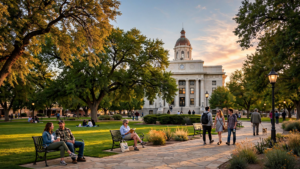
On most evenings, downtown Prescott is easy to understand. Gurley Street leads toward the courthouse square, historic buildings frame the sidewalks, and the center of town settles into its familiar rhythm of restaurants, shops, offices, and visitors.
Then the first Friday of the month arrives.
As galleries and participating businesses open their doors for the First Friday Art Walk, downtown becomes less like a place people pass through and more like a place people explore. A storefront may become a temporary exhibition room. A studio may offer a glimpse of work normally made behind closed doors. A restaurant or shop may become part of an evening built around conversation, color, and discovery.
The event is not a new museum or a single permanent attraction. Its strength is more ordinary and, in some ways, more useful: it gives Prescott’s existing downtown a recurring reason to be experienced differently.
A gallery district without gallery-district boundaries
Prescott’s art walk works because it does not require visitors to understand one particular institution before they begin. There is no single entrance, ticket counter, or prescribed route. Participants can move from gallery to gallery, pause in the plaza, browse a shop, stop for food, and continue whenever something catches their attention.
The official event information describes the walk as a monthly downtown gathering involving local galleries, artists, businesses, and other participating venues. The details can vary from one month to the next, but the basic idea remains consistent: art is placed into the flow of an ordinary evening rather than separated from it.
That difference matters. A traditional gallery visit can feel intentional and even intimidating. An art walk lowers the threshold. Someone may enter because a painting is visible from the sidewalk, because a friend wants to stop, or because the evening provides a pleasant reason to wander. The first encounter with an artist’s work does not need to begin with specialized knowledge.
For residents, the event also provides a way to revisit familiar streets. A business that is usually associated with one purpose may reveal another side of itself. A shop may host a visiting maker. A gallery may feature a new exhibition. A public-facing studio may help explain how a finished object came into being.
Why Prescott is a natural setting for an art walk
Prescott’s downtown already has many of the physical qualities that make an evening walking event feel cohesive. The city’s historic center is compact enough to explore on foot, with older commercial buildings, shaded sidewalks, storefront windows, and public gathering spaces concentrated within a relatively small area.
The setting gives the art walk a second layer. Visitors are not moving through neutral corridors between exhibitions; they are moving through a historic Arizona town whose architecture and street pattern are part of the experience. The buildings provide a visual backdrop, while the businesses provide the changing program.
Prescott’s historic-preservation work helps explain why that backdrop remains recognizable. Local preservation efforts focus on maintaining the character of older districts and buildings while allowing them to continue serving present-day needs. That balance is important for an event such as First Friday. A downtown that preserves only façades can feel frozen, while a downtown that changes without regard for its setting can lose the atmosphere that makes walking there distinctive.
The art walk occupies the space between those extremes. It uses the historic center as a living setting rather than treating it as a museum. The result is not a reconstruction of the past, but a contemporary community event held in a place that still carries visible layers of local history.
Art becomes part of the evening, not the whole assignment
One reason recurring art walks continue to appeal to towns and cities is their flexibility. They can serve serious collectors, curious visitors, working artists, families, downtown employees, and people who simply want something different to do after work.
Not every participant arrives with the same goal. One person may be looking for a particular medium or artist. Another may be more interested in meeting neighbors. Someone else may treat the event as a date-night route through downtown. The same evening can support all of those uses without requiring the event to become a festival with a large production footprint.
That flexibility is especially valuable for local artists. A regular public event offers repeated opportunities to show work, meet potential audiences, and explain creative processes. Visibility is not the same as guaranteed sales, and an art walk should not be presented as a simple economic solution for artists or businesses. But it does create contact—between makers and viewers, independent businesses and passersby, and downtown organizations and the public.
Those contacts are often the beginning of a stronger local creative network. A visitor who discovers one gallery may return for another exhibition. A resident who meets an artist may begin following that artist’s work. A business owner may see the value of hosting creative activity. Over time, these small connections can make a downtown feel more culturally active without requiring a single major institution to carry the entire burden.
The permanent art around the temporary event
First Friday is also part of a larger visual landscape. Prescott maintains public art in civic and public settings, adding another layer of creative work that remains available beyond event hours. Murals, sculptures, installations, and other public pieces change the way people read a street or public space, even when no formal program is taking place.
Temporary exhibitions and permanent public art serve different purposes. A gallery show can change within weeks or months. A sculpture or mural may become a long-term landmark. The first invites repeat visits; the second gradually becomes part of daily memory.
Together, they make the city easier to explore through attention. A person walking downtown for an appointment may notice a piece that had previously blended into the background. A visitor may begin to understand that Prescott’s cultural life is not confined to one museum or one annual celebration. It appears in windows, on walls, in public gathering places, and in the businesses that choose to participate.
This is one of the quiet achievements of a recurring art walk: it teaches people to look again. The event does not need to transform every block. It only needs to make familiar surroundings feel newly available for a few hours.
A small event with a civic role
Downtown events are sometimes judged only by attendance or sales, but their civic value can be broader. A walkable evening gathering can create chances for casual interaction among people who might otherwise share the same town without meeting. It can help residents feel connected to local businesses and give visitors a more personal introduction to the city.
That kind of connection is easy to underestimate because it is not dramatic. There is no single moment when a community is transformed. Instead, the effect accumulates: one conversation with an artist, one return visit to a gallery, one shop remembered because it welcomed people in, one downtown street experienced as a shared public place rather than a route between errands.
For Prescott, the setting reinforces that civic role. The historic center is already one of the city’s most recognizable places, but recognition alone does not keep a downtown lively. It needs reasons for people to return, and those reasons need to feel varied enough to serve different interests.
First Friday supplies one of those reasons. It brings culture into the middle of everyday downtown life without asking the city to become something it is not. The event is informal, local, and dependent on participation from many small places rather than one large stage.
How to experience the walk
Because participating venues and monthly activities can change, visitors should check the current event information before going. A useful approach is to begin with a general route rather than trying to see everything. Choose a few galleries or businesses, leave time to pause, and allow the evening to develop around unexpected stops.
Walking is part of the point. So is lingering. The most memorable discovery may not be the first exhibition on a list, but the piece noticed through a window, the artist who explains a technique, or the unfamiliar business that becomes a new downtown favorite.
It is also worth seeing the event as one part of a broader Prescott visit. Historic buildings, public art, independent shops, restaurants, and nearby public spaces all contribute to the experience. The art walk does not replace those places; it connects them for an evening.
In a city known for its history and mountain setting, First Friday offers a reminder that place is not only something inherited. It is also something renewed through repeated public use. Once a month, Prescott’s downtown becomes a little more open, a little more conversational, and a little more willing to show what is being made there now.