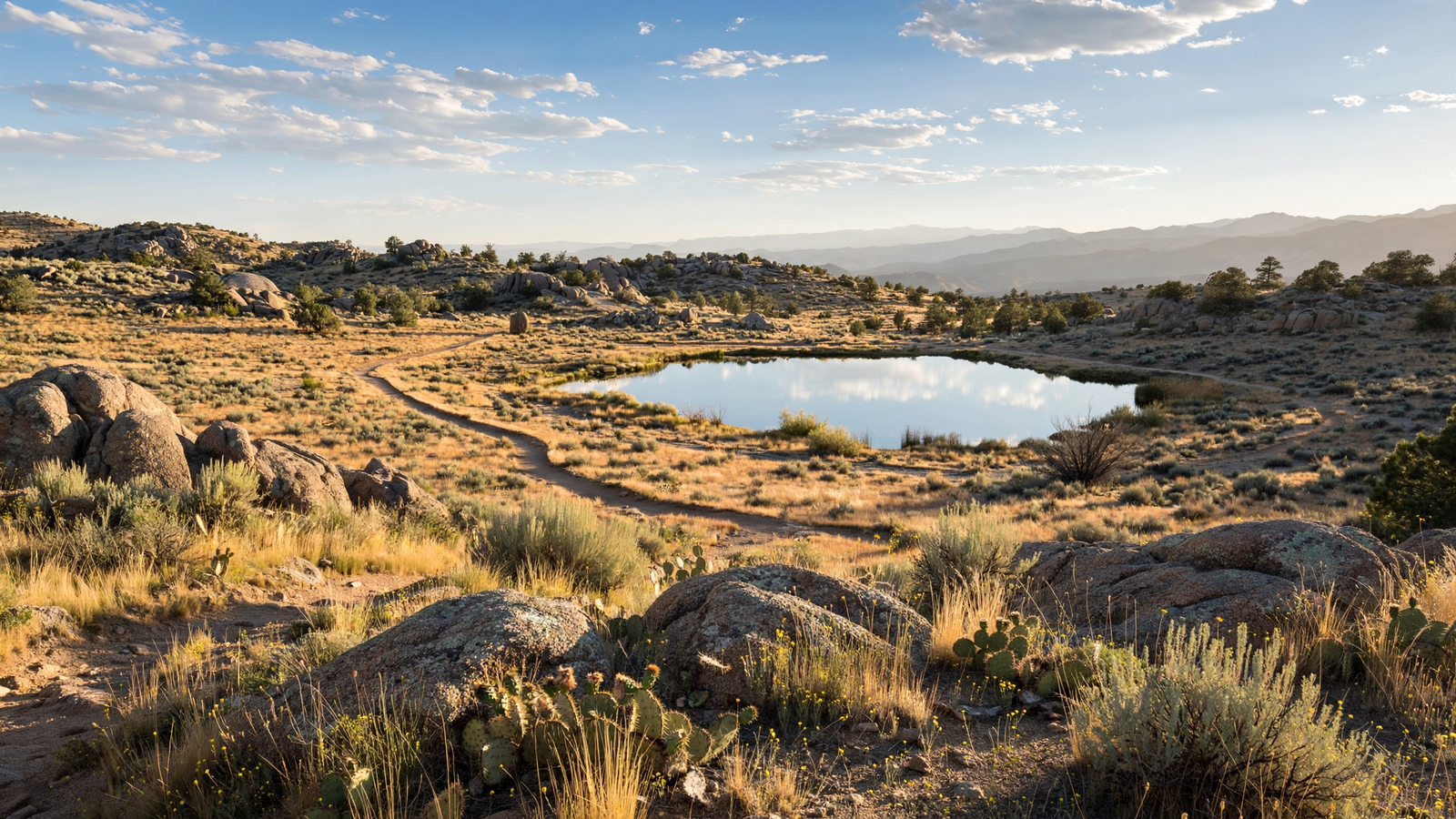
On the northeast side of Prescott, the landscape changes in a way that is easy to miss if the city is treated only as a historic downtown and a gateway to the forest. Roads and homes spread across the high desert, but so do long views, patches of juniper and scrub, seasonal drainage channels, ponds, and trails that follow the shape of the land.
This is Prescott Lakes, a planned community whose most interesting feature is not a building. It is the amount of open country woven through and around the development.
Prescott Lakes is not an untouched wilderness, and it should not be confused with public land. It is a private community with its own rules, amenities, and trail system. Yet its network of preserved open space offers a useful look at a question facing many mountain towns: how can a place grow without turning every remaining view, wash, and hillside into another construction site?
A different kind of Prescott landscape
Prescott is often pictured through its most recognizable settings: the courthouse square, historic neighborhoods, ponderosa pine forests, granite formations, and reservoirs. Prescott Lakes belongs to a newer chapter. It was planned as a large residential community on land that had previously been associated with ranching and open high-desert terrain.
The result is a landscape of contrasts. Streets lead to houses, but the built areas are interrupted by broad undeveloped spaces. Golf-course greens sit near native vegetation. Constructed ponds reflect the surrounding hills. Trails pass through terrain that can feel more like the edge of town than the center of a subdivision.
That mixture matters because open space is not simply empty land. In an arid environment, it can carry stormwater, provide habitat, protect sightlines, and give residents and visitors a sense of the region’s underlying character. Even when a landscape has been shaped by roads, drainage work, landscaping, and recreation, pieces of the original high-desert pattern can remain visible.
Trails that follow the shape of the ground
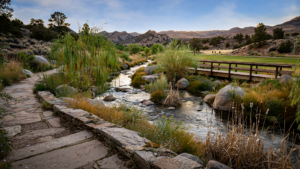
Prescott Lakes’ trail system is one of the clearest ways to experience that pattern. The paths connect residential areas with open-space corridors and higher ground, giving walkers a changing sequence of views rather than a single destination.
On one stretch, the trail may feel suburban, bordered by homes and maintained landscaping. Farther along, the same route can open toward rocky slopes, chaparral, juniper, and distant mountains. The experience is less about conquering a famous summit than about watching a town dissolve gradually into its setting.
That gradual transition is valuable for everyday recreation. A trail does not need to be remote to provide a meaningful encounter with nature. A short walk before work, an evening loop, or a family outing can make the surrounding environment part of ordinary life. In a region where summer heat, winter snow, and sudden weather shifts shape outdoor activity, nearby access can matter as much as spectacular scenery.
Trail conditions and access can vary by route. Some paths are associated with the private community, while nearby connections may involve public roads or regional trail systems. Visitors should check current rules, parking information, closures, and permitted uses before setting out. The important point is not that every part of Prescott Lakes is open to everyone, but that the community’s design places walking and open space near the center of its identity.
Water in a dry country
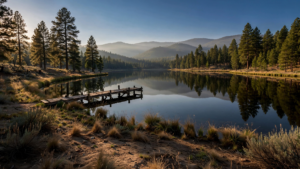
Water gives the Prescott Lakes landscape another layer of interest. Ponds and managed water features are visible reminders that this is a carefully engineered environment, not a naturally occurring lake district. They contribute to the community’s recreation and appearance, while the surrounding drainage features help move water through the developed landscape.
In Prescott’s high-desert climate, every water feature raises larger questions. Where does the water come from? How is it managed? What happens during monsoon storms or winter runoff? How can a community maintain attractive public-facing spaces without losing sight of long-term water limits?
The presence of ponds does not mean the region has abundant water. If anything, it makes the challenge more visible. Prescott and the surrounding communities have spent decades dealing with growth, groundwater pressure, conservation, and the need to match development with a limited supply. A responsible reading of Prescott Lakes is therefore not that development has solved the water problem, but that a modern community must make water infrastructure part of its design from the beginning.
That design can also create habitat value, although managed ponds should not automatically be treated as natural wetlands. Birds and other wildlife may use water and vegetation wherever they find it, but the ecological benefits depend on how areas are planted, maintained, connected, and protected from disturbance.
Wildlife at the edge of town
The open spaces around Prescott Lakes form part of a broader mosaic of habitat across the Prescott region. Birds, rabbits, lizards, mule deer, and other high-desert species can move through a landscape even when it is bordered by houses. The quality of that movement depends on connected corridors, quiet places, native vegetation, and the availability of water.
For people, this can make a neighborhood feel unexpectedly alive. A morning walk may include ravens crossing the sky, quail moving through brush, or a hawk circling above a ridge. Those encounters are not proof that a development has replaced a wild landscape. They are reminders that wildlife often persists in the margins humans leave behind—and that the way those margins are designed can make a difference.
Residents and visitors can help by keeping dogs under control, staying on designated paths, avoiding nesting or denning areas, and resisting the temptation to feed wildlife. In dry country, even small disturbances can have outsized effects, particularly near water.
Why planned open space matters
Prescott Lakes offers a useful case study because it complicates the usual argument about development. A growing community is not automatically environmentally gentle simply because it includes trails or landscaped open areas. At the same time, development is not always a total loss of landscape. The outcome depends on what is protected, how it connects, who can use it, and whether it remains meaningful as the surrounding town expands.
Open space inside a development can provide several public benefits. It can preserve views toward the Bradshaw Mountains and other regional landmarks. It can reduce the visual and physical sense of continuous construction. It can create routes for walking that do not require a trip to a distant trailhead. It can also keep fragments of native terrain present in the daily lives of people who may not have time for a full day in the national forest.
But those benefits are strongest when open land is treated as more than decoration. A few isolated lawns do not function like connected habitat. A trail that ends at a private gate does not offer the same public value as a route with dependable access. A pond maintained only for appearance may contribute less ecologically than a carefully managed drainage corridor planted with regionally appropriate vegetation.
Those distinctions are part of what makes Prescott Lakes worth noticing. Its open spaces invite a closer look at how communities measure success. Is the goal simply to add homes and amenities, or can a development also preserve pieces of the place that made the land desirable in the first place?
A quieter way to understand Prescott
Prescott Lakes is not the city’s oldest place, its wildest place, or its most famous place. Its value lies in what it reveals about contemporary Prescott. The community shows a mountain town negotiating growth while trying to keep open ground, recreation, and regional identity within reach.
For a visitor, the experience is best approached without treating it as a substitute for Prescott’s public trails, lakes, or national forest. Instead, it is a quieter complement: a place to notice how the high desert survives inside a built environment. The broad views, rocky edges, managed water, and everyday footpaths all tell the same story from different angles.
Prescott’s future will not be decided only in historic buildings or on remote forest roads. It will also be shaped in places like this, where houses meet washes, trails meet streets, and the remaining open land has to carry several responsibilities at once. Prescott Lakes suggests that growth can leave room for a recognizable landscape—but only when open space is planned, connected, maintained, and valued as part of the community rather than as leftover ground.