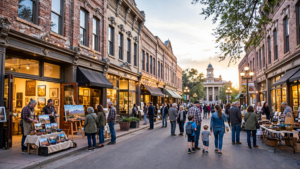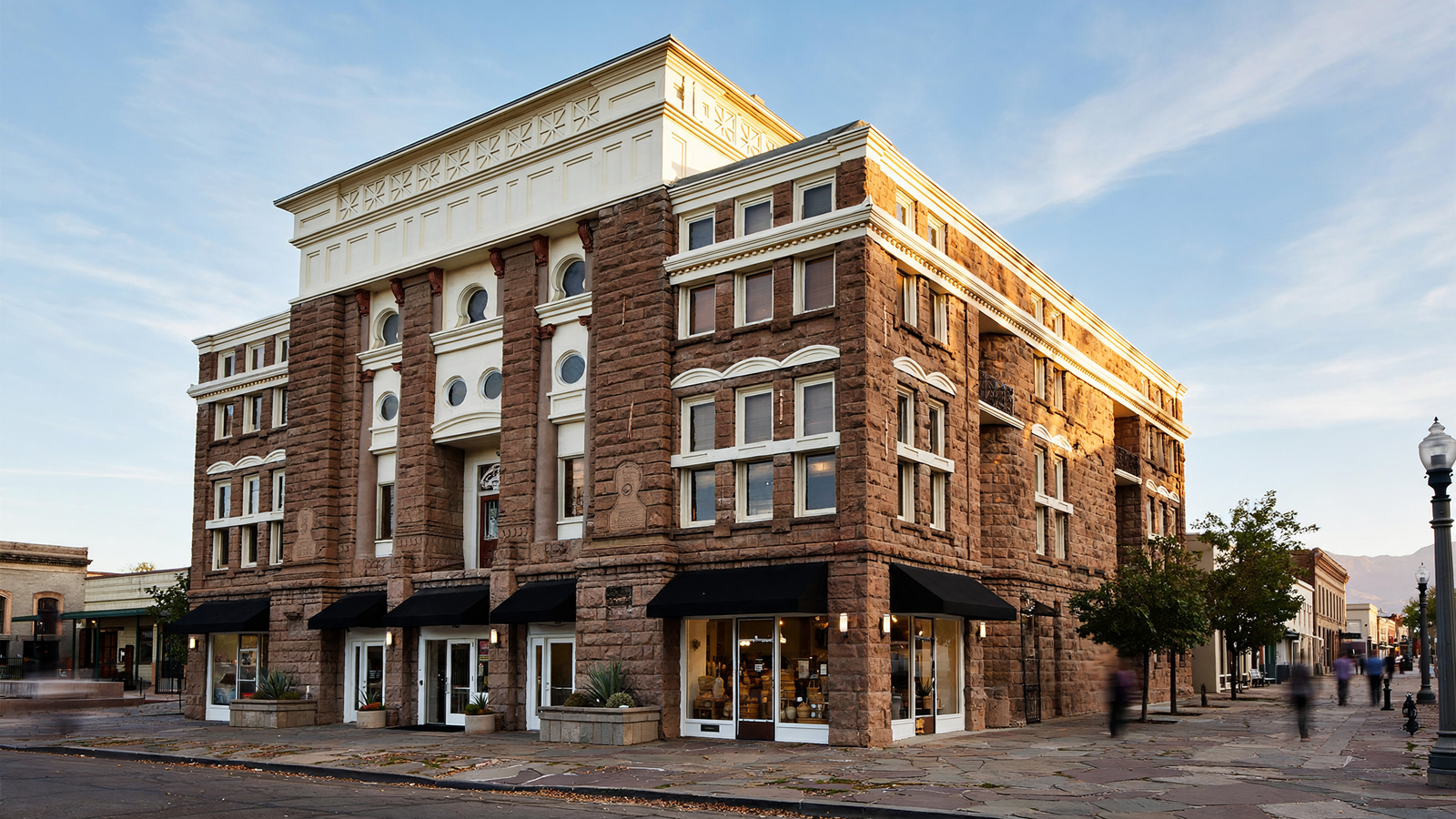
Prescott’s downtown is easy to recognize by its most famous spaces: the courthouse square, the storefronts along Whiskey Row, the broad sidewalks, and the mountains that appear at the end of so many streets. But some of the city’s character is held by quieter places—buildings that do not announce themselves as landmarks yet continue to shape how people move, shop, meet, and remember the center of town.
Bashford Courts is one of those places.
Set within Prescott’s historic commercial district, the complex is a reminder that preservation is not only about keeping an old façade intact. It is also about finding ways for a historic building to keep working. Stores change. Businesses come and go. Interior spaces are updated. The building’s role evolves with the city around it. What remains important is that the place continues to welcome everyday activity.
That makes Bashford Courts a useful way to understand Prescott’s downtown today: not as a museum district, but as a historic neighborhood that still has to function.
A commercial place with more than one life
Prescott’s central business district grew from the practical needs of an early territorial town. Businesses clustered around the courthouse and the principal streets because proximity mattered. Hotels, offices, shops, restaurants, and public institutions depended on one another. Downtown was a marketplace, a transportation hub, and a social meeting ground at the same time.
Buildings such as Bashford Courts belong to that larger commercial story. Their value is not limited to a single architectural detail or one famous occupant. They show how a town’s economic center can be built up over several generations, with later uses layered over earlier ones.
That layering is easy to overlook. A visitor may see a collection of shops and restaurants. A local resident may see a familiar shortcut, a place to meet friends, or a business that has become part of a weekly routine. A preservation specialist may see a contributing structure within a historic district. All three views can be true at once.
The building’s continued use is especially meaningful in a community where historic character is central to the local economy. Prescott welcomes visitors because its streets feel distinctive, but the downtown remains healthy only when residents also have reasons to use it. A historic commercial building that supports current businesses serves both purposes.
Why adaptive reuse matters in a small city
Historic preservation is sometimes described as a choice between protecting the past and accommodating the present. In practice, the more durable solution is usually adaptation. Buildings survive when they can accept new forms of work, retail, food service, culture, or housing without losing the features that make them recognizable.
Bashford Courts illustrates that middle ground. Its identity comes from the building itself—its location, scale, relationship to surrounding streets, and place in Prescott’s commercial history. Its usefulness comes from what happens inside it now.
That distinction matters because a building can be preserved in a technical sense and still lose its public life. An empty structure may retain historic materials, but it no longer contributes much to the daily life of a town. A working historic property has a different kind of value. It gives preservation a practical purpose.
For Prescott, that purpose is visible throughout the downtown area. Older buildings create a walkable sequence of storefronts and entrances. They make the center feel more varied than a modern commercial strip, where buildings are often set back behind parking lots and designed as separate destinations. The older pattern encourages people to move from one place to another on foot.
Bashford Courts fits into that pattern by helping keep activity concentrated in the historic center. Its presence supports the idea that downtown is not simply a backdrop for festivals or tourism photography. It is a place for errands, meals, work, browsing, and unplanned encounters.
The value of a building people use
Prescott’s historic district is often discussed through its appearance. The preserved storefronts, decorative details, and recognizable street walls are important, but appearance is only part of the story. The strongest historic places are also places people use without thinking of themselves as participating in preservation.
Someone entering a shop, meeting a friend for lunch, or walking through the district may not be focused on architectural history. That is not a weakness. It is evidence that the historic environment has become ordinary in the best possible sense. The past is present, but it does not require a formal ceremony every time someone passes through the door.
This kind of everyday use also creates a more resilient downtown economy. No single business has to carry the identity of the entire area. Instead, a collection of smaller activities creates reasons to visit at different times of day and for different purposes. A place can be attractive to a visitor while remaining useful to someone who lives nearby.
That balance is difficult. Downtown districts can become overly dependent on tourism, losing the services and businesses that make them livable. They can also lose their distinctiveness if older buildings are replaced by development that could exist anywhere. Bashford Courts represents another possibility: a historic setting that continues to accommodate changing needs.
Preservation as a current responsibility
Keeping a historic commercial property active is not effortless. Older buildings require maintenance, careful repairs, code upgrades, and decisions about accessibility and energy use. Owners and tenants must work within the limits of historic materials while meeting the expectations of contemporary customers.
Those challenges are part of the current preservation conversation in Prescott. The city’s historic districts depend on private buildings as much as public landmarks. Regulations and design guidelines can help protect the character of a district, but the long-term success of preservation depends on whether the buildings remain useful and economically viable.
That is why individual properties matter. A downtown’s character is not created by one landmark alone. It comes from the cumulative effect of many buildings, streets, signs, windows, entrances, and public spaces. Remove enough of those pieces, and the experience changes even if a few celebrated landmarks remain.
Bashford Courts contributes to that larger continuity. It helps connect Prescott’s earlier commercial life with the present without pretending that the town has stopped changing. Its story is not simply that an old building survived. It is that the building still has a role.
A different way to experience Prescott
For visitors, Bashford Courts offers a reason to look beyond Prescott’s most photographed locations. The city’s historic center is best understood at walking speed. Details emerge gradually: the relationship between a storefront and the sidewalk, the way a newer business occupies an older room, or the contrast between a preserved building and a contemporary sign.
That slower attention reveals how much of Prescott’s appeal comes from its mixture of time periods. The town is neither entirely old nor entirely new. It is a working community whose historic center has accumulated layers rather than replacing them all at once.
For residents, the building represents something even more important: continuity without stagnation. A familiar place can remain part of daily life while serving different people and different purposes over time. That is one of the quiet successes of adaptive reuse.
Prescott does not need every historic building to remain unchanged. It needs enough of them to remain recognizable, connected, and useful. Bashford Courts shows what that can look like on the ground—a place where preservation is not separated from commerce, and where the past remains valuable partly because people still have reasons to enter it.
In a city known for its history, that may be the most encouraging kind of preservation: not merely saving an old place, but allowing it to keep participating in the life of the town.