Some of Prescott’s most important places are not destinations that require a special plan. They are the places people pass through on an ordinary afternoon, the ones that can accommodate several kinds of day at once.
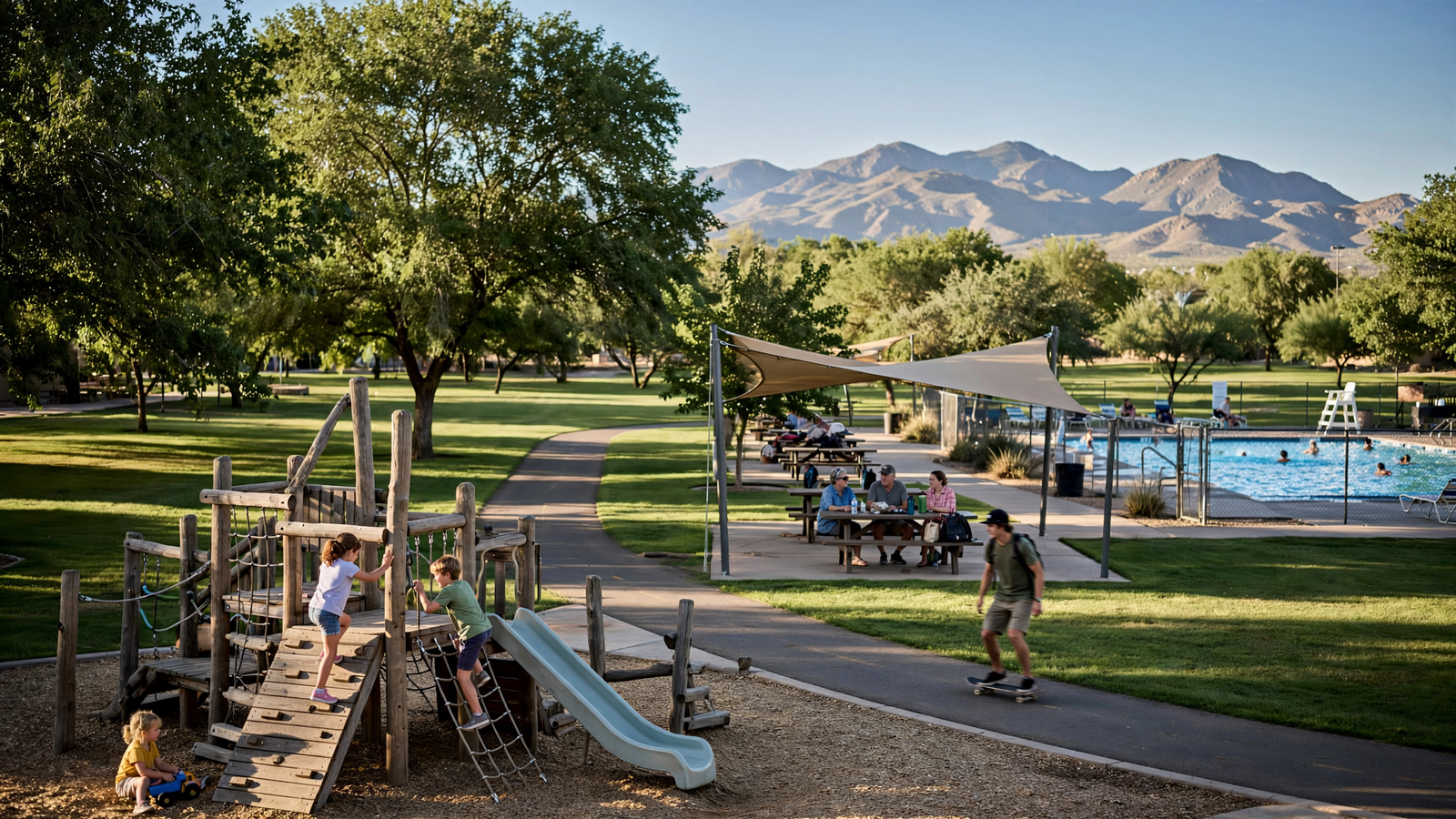
Ken Lindley Park is one of those places. Close to downtown on East Gurley Street, the city park gathers a public swimming facility, a skatepark, courts, open lawn, picnic areas, and play spaces into a compact civic landscape. A child can arrive for the playground and stay to watch skateboarders. A teenager can meet friends at the courts. A family can use the pool, find shade, and leave without having turned the visit into a major outing.
That mixture is what makes the park worth noticing now. It is not simply a green patch beside a road, and it is not defined by one signature attraction. Its character comes from the way different forms of recreation overlap. Ken Lindley Park shows how an urban park can be useful not because it offers one spectacular experience, but because it leaves room for many ordinary ones.
A park with more than one center
The City of Prescott identifies Ken Lindley Park as a multi-use community park. Its facilities include the Prescott Aquatic Center, a skatepark, tennis courts, basketball facilities, a playground, picnic areas, and fields or open spaces used for recreation. Those elements give the park several centers of activity rather than a single front door.
That matters in a mountain city where public life is often organized around individual destinations: a trailhead, a lake, a historic building, or a downtown event. Ken Lindley Park works differently. Visitors do not all have to want the same thing. One person can be exercising while another is sitting beneath a tree. A group can reserve or use a court while younger visitors move toward the playground. The park’s usefulness depends on that coexistence.
It also gives the place a distinctly local rhythm. The park is close enough to downtown to be part of a walk through Prescott, yet its facilities encourage people to remain for a while. It can function as a beginning point, a stop between errands, or the entire purpose of an afternoon.
Water, wheels, and open space
The Prescott Aquatic Center gives Ken Lindley Park an activity that many outdoor public spaces cannot provide: a reason to visit during the hottest part of the day and a place where swimming is the main event. The center offers aquatic programming and public-use opportunities through the city’s parks and recreation system. Its presence broadens the park’s audience beyond people looking for grass, courts, or playground equipment.
Nearby, the skatepark adds a different kind of movement. Skateboarding is not organized around lanes in the same way as a lap pool or tennis court. It is built around repetition, balance, experimentation, and watching other people develop skill. A skatepark can be a destination for experienced riders, but it can also be a public stage where beginners learn by observing.
These two facilities represent contrasting ideas about recreation. The aquatic center is structured around water, schedules, safety rules, and instruction. The skatepark is more open-ended and self-directed. Together, they help explain why a park with varied facilities can serve a wider public than one designed around a single activity.
The courts and playground add still more layers. Courts make room for games with clear boundaries and shared rules. A playground supports imaginative, less predictable movement. Open lawn and picnic spaces provide the least programmed part of the park—the part where people can sit, talk, eat, wait, or decide what to do next.
The value of an everyday public place
Public parks are sometimes judged by their most visible features: the size of a field, the novelty of a playground, or the number of amenities listed on a city webpage. But a park’s deeper value often appears in less measurable ways.
Ken Lindley Park reduces the need to choose between different kinds of recreation. A household with children of different ages can find more than one suitable activity. Friends with different interests can share a destination without sharing the same schedule. Someone who does not want to participate in a sport can still belong in the space as a spectator, walker, parent, or neighbor.
That kind of flexibility is especially important in a community where public life includes residents, seasonal visitors, students, working families, and older adults. A park does not have to look the same to everyone. Its success can be the fact that it supports many small routines at the same time.
There is also a social benefit to placing varied facilities together. People encounter activities they did not come to see. A visitor using the pool may notice the skatepark. A person arriving for tennis may cross paths with families using the playground. These casual overlaps create a form of public familiarity. They are not programmed community events, but they help a city feel shared.
Why location changes the experience
Ken Lindley Park’s location near central Prescott gives it a different role from a park reached mainly by car at the edge of town. Its relationship to downtown means the park can be folded into a larger day. A visit can connect with shopping, a meal, a library stop, or a walk through the historic center.
That proximity also makes the park part of the city’s visible civic landscape. It is not hidden behind a long drive or separated from daily life by a large complex of roads. The park sits where recreation and ordinary urban movement meet.
For visitors, that makes it an accessible way to experience Prescott beyond its most photographed places. The city is widely associated with courthouse events, historic buildings, forested trails, and western heritage. Ken Lindley Park offers a more contemporary picture: residents gathering for sports, lessons, play, exercise, and time outside.
For residents, the location supports the kind of spontaneous use that planned outings often lack. A park near the center of town can become part of a routine precisely because it does not require a full-day commitment.
A place that changes with the calendar
The park’s identity shifts through the year. Aquatic activities and outdoor play take on a different importance in summer. Cooler months may make courts, walking, and open areas more appealing than swimming. School schedules, sports seasons, lessons, and weekend habits all change the mix of people using the site.
This seasonal variety is one reason a multi-use park can remain relevant. A single-purpose facility may be busy during its season and quiet outside it. A park with several forms of activity has more opportunities to stay useful. Even when one facility is not being used, another part of the landscape can continue to draw people.
Prescott’s high-country setting adds another dimension. Outdoor recreation is central to the region’s identity, but not everyone can or wants to spend every outing on a long trail or at a remote recreation area. Ken Lindley Park provides a lower-barrier version of being outside. It brings movement, shade, social life, and play into the middle of town.
What the park says about Prescott
A city’s character is visible in the places it preserves for activities that do not have to produce anything. Parks do not exist only to attract visitors or host major events. They provide room for practice, rest, conversation, and repetition—the ordinary uses that make a place feel lived in.
Ken Lindley Park is valuable because it accepts that public recreation comes in many forms. The competitive athlete and the casual player can occupy the same broad setting. The swimmer, skater, spectator, walker, and picnic-goer do not need identical goals. The park can hold all of them without turning every visit into a formal program.
That is a modest achievement, but it is also a meaningful one. In a growing and changing community, accessible shared places help preserve the possibility of unplanned contact. They give people somewhere to go without needing to buy a ticket, join a club, or travel far from the center of town.
Ken Lindley Park may never be the only reason someone comes to Prescott. Its importance is more durable than that. It is the place people can add to a day, return to through different seasons, and use in ways that do not need to be announced. In that sense, the park is not just a collection of facilities. It is one of the city’s everyday rooms—open, varied, and continually being redefined by the people who use it.
Planning a visit
Because the park contains facilities with different operating schedules, visitors should check the City of Prescott’s current parks and recreation pages before going. Aquatic-center hours, programs, reservations, and seasonal access can change. The city’s official information also provides the best guidance on rules, parking, and facility availability.