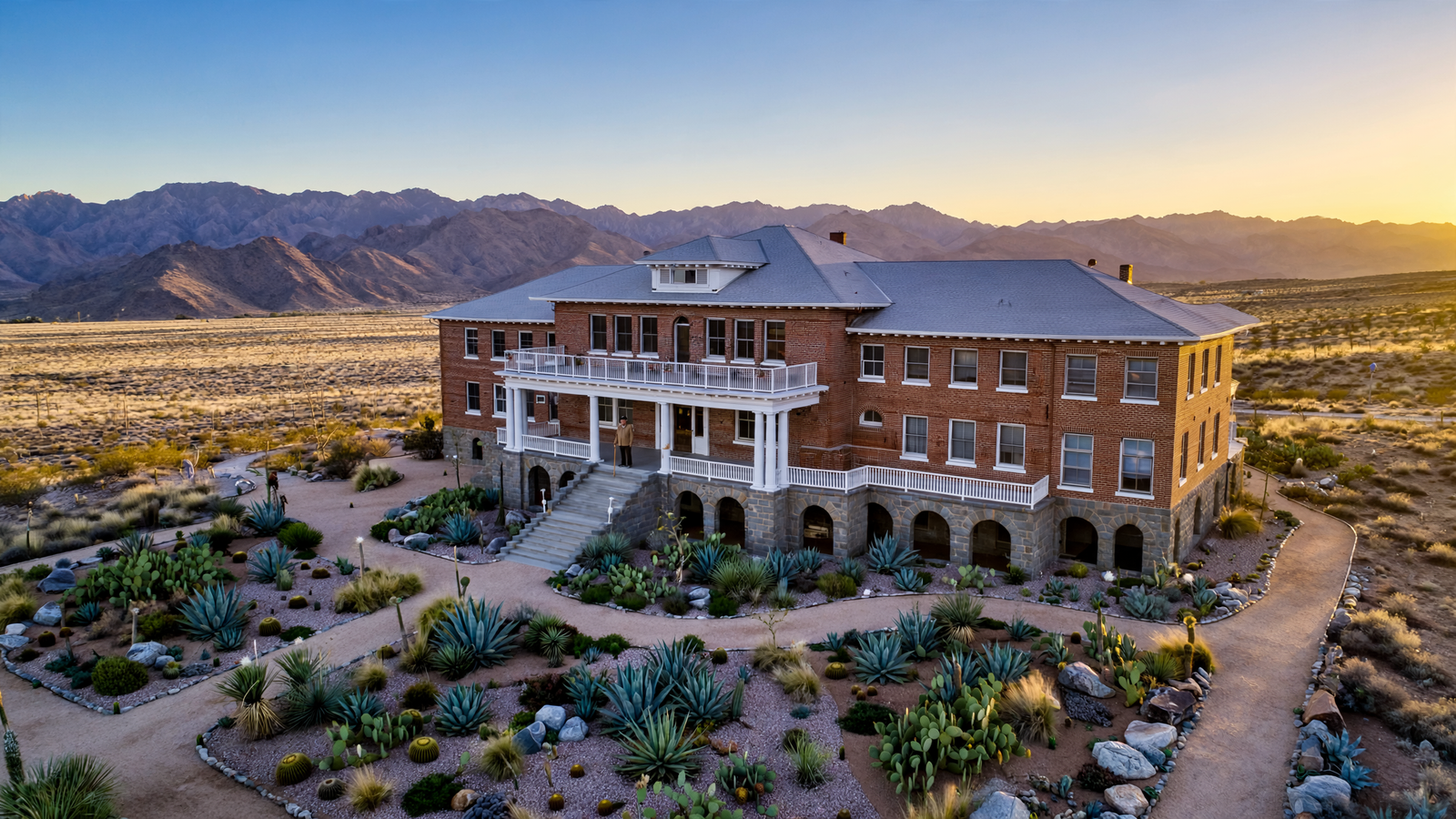
On a hillside south of downtown Prescott, a long-running Arizona institution has preserved history in an unusually human way. The Arizona Pioneers’ Home is not a museum, monument, or restored frontier building. It is a working residence—a place where generations of older Arizonans have lived, received care, and remained part of the community.
That combination makes the home one of Prescott’s most distinctive places. Its story is about Arizona’s early settlers, miners, ranchers, business owners, teachers, and public servants. But it is also about a practical question that followed the territory from the nineteenth century into statehood: What responsibility does a young place have to the people who built it?
A home for the people who made a territory
When Arizona was still a territory, many of its communities were remote, small, and economically uncertain. People who arrived during the territory’s formative decades could spend their working lives helping establish towns, mines, farms, roads, schools, and local governments. By old age, however, some had little family support or financial security.
Arizona’s answer was unusual for its time. Rather than leaving the needs of elderly pioneers entirely to private charity, the territory moved toward creating a public home. The institution opened in Prescott in the early twentieth century, just before Arizona entered the Union, and became part of the new state’s public responsibilities.
The home’s origins are tied to the state’s territorial-era identity. Prescott had served as Arizona’s first territorial capital and remained one of the region’s most important early communities. Its location in the central highlands also made it a natural setting for an institution connected to the territory’s early residents.
Today, the Arizona Pioneers’ Home is operated by the State of Arizona. Its purpose has expanded beyond a narrow definition of “pioneer,” but its historic mission remains visible: to provide residential care and support for eligible older Arizonans, including people whose lives are connected to the state’s early development.
Why Prescott became the setting
Prescott’s importance to the home is more than geographic. The city still carries the physical and cultural traces of Arizona’s territorial period. Its courthouse plaza, historic commercial streets, surrounding mining landscapes, and nearby forest roads all help explain why the town became an early center of government and commerce.
For residents of the Pioneers’ Home, that setting can make the past feel less abstract. The landscape around Prescott is part of the same broad world in which many early Arizonans worked and traveled. The mountains and high-desert climate are not merely scenery; they are part of the regional history that brought people to the area.
The city also offers something that a remote commemorative site could not: ordinary community life. A residential institution works best when its occupants are not isolated from the town around them. Prescott’s public events, historic attractions, civic organizations, and visitor activity help keep the home connected to the life of the city.
From pioneer shelter to continuing care
The word “home” matters. The institution was not created simply to display the people associated with Arizona’s past. It was designed as a place to live.
That distinction helps explain why the Pioneers’ Home has endured. Its significance is not limited to the age of its buildings or the stories attached to its residents. The institution has continued by adapting to changing ideas about aging, health care, and public service.
Residential care today involves far more than providing a bed and meals. Older adults may need help with daily activities, medication, mobility, health monitoring, and social connection. A state-supported home can bring those services together while also offering the stability of a familiar community.
The home’s current role therefore sits at the intersection of history and public care. It honors the state’s early residents, but it is also part of Arizona’s broader system for supporting older adults. Its historical identity gives the place meaning; its continuing operations give that meaning practical value.
The people behind the phrase “Arizona pioneer”
“Pioneer” can sound like a single character from a Western story: a prospector on horseback, a homesteader crossing open country, or a town founder standing beside a rough wooden storefront. The real population connected to Arizona’s early growth was more varied.
Women played essential roles in territorial households, schools, businesses, hospitals, and community organizations. Indigenous people had lived in the region for centuries before American territorial institutions appeared. Mexican and Mexican American communities shaped the borderlands economy and culture. Chinese immigrants, Black residents, European immigrants, railroad workers, soldiers, laborers, and entrepreneurs all contributed to the complicated history of the Southwest.
A place like the Pioneers’ Home is valuable partly because it can move the idea of a pioneer away from a purely heroic legend and toward lived experience. The people who made early Arizona were not only symbols of courage or hardship. They were neighbors, parents, workers, voters, caregivers, and community members who grew old.
That human scale is one of the institution’s strongest connections to public history. Instead of presenting the past as something finished, the home shows that historical change happened to real people—and that those people continued to have needs, relationships, and stories long after the moment of settlement had passed.
A place where history remains active
Many historic places preserve the past by keeping rooms unchanged. The Arizona Pioneers’ Home preserves it in a different way: by remaining in use.
Its ongoing operation creates a living link between Arizona’s early decades and the present. The residents are not actors reenacting history, and the home is not a themed attraction. It is a real community whose history is carried through personal memories, family connections, photographs, documents, and everyday routines.
That living quality also makes the institution a reminder that public history is not only about buildings. It is about the choices communities make regarding whose experiences deserve care and remembrance. A state can celebrate its pioneers in statues and commemorative plaques. It can also provide a place where older people are treated as members of the civic story rather than as people who have been left behind by it.
In Prescott, those two impulses meet. The city’s historic character draws attention to Arizona’s past, while the Pioneers’ Home gives that past a continuing social purpose.
Why the home still matters
The Arizona Pioneers’ Home does not tell the entire history of Arizona, and it should not be expected to. No single institution can represent every community, culture, or experience that shaped the state. But it does preserve an important question: how should a society care for the people who helped create it?
More than a century after the home opened, the question remains current. Arizona is still growing, and its population is still changing. New residents are building the next version of the state while earlier generations age in place. The challenge is to treat those generations not as separate worlds, but as part of one continuing civic landscape.
That is what makes the Pioneers’ Home a meaningful Prescott place. Its importance is not only that it is old. It is that it has continued to serve a public purpose while carrying the memory of an earlier Arizona forward.
In a state often associated with rapid development and dramatic change, the home offers a quieter kind of continuity. It says that building the future does not require abandoning the people who built the past. Sometimes the most enduring monument is a place that keeps making room for them.