Long before the modern auto show filled its floors with electric supercars, autonomous shuttles, and impossible-looking prototypes, one American car quietly changed the way the automobile could imagine its own future.
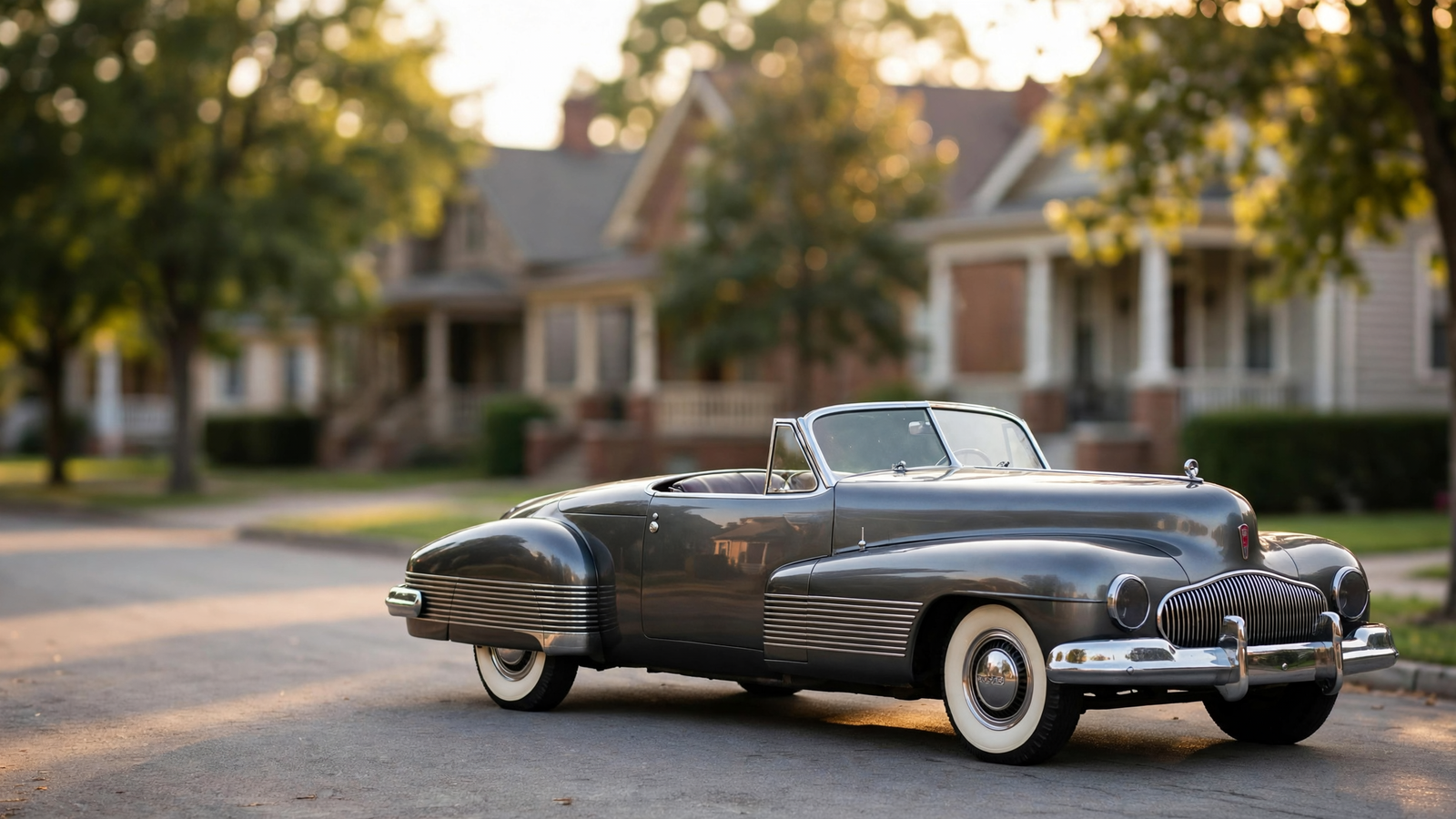
It was called the Buick Y-Job. Built in 1938 under the direction of General Motors designer Harley Earl, it looked like a large Buick but behaved like something more unusual: part engineering experiment, part styling exercise, and part personal transportation. It was not intended for mass production. It was created to test ideas in the real world—and to show that a car could be a laboratory for design as much as a machine for getting somewhere.
The Y-Job is widely recognized as the first modern concept car. Its importance was not simply that it had unusual features. The deeper change was cultural. Detroit had begun treating the future not as a distant technical problem, but as something that could be presented, discussed, and eventually sold through the language of style.
A new kind of automobile experiment
In the 1930s, American automakers already used prototypes and engineering test vehicles. But those cars generally existed behind the scenes. They helped companies evaluate engines, suspensions, bodies, and manufacturing methods before a production model reached customers.
The Y-Job brought a different attitude to the work. Earl, GM’s influential head of styling, wanted a car that could demonstrate where automotive design might go next. Instead of building a conventional prototype and hiding it from public view, Buick created a finished, drivable automobile with a carefully considered visual identity.
The name itself was a piece of industry shorthand. Experimental aircraft were sometimes given an “X” designation, and Earl reportedly chose “Y” for his automobile because the letter followed that familiar pattern. Whatever the exact inspiration, the name helped separate the car from ordinary Buick model names and signaled that it belonged to a different category.
The project also reflected a major shift inside the automobile business. Mechanical engineering remained essential, but styling was becoming a competitive force. As cars grew more reliable and more manufacturers offered similar basic transportation, shape, proportion, trim, and visual distinction became increasingly important. The Y-Job gave styling a rolling platform.
What made the Y-Job look new
The car’s design was not futuristic in the science-fiction sense. It still had a long hood, a passenger compartment, four wheels, and the broad presence associated with a prestigious American automobile. Its innovation came through restraint and integration.
Many of its features now seem familiar because later cars adopted related ideas. The Y-Job used concealed headlights, allowing the front end to appear smoother when the lamps were not in use. Its bumpers were integrated into the overall body rather than treated as separate pieces. The grille was lower and wider than the upright faces common on many cars of the period. The body sides were clean, with fewer prominent running boards and less visual clutter.
A wraparound windshield helped create a more continuous glasshouse. The car also included powered windows and a powered convertible top—features that were not ordinary equipment on most American cars of the late 1930s. Its body was low and carefully proportioned, communicating speed without depending on excessive ornament.
None of these ideas existed in isolation. Designers and engineers had explored variations of hidden lamps, streamlined bodies, powered accessories, and curved glass before. The Y-Job’s achievement was to assemble such ideas into a coherent, usable vehicle. It showed what happened when experimental details were treated as parts of one design rather than as disconnected novelties.
Harley Earl’s car in everyday life
The Y-Job was not merely rolled onto a turntable and forgotten. Earl used it as a personal car for years, giving the experiment a life outside the studio. That mattered because a design that looks persuasive in a sketch or exhibition hall can behave differently on ordinary roads.
Driving the car allowed Earl and GM’s design staff to see how its proportions worked in traffic, how its controls functioned, and how people reacted to it in daily settings. The Y-Job could be examined not only as a piece of styling, but as a complete automobile.
That distinction helped establish an important principle of concept-car culture: the best design studies do more than attract attention. They create a conversation between possibility and practicality. Some features can move directly into production. Others may need to be modified, delayed, or abandoned. The concept car becomes a way to test public response before a company commits to tooling and mass manufacture.
The Y-Job also demonstrated that an experimental car did not have to sacrifice dignity for novelty. It was not an awkward collection of gadgets. It retained the proportions and presence expected of a premium American automobile while making room for unfamiliar solutions.
From private experiment to industry tradition
After the Y-Job, concept cars became an increasingly visible part of the American automotive landscape. Automakers began creating dream cars for exhibitions, dealer events, magazine coverage, and major auto shows. Some proposed technical breakthroughs. Others explored radical body shapes or imagined new kinds of personal transportation.
Not every concept was intended to predict a production model. In many cases, the purpose was to learn what captured attention. A company could introduce an unusual roofline, a different arrangement of glass, or a new approach to interior space and observe how the public responded.
This gave the automobile industry a new form of research. Instead of relying only on surveys, sales numbers, and engineering tests, designers could place a physical argument in front of people. The public could walk around it, sit inside it, photograph it, and decide whether the future looked inviting or absurd.
The practice eventually became central to auto-show culture. The dazzling prototypes of the 1950s, the experimental safety cars of the 1960s and 1970s, and the technology demonstrations of later decades all inherited something from the Y-Job: the idea that a car could be both a vehicle and a question.
The lasting influence of a one-off Buick
The Y-Job did not launch a new Buick model line, and it did not put every one of its features into showrooms. Its influence was less direct and more important. It helped establish styling as a form of product development with its own tools, language, and public role.
In the decades that followed, American cars became increasingly shaped by planned annual changes, recognizable design themes, and the promise of something newer just ahead. The concept car fit perfectly into that environment. It allowed automakers to make tomorrow visible before tomorrow was ready for production.
Some of the Y-Job’s details eventually became common. Hidden headlights appeared on many later cars. Power accessories spread as consumers came to expect greater convenience. Smoother body forms and more integrated bumpers gradually replaced much of the separate, upright hardware associated with earlier automobiles.
But the most enduring legacy was not any single component. It was the permission to experiment in public.
Today’s concept cars may preview electrification, advanced driver assistance, alternative interiors, or entirely new ideas about ownership. Their technology is far removed from the Y-Job’s mechanical world, but their basic purpose remains recognizable. They let a manufacturer ask what people might want before the market has fully learned how to ask for it.
The Buick Y-Job stands at the beginning of that tradition because it made experimentation feel complete. It was not a drawing, a clay model, or a collection of disconnected parts. It was a functioning American automobile with enough imagination to suggest that the next important feature might not be under the hood at all. It might be the shape of the future itself.