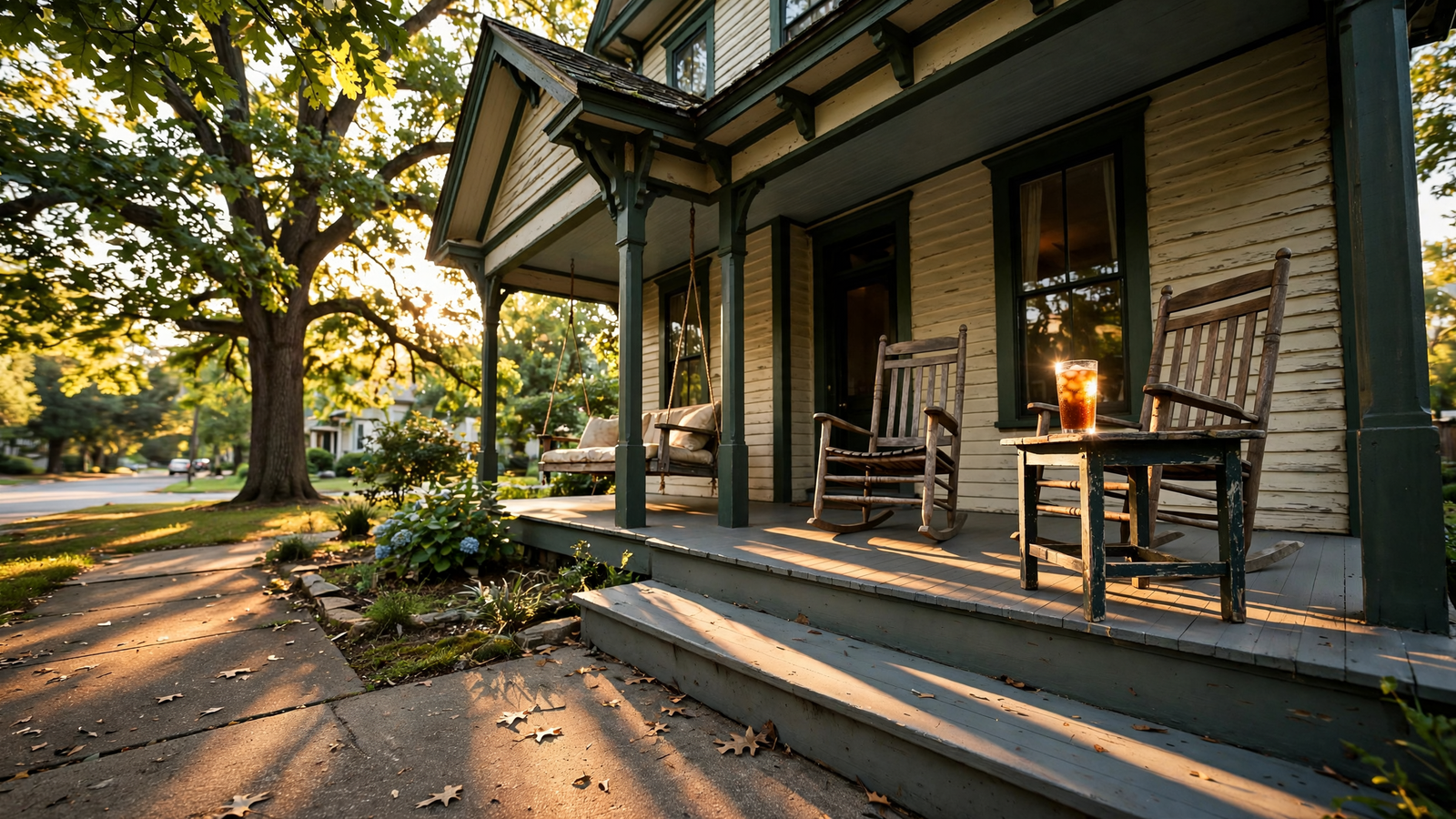
Before air-conditioning transformed summer life, a shaded porch could be one of the most comfortable rooms in an American house. It was not quite indoors and not quite outside: a place for a rocking chair, a glass of iced tea, a conversation across the railing, or a few quiet minutes watching the world pass.
That in-between quality helped make the porch one of the most recognizable features of American home life. It turned the edge of a house into usable space—and, in many communities, made the boundary between household and neighborhood feel a little less formal.
More than an entrance
Porches have deep architectural precedents around the world. In the United States, however, they became especially prominent during the 19th century, as builders adapted earlier forms such as the portico, veranda, gallery, and covered stoop to changing patterns of domestic life.
The National Park Service notes that improvements in manufacturing and transportation made architectural details easier to produce and distribute. Turned posts, decorative brackets, spindles, and patterned railings could be ordered through catalogs or supplied by local mills. A porch was therefore both functional and expressive: it provided shade and shelter while also giving a house a visible character.
Regional climate shaped the result. Deep, roofed verandas suited hot and humid areas, where outdoor airflow was valuable. In colder regions, smaller entry porches offered protection from snow and rain. In towns and cities, porches often faced sidewalks or streets, placing domestic life within view of the public realm.
A room between private and public
The porch’s importance was not only architectural. It supported a flexible kind of social life. Family members could sit outside without fully leaving home. Neighbors could stop for a brief conversation without requiring the formality of an indoor visit. Children could play nearby while adults remained within sight. The arrangement offered contact without demanding constant participation.
That openness also reflected the limits of the ideal. Not every household had a safe, comfortable, or welcoming porch, and access to pleasant residential space has always been shaped by income, race, disability, and neighborhood design. Still, the porch became a durable symbol of hospitality because it suggested that a home could have a public-facing side without surrendering its privacy.
Why the porch still feels current
Modern houses may include screened rooms, balconies, patios, and elaborate outdoor kitchens, but the basic appeal remains familiar: people want a comfortable threshold between the demands of the household and the life beyond it.
Historic-preservation guidance treats porches as important parts of a building’s design rather than disposable decoration. Their proportions, columns, railings, rooflines, and relationship to the street can tell us how a house was meant to be used. Restoring one can preserve not just an architectural detail, but a pattern of everyday life.
The American porch endures because it solves a simple human problem. It creates a place to pause. It offers shade, air, and a view. Most of all, it makes room for connection while allowing people to remain at home—a modest idea that has shaped the look and feeling of American neighborhoods for generations.