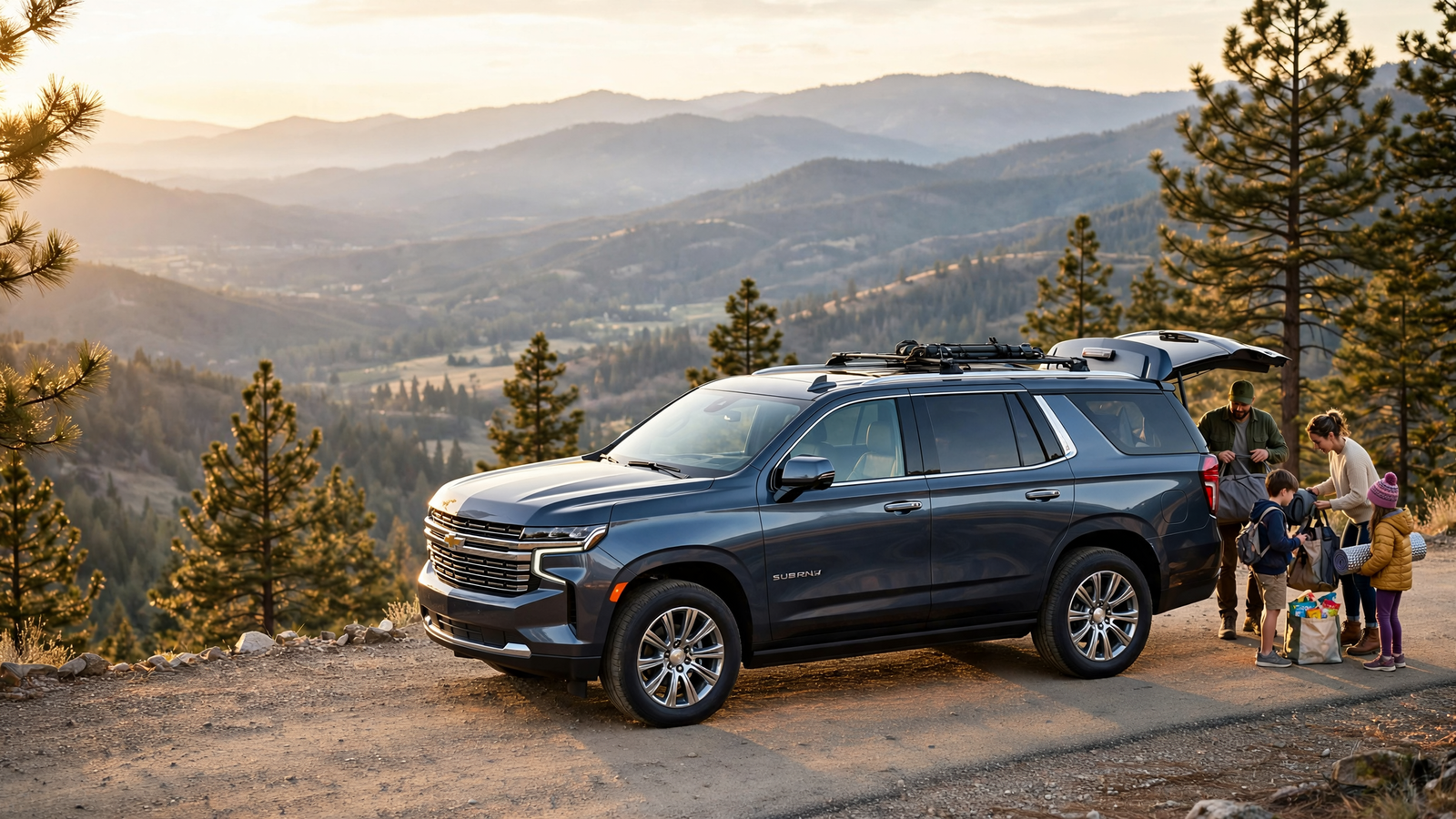
Long before the modern sport-utility vehicle became a fixture of school drop-offs, airport arrivals, and suburban driveways, Chevrolet was experimenting with a simple proposition: what if a truck could carry people as naturally as it carried cargo?
The answer arrived in 1935 as the Chevrolet Suburban Carryall. It was tall, practical, and unmistakably built from the world of commercial vehicles. Yet it also offered something that many trucks did not: a fully enclosed body with room for passengers, equipment, and the unpredictable demands of everyday life.
Ninety years later, the Suburban remains one of the longest-running nameplates in automotive history. Its importance is not simply that it survived. It is that the vehicle kept adapting as America changed—from a nation of working farms and small businesses into a country of long commutes, expanding suburbs, organized youth sports, and road trips measured in hundreds of miles.
A truck with a different kind of usefulness
In the 1930s, the automobile market was still divided more clearly than it is today. Cars were designed primarily for passengers. Trucks were designed primarily for work. Commercial vehicles often used open beds or bare chassis that could be fitted with specialized bodies.
The first Suburban occupied the space between those categories. Chevrolet based it on a light-truck chassis, but gave it a steel body that could carry a large group of passengers in a protected cabin. Depending on configuration, it could seat as many as eight people. Its shape was not intended to be glamorous. The point was access, durability, and flexibility.
That combination made sense in a country where a single vehicle might serve several purposes in the same week. A business owner could use it to move workers and supplies. A rural family could take it into town. A utility company or public agency could adapt it to a specialized job. The Suburban did not ask its owner to choose between passenger space and truck-like capability.
That was the beginning of a formula that would eventually define the SUV: a raised driving position, enclosed passenger room, substantial cargo capacity, and the ability to operate beyond the limits of an ordinary sedan.
From commercial equipment to everyday transportation
The early Suburban was a product of its time. Its construction was straightforward, and its styling followed the practical forms of prewar trucks. But the basic idea proved durable enough to survive changing body designs, new engines, improved roads, and shifting expectations about comfort.
After the Second World War, American families increasingly traveled by car for work, recreation, and holidays. The growing highway system made longer journeys easier, while postwar prosperity expanded the market for vehicles that could carry more than a conventional sedan. Chevrolet continued to refine the Suburban, making it more comfortable without abandoning its underlying utility.
The vehicle’s appeal was especially clear for people whose lives did not fit neatly into one category. A Suburban could be a contractor’s work vehicle during the week and a family hauler on the weekend. It could carry camping equipment, musical instruments, groceries, or a full load of passengers. Its usefulness was not tied to one occupation or one landscape.
That versatility also helped the Suburban become part of the public infrastructure of American life. Government agencies, emergency services, construction companies, ranches, and outdoor organizations all found roles for a large enclosed truck. The model was never only a suburban family vehicle; its name simply became closely associated with the broad middle ground between commercial transportation and private life.
The long road to the modern SUV
The Suburban was not the only vehicle to explore this territory. Station wagons brought enclosed cargo space to passenger-car buyers. Four-wheel-drive wagons and utility vehicles offered traction and ruggedness. Other manufacturers developed their own large people carriers.
But the Suburban’s continuity gave it unusual cultural weight. It kept a truck-based identity while gradually acquiring features that once belonged mainly to cars: improved seating, quieter cabins, more sophisticated suspension systems, air conditioning, safety equipment, and electronic convenience features.
By the 1970s and 1980s, the model looked increasingly familiar to modern eyes. It was large, boxy, and capable of carrying a substantial number of people. Four-wheel drive made it attractive in snow country, rural areas, and places where unpaved roads were part of daily life. At the same time, its enclosed body made it more practical for families than a pickup with an open bed.
The Suburban helped normalize the idea that one vehicle could be both a tool and a household. It did not require a family to own a separate car for vacations, a truck for projects, and a wagon for daily errands. That all-purpose character became one of the central ideas behind the SUV boom that followed.
A nameplate that kept absorbing change
One reason the Suburban story matters is that the vehicle changed without losing its central identity. The model grew larger over time, and later generations offered more seating, more cargo organization, and greater towing ability. Yet the basic promise remained recognizable: carry people and belongings in a truck-based package.
Its dimensions and fuel demands have also made the Suburban part of larger national debates about transportation, energy, safety, and urban space. That complexity is part of its history. An honest account of the vehicle cannot treat its popularity as entirely simple or universally beneficial. Large vehicles consume more material and energy than smaller ones, and their size affects the way roads and parking areas are designed.
Still, the Suburban’s endurance reveals something important about American mobility. The country is geographically large, many communities remain car-dependent, and daily schedules often combine work, family, recreation, and long-distance travel. The Suburban became a response to that reality, even as it helped reinforce it.
Its success also demonstrates how automotive design often evolves through practical compromise rather than dramatic invention. The Suburban did not begin as a futuristic concept. It was a useful answer to a basic question about carrying people and goods. Over decades, that answer became a template copied, refined, and reinterpreted across the global automobile industry.
The vehicle as a moving record of American life
Look at a Suburban across different generations and the country around it changes. Early models belong to an era of steel-bodied commercial vehicles and local roads. Postwar examples reflect the rise of family road travel. Later versions arrived during the expansion of suburbs, the growth of recreational driving, and the increasing expectation that one vehicle should be ready for nearly any occasion.
That is why the Suburban is more than a particularly large Chevrolet. It is a rolling record of how Americans have imagined convenience, independence, and preparedness. Its passengers might be farm workers, firefighters, grandparents, children headed to a tournament, or a group leaving town for a weekend outdoors. The vehicle’s meaning has always come from what people ask it to do.
The name itself has endured through changes in automotive fashion that eliminated many other models. Station wagons faded from the mainstream. Minivans rose and then lost some of their cultural status. Crossovers became the dominant family vehicle for many buyers. Through each shift, the Suburban remained tied to a particular kind of capacity: not merely carrying a family, but making room for an entire day’s possibilities.
Why the Suburban still matters
The Chevrolet Suburban did not invent the need for a versatile vehicle, and it did not single-handedly create the SUV. Its achievement was more gradual and, in some ways, more revealing. It demonstrated that a commercial vehicle could become part of ordinary domestic life without giving up its working character.
That bridge between work and family is a distinctly American theme. The same vehicle can be asked to haul lumber, tow a trailer, transport a school group, cross a mountain pass, and make a long highway journey. The Suburban made that versatility visible and dependable enough to become a tradition.
For nine decades, the model has carried more than passengers. It has carried the country’s changing expectations of what a vehicle should be: useful but comfortable, rugged but organized, personal but capable of serving a whole group. Its lasting place in automotive history comes from that rare ability to keep changing while continuing to answer the same old question—how much of life can one vehicle hold?