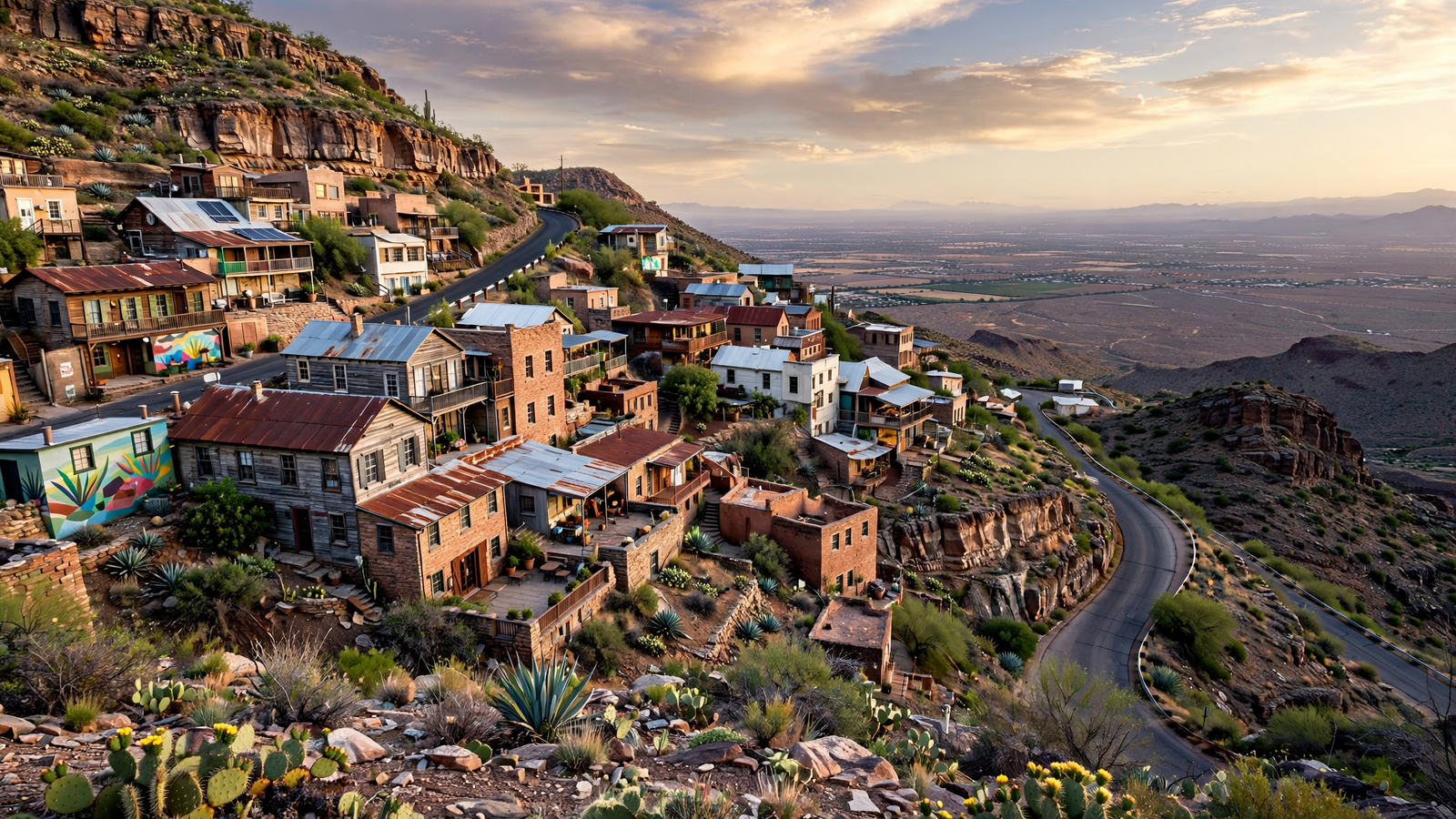
On the side of Cleopatra Hill, Jerome appears to balance between the Black Hills and the Verde Valley. Its streets climb, bend and narrow around the mountain. Old commercial buildings stand beside galleries, restaurants, homes, museums and overlooks. Below them, the broad valley opens toward Cottonwood and the red-rock country beyond.
Jerome is often introduced as a former mining town. That description is accurate, but incomplete. The town is also a useful example of how a place can change without erasing its past. Copper created Jerome, mining nearly emptied it, and preservation gave the community a way to remain more than a collection of abandoned buildings.
A town built on copper
Jerome’s story began with the discovery of copper in the Black Hills in the late 19th century. Mining activity brought workers, investors, merchants and transportation links to a difficult mountain site. The town took its name from Eugene Jerome, a New York investor associated with early development of the United Verde mine.
The ore body beneath the mountain eventually attracted William Andrews Clark, the Montana mining and political figure who acquired control of the United Verde operation in the late 1880s. Under Clark’s ownership, the mine became one of the major copper producers in the Southwest. The company built infrastructure that helped turn a rough mining camp into a substantial industrial town.
Jerome’s physical setting shaped daily life. There was little level land, so buildings were stacked along the slope and roads followed the contours of the hill. The mine, smelter and supporting businesses were closely connected to the town. Workers and their families lived near the industrial operation, while hotels, stores, boardinghouses and other services filled the commercial center.
At its height, Jerome had a population in the thousands. The town expanded rapidly during periods when copper was in demand, and it contracted when prices fell or work stopped. That dependence gave Jerome its energy, but it also made the community vulnerable to changes beyond the mountain.
Fire, movement and industrial change
Jerome’s history was not only shaped by mining. Fire repeatedly tested the town’s buildings, and a major fire in 1897 destroyed much of the early settlement. Another large fire in 1918 led to extensive rebuilding. The town’s steep terrain and limited space made every reconstruction a practical challenge.
Some of Jerome’s most memorable features also reflect the instability of the hillside. The so-called Sliding Jail was originally built near the center of town in 1912. Over time, shifting ground carried the structure downhill. The jail is now preserved as a visible reminder that Jerome was built on a working, moving mountain rather than on a conventional town grid.
Mining sustained Jerome through the early decades of the 20th century, including the years when copper was essential to American industry and wartime production. But the operation eventually became less profitable. The United Verde mine closed in 1953, ending the economic system around which the town had been organized.
The closure brought a familiar problem to former company towns: what remains when the central industry disappears? In Jerome, the answer was not immediate. Businesses closed, buildings stood vacant and many residents left. The town’s steep location, once an advantage for mining, made redevelopment difficult. For a time, Jerome seemed likely to become another abandoned settlement in the western landscape.
Preservation became a second beginning
Jerome’s recovery was gradual. Artists, preservationists and new residents began to see value in the old buildings and in the town’s unusual setting. Rather than replacing the historic core with a new development, they helped keep much of the existing town visible and usable.
The Jerome Historic District was recognized nationally for its significance, and the town became a National Historic Landmark. That designation did not freeze Jerome in one moment. Instead, it helped draw attention to the surviving streetscape: commercial buildings, residences, industrial remnants and public spaces that together show how a mining community functioned.
Preservation is especially important in Jerome because individual buildings make the most sense as part of a larger landscape. A former store is not just an old storefront. It belongs to a street that once served miners and families. A museum is not separate from the mountain below it. The mine, the smelter, the roads, the homes and the valley views all belong to the same story.
One of the clearest places to begin that story is Jerome State Historic Park. The park is housed in the Douglas Mansion, built in 1916 for the family of mining leader James S. Douglas. The mansion now contains exhibits about the United Verde mine, Jerome and the broader mining history of the region. Its displays help visitors connect the town’s surviving architecture with the industrial operation that made the community possible.
The park also offers a practical advantage for understanding Jerome: it places history in a landscape. From the grounds, visitors can see the Verde Valley and the surrounding mountains while learning about the technology, labor and investment that transformed the hill. The view is scenic, but it is also evidence. Geography explains why the town looks the way it does.
What visitors can still read in the town
Jerome works best as a place to explore slowly. Its main streets are compact, but the history is layered. A visitor can notice the difference between buildings associated with commerce, homes built for workers and managers, and structures connected to public services. The changes in elevation are part of the experience rather than an obstacle to be edited out.
The town’s museums add different perspectives. The Jerome Historical Society’s museum preserves local objects and stories, while the Mine Museum focuses on the machinery, geology and working conditions of underground mining. Together with the state park, they make it possible to move from a broad history of the town to the details of everyday work.
Jerome’s art galleries and independent businesses are part of its modern identity, but they are most interesting when viewed as a continuation of adaptation. The town is no longer organized around one mine. Its economy now depends on heritage, tourism, creative work, hospitality and the appeal of an unusual historic setting. That change has not made Jerome less historic; it has allowed the historic town to remain inhabited.
There is a difference between preserving a place as a monument and keeping it alive as a community. A monument can be carefully maintained while serving no ordinary purpose. Jerome’s buildings, by contrast, continue to hold shops, studios, restaurants, homes and public institutions. The uses have changed, but the town’s basic character as a walkable mountain settlement remains legible.
A useful lesson in place-making
Jerome offers an enduring lesson for other towns built around industries that no longer dominate. Preservation does not require pretending that the past was simple or romantic. Mining brought jobs and infrastructure, but it also brought dangerous work, environmental costs and dependence on volatile markets. A responsible account of Jerome has to include both the town’s achievements and the forces that made its decline so severe.
Nor does adaptation mean starting over. Jerome’s continuing appeal comes largely from what survived: the street pattern, the buildings, the mine landscape and the relationship between the town and the valley. New uses became possible because the older physical setting was retained.
That is why Jerome remains more than a scenic stop in Yavapai County. It is a compact case study in American change. A mining camp became an industrial town; an industrial town became a near-ghost town; and a near-ghost town became a living historic community. The transformation was not automatic. It depended on people recognizing that old places can support new lives when their history is treated as an asset rather than an inconvenience.
For visitors, the most rewarding approach is simple: allow time for the museums, look closely at the buildings, follow the streets beyond the first overlook and pay attention to the mountain itself. Jerome’s story is written in all of them. The town’s past is not sealed behind glass. It is still part of the way the community looks, works and meets the landscape every day.