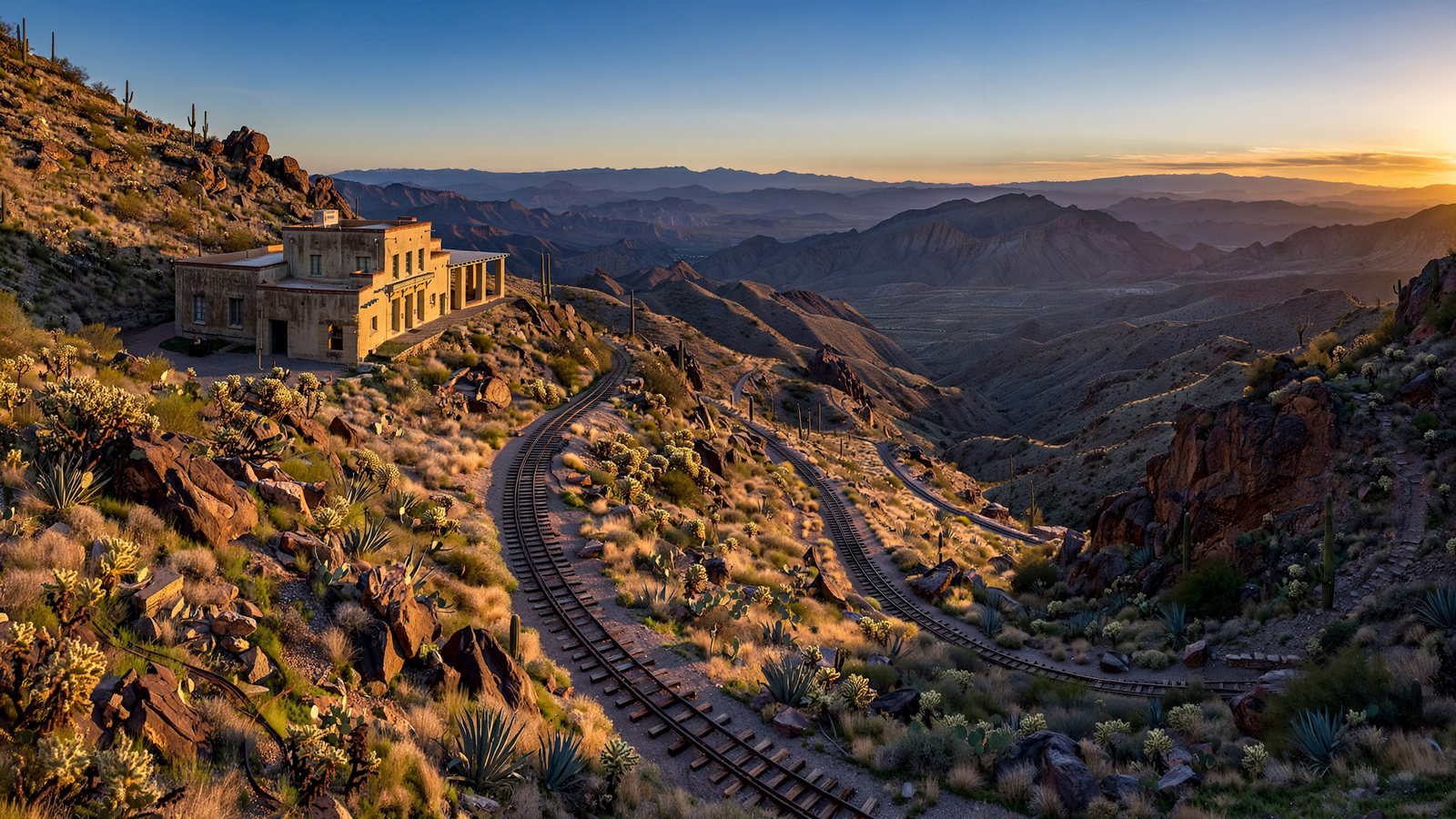
On the mountainside above the Verde Valley, Jerome can feel less like a town than a thought that refused to disappear. Its streets climb sharply through the Black Hills. Buildings cling to slopes. The view opens suddenly toward Cottonwood, red-rock country, and distant desert ranges. For related reading, see Jerome: How an Arizona Mining Town Became a Living Mountain Community.
At the center of that landscape is Jerome State Historic Park, a small museum inside the Douglas Mansion. The building is more than an attractive remnant of mining wealth. It is a way to understand how copper transformed a remote Arizona hillside, how an industrial town grew almost overnight, and how a community found a second life after its original economy ended. For related reading, see Dead Horse Ranch State Park: How a Cottonwood Ranch Became a Verde Valley Refuge.
A town built around copper
Jerome’s story began with geology. The mountain contained valuable copper ore, and by the late 19th century mining had drawn workers, investors, merchants, engineers, and families to a place that was difficult to reach and even harder to build on. The settlement grew on Cleopatra Hill, above the Verde Valley and near the mines that would define its future. For related reading, see Sahuaro Ranch: How a Glendale Farm Became a Public Historic Landscape.
Mining towns often appear in history as temporary places: camps that expand when a resource is profitable and contract when the resource is exhausted. Jerome followed that pattern, but on an unusually large scale. At its height, it was one of Arizona’s major copper centers, with a population commonly estimated at roughly 10,000 to 15,000 people.
The town had hotels, restaurants, stores, churches, schools, newspapers, saloons, and civic institutions. Its steep streets were crowded with people whose daily lives depended on a complicated industrial system below and around them. Ore had to be extracted, processed, transported, and sold. The mountain was not merely a backdrop. It was the reason the town existed.
Jerome also became a place of technological and corporate change. Early operations were associated with the United Verde mine, while the United Verde Extension became another major force in the district. Later, Phelps Dodge became closely connected with Jerome’s mining operations. These companies brought capital and engineering expertise, but the town’s growth also depended on miners, tradespeople, shopkeepers, cooks, teachers, and the families who made a difficult work camp into a community.
The mansion on the hill
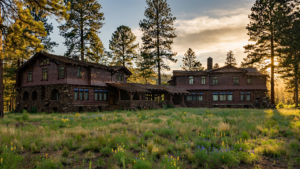
Jerome State Historic Park is housed in the Douglas Mansion, completed in 1916 for James S. Douglas. Douglas was part of the family connected with the United Verde mine, and the mansion reflected the prosperity generated by the district’s copper production.
The building’s setting tells part of the story before visitors enter. From the grounds, the Verde Valley spreads below the mountain. The view helps explain both Jerome’s appeal and its challenge. The town was close to the mines, but it occupied a narrow, unstable, steep-sided site. Every road, home, utility line, and public building had to negotiate the terrain.
Inside, the museum places Jerome’s industrial history in a human and physical context. Displays include mining equipment, photographs, mineral specimens, maps, and objects associated with the community. The collection helps connect the polished surface of the Douglas Mansion to the hard labor that made such a house possible.
That contrast is one of the park’s strengths. A mansion can easily become a story about one prosperous family. In Jerome, however, the building works better as a lens on the whole district. Its rooms point toward the economic hierarchy of the mining era, while the museum’s broader collections recall the thousands of people who lived and worked on the hill.
Reading the landscape as evidence
Jerome is especially valuable because the surrounding landscape remains part of the historical record. The town’s position, surviving buildings, mine-related features, and views across the valley all show how industrial development reshaped a mountain environment.
Visitors do not need to know every name in Jerome’s mining history to notice the clues. The road grade reveals the difficulty of moving supplies and ore. The dense arrangement of buildings reflects the limited space available for construction. The broad valley below suggests the transportation routes and agricultural communities that supported the mining district. Even the town’s dramatic elevation changes are historical evidence: Jerome was built where the ore was, not where a planner would have chosen a level site.
The museum’s mineral displays add another layer. Copper ore is not an abstract resource when it is seen as rock. Specimens make the connection between underground geology and surface history visible. The wealth that built businesses, homes, and public buildings began as material embedded in the mountain.
This is also why a visit to the park works well as an introduction to Jerome itself. The town can be visually overwhelming, with historic storefronts, hillside homes, galleries, restaurants, and roads that seem to fold back on themselves. The state park provides a starting point. It gives the landscape a sequence: geology, mining, settlement, decline, and preservation.
What happened when the mines closed
Jerome’s prosperity was never permanent. Copper production changed, ore bodies became less profitable, and the industrial system that supported the town began to contract. The United Verde mine closed in the 1950s, and the loss of mining jobs led to a dramatic population decline.
Many mining towns vanish almost completely after that kind of economic collapse. Jerome instead entered a long and uncertain period of reinvention. Some buildings disappeared, some were abandoned, and others survived because they could be adapted. Artists, preservationists, small-business owners, and residents helped turn the former company town into a place whose identity rested increasingly on history, architecture, and the mountain setting.
That transition did not erase the mining past. It made preservation more urgent. A town built for industrial production had to decide what could be saved and what could be allowed to change. Jerome’s survival depended not on freezing every building in time, but on finding new uses for an old physical framework.
Jerome State Historic Park belongs to that effort. The park was established in 1965, when the town’s mining era was already over and its future was unsettled. By preserving the Douglas Mansion and interpreting the surrounding district, Arizona created a public place where the town’s history could remain accessible even as Jerome developed a new economy.
A public view of private wealth
Historic houses can sometimes make the past seem tidier than it was. The Douglas Mansion is impressive, but the park’s value comes from refusing to let elegance become the entire story. The building represents the rewards of mining, while the exhibits and surrounding town invite questions about labor, risk, migration, technology, and environmental change.
Who lived comfortably because copper was profitable? Who worked underground or around the mills? How did families manage life on a steep mountain? What happened to people when the jobs disappeared? How did the town’s relationship with the landscape change once extraction no longer determined every decision?
The park cannot answer every question, and no single museum can represent all of Jerome’s experiences. It does something more useful: it gives visitors enough evidence to keep asking. The mansion, photographs, tools, ore samples, maps, and views work together as fragments of a larger civic story.
Planning a visit
Jerome State Historic Park is best approached as both a museum and a viewpoint. Visitors should allow time to examine the exhibits rather than treating the mansion as a quick stop. The outdoor setting deserves attention too, particularly the way the town occupies the mountainside and the valley opens beyond it.
Because Jerome is a historic hillside community, conditions can include narrow roads, uneven surfaces, stairs, and limited parking. Hours, admission information, and accessibility details can change, so checking Arizona State Parks before traveling is sensible. The park is also one part of a larger town experience; nearby streets and historic sites reveal different chapters of Jerome’s past, but the state park provides the clearest overview of the mining era.
A thoughtful visit does not require romanticizing the old company town. Jerome’s history includes prosperity and hardship, technological achievement and environmental cost, civic energy and economic dependence. The lasting appeal of the park is that it holds those tensions together.
Why Jerome still matters
Jerome State Historic Park preserves more than a mansion on a scenic overlook. It preserves a question that appears throughout the American West: what happens to a place after the industry that created it is gone?
Jerome’s answer has been neither disappearance nor simple nostalgia. The town remains a living community, while the park keeps the mining era available for study. Together, they show how history can become part of a place’s future without being reduced to decoration.
From the Douglas Mansion, the Verde Valley looks spacious and quiet. The view can make Jerome’s industrial past seem improbable. The museum corrects that impression. It reminds visitors that this mountain once supported a dense, noisy, ambitious town—and that the surviving landscape still carries the evidence.
Use: Park history, Douglas Mansion, museum interpretation, setting, visitor information, and establishment of the state park.
Use: Historical context on Jerome, its mining-era community, preservation, and local heritage.
Use: Municipal context for Jerome’s historic district, community history, and present-day setting.
Use: Institutional archival context and historical photographs and records related to Arizona communities, including Jerome.
Arizona State Parks and Trails — Jerome State Historic Park — https://azstateparks.com/jerome — Park history, Douglas Mansion, museum interpretation, setting, visitor information, and establishment of the state park.
Jerome Historical Society — https://www.jeromehistoricalsociety.com/ — Historical context on Jerome, its mining-era community, preservation, and local heritage.
City of Jerome — History and Historic Preservation — https://www.jeromeaz.gov/ — Municipal context for Jerome’s historic district, community history, and present-day setting.
Arizona Memory Project — Jerome collections — https://azmemory.azlibrary.gov/ — Institutional archival context and historical photographs and records related to Arizona communities, including Jerome.