Long before Glendale’s streets filled with subdivisions and shopping centers, the western edge of the Salt River Valley was a place of irrigation ditches, citrus groves, livestock, and ambitious experiments in desert living. One of the clearest surviving reminders of that transformation is Sahuaro Ranch Park, where historic buildings and gardens still occupy land first developed as a ranch in the 1880s. For related reading, see Granite Dells: How Prescott’s Ancient Rocks Became a Public Landscape.
The park is not simply a preserved house. Its significance comes from the larger setting: a working agricultural property that contained a residence, farm buildings, orchards, gardens, and the practical infrastructure needed to support life in a hot, water-dependent landscape. Today, visitors can walk through a public park while still seeing the outlines of the private world that once made the ranch function. For related reading, see Dead Horse Ranch State Park: How a Cottonwood Ranch Became a Verde Valley Refuge.
A ranch at the edge of a growing desert community
William Henry Bartlett established Sahuaro Ranch in 1885, during a period when settlers and developers were reshaping the Salt River Valley through irrigation and agriculture. Glendale itself was founded in the same decade, and the surrounding area was changing quickly as canals made it possible to cultivate land that otherwise would have been difficult to farm reliably. For related reading, see Jerome State Historic Park: How a Copper Town’s Mansion Became a Mountain Archive.
The ranch’s name reflects the region’s distinctive landscape. “Sahuaro” is an older spelling of “saguaro,” the tall cactus that has become one of the most recognizable symbols of the Sonoran Desert. The name placed the property within the visual world of central Arizona even as the ranch’s orchards, lawns, and cultivated fields represented a deliberate effort to modify that environment.
That contrast is central to understanding Sahuaro Ranch. It was a home, but it was also a production site. Its residents did not merely occupy a desert landscape; they had to organize water, shade, food, transportation, animals, and seasonal labor. The property shows how domestic life in early Glendale depended on a much larger agricultural system.
What made the property a home
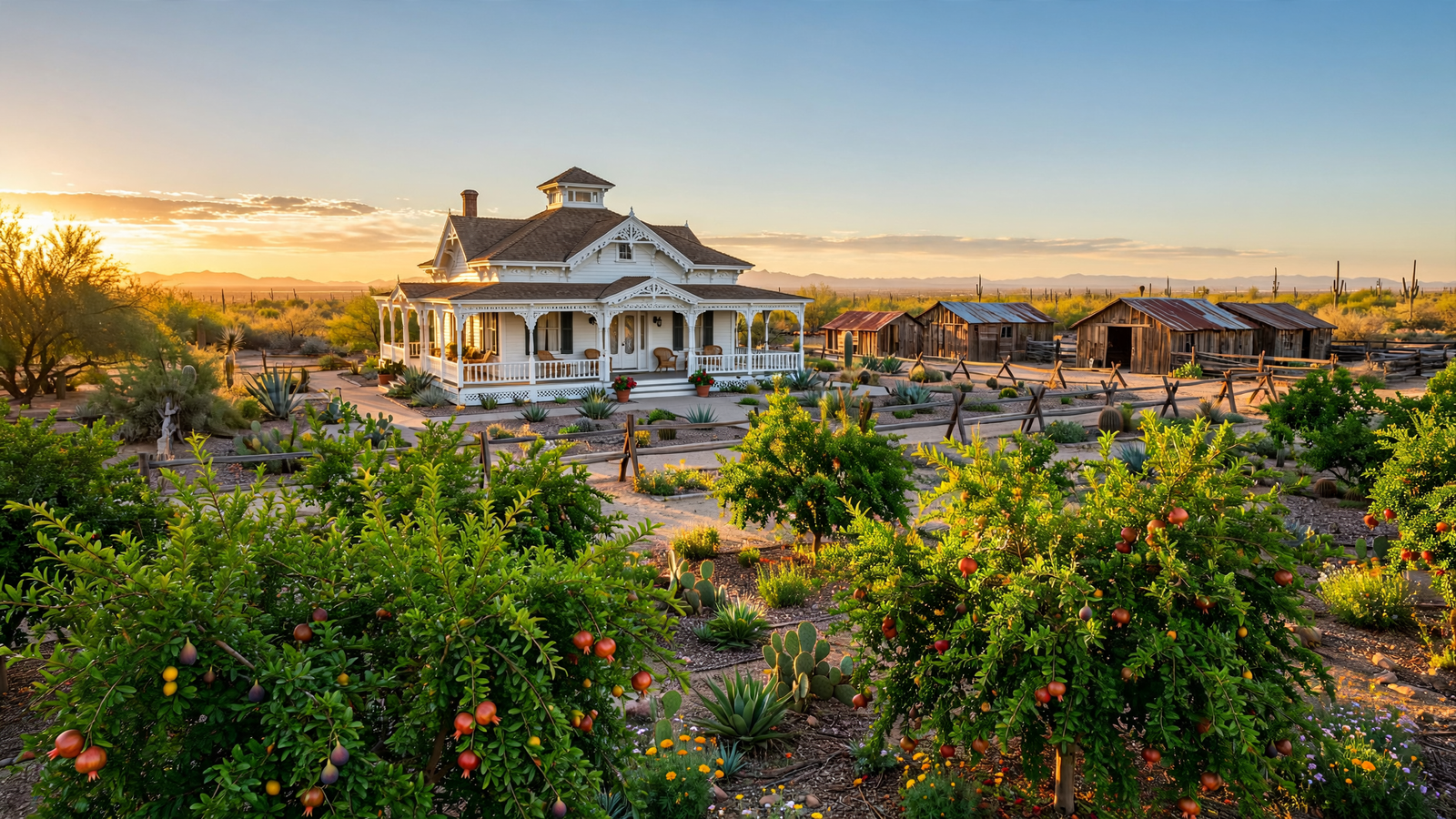
The ranch’s historic core brought together spaces with very different purposes. The main residence provided a family setting, while surrounding structures supported the work that kept the property operating. Barns, sheds, outbuildings, and other service areas made the ranch more than a picturesque country house.
That arrangement offers a useful correction to the way historic homes are often presented. A preserved residence can make the past look private and self-contained, as though daily life happened mainly indoors. At Sahuaro Ranch, the home cannot be separated from the land around it. Food production, animal care, irrigation, gardening, and maintenance were all part of the household’s reality.
The ranch also illustrates the importance of outdoor domestic space in the desert. Trees and planted gardens were not decorative extras. They created shade, moderated heat, and made the property more comfortable. The gardens and mature plantings that remain today help visitors understand how carefully designed vegetation could turn an exposed agricultural site into a livable environment.
Gardens, animals, and the social life of the ranch
Sahuaro Ranch became known for its landscaped grounds as well as its agricultural operations. Historic accounts and city descriptions identify gardens, orchards, and other cultivated areas as important features of the property. The grounds gave the ranch a more formal character than a purely utilitarian farm, while still retaining its working identity.
The property’s peacocks are among its most recognizable living features. Their presence has become part of the park’s public character, linking the historic grounds to an ongoing experience rather than leaving the site as a collection of empty buildings. They also contribute to the sense that Sahuaro Ranch was a place of display and leisure as well as work.
That combination was not unusual for prosperous agricultural properties in the late nineteenth and early twentieth centuries. A ranch could be economically productive while also expressing status through trees, gardens, architecture, and entertaining spaces. In central Arizona, where creating and maintaining a lush landscape required planning and resources, a well-tended property made its own statement about success.
Preserving more than a single building
Historic preservation often focuses on the most visually impressive structure: a mansion, courthouse, or church. Sahuaro Ranch is valuable because its story is distributed across the property. The residence matters, but so do the smaller buildings and the relationships among them.
The layout helps explain how the ranch worked. A visitor can see that domestic life, agricultural labor, storage, animal keeping, and recreation were connected but not identical activities. The property’s surviving features turn an abstract account of early settlement into something easier to imagine: people moving between the house and the grounds, tending plants, caring for animals, maintaining structures, and using the landscape through the changing seasons.
That kind of preservation is especially important in a region where rapid growth has transformed much of the original agricultural landscape. Glendale’s modern cityscape can make the valley’s farming past seem distant, even though its roads, neighborhoods, and water systems developed from that earlier landscape. Sahuaro Ranch keeps one portion of that history visible in place.
From private property to public park
As the Phoenix metropolitan area expanded, properties like Sahuaro Ranch faced a familiar question: could historic land survive the pressure to be subdivided or redeveloped? The City of Glendale ultimately acquired the ranch and converted it into a public park, preserving the historic core for community use.
The change in ownership altered the meaning of the site without erasing its earlier purpose. What had once been a private ranch became a place where anyone could encounter a version of Glendale’s agricultural past. The property’s open grounds also allowed preservation to extend beyond interiors. People could experience the relationship between buildings, gardens, trees, and working spaces rather than viewing historic architecture as an isolated artifact.
Today, Sahuaro Ranch Park combines several roles. It is a neighborhood park, a landscape for walking and outdoor activity, a setting for community events, and a historic resource. Those uses are not competing interpretations; together, they reflect the property’s long history as a place where people lived, worked, gathered, and shaped the land.
A lesson in desert home life
Sahuaro Ranch’s most lasting lesson is not simply that an old Glendale property survived. It is that early Arizona home life was inseparable from environmental management. A comfortable residence required water. A productive ranch required shade and cultivated soil. A garden required ongoing labor. The boundary between “home” and “work” was far less distinct than it is for many modern households.
The ranch also shows that desert settlement was never just a story of buildings appearing on empty land. Its development depended on systems of water and agriculture that altered a landscape already inhabited and used by Indigenous communities, particularly the Akimel O’odham people of the Salt River Valley. A fuller history recognizes both the later ranching story and the much older human history of the valley.
That broader perspective makes the preserved property more, not less, meaningful. Sahuaro Ranch is a record of one family’s home and one agricultural enterprise, but it is also evidence of the forces that helped produce modern central Arizona: irrigation, farming, migration, investment, labor, and the persistent desire to create livable surroundings in a challenging climate.
Why Sahuaro Ranch still matters
At many historic sites, the past is presented as a finished chapter. Sahuaro Ranch feels different because the landscape remains active. Trees still cast shade. Gardens still organize the grounds. Animals still move through the property. Visitors still use the site as part of everyday life.
That continuity gives the ranch its particular strength. The park does not recreate the nineteenth century, and it cannot reproduce the labor or social conditions of the original ranch. Instead, it preserves enough of the setting to make historical questions tangible. How did people make a home here? What did they have to grow, build, maintain, and protect? How did a rural property become part of a growing city?
Sahuaro Ranch Park keeps those questions open. Its buildings tell one part of the story, but its gardens, working structures, trees, and public pathways complete the picture. In a rapidly changing metropolitan region, the ranch remains a rare place where Glendale’s domestic and agricultural past can still be encountered as a landscape rather than merely remembered as a date.
Use: Official information about the park, its historic buildings, landscape, public use, and preservation.
Use: Authoritative federal preservation context and National Register research resources for historic properties.
Use: Repository search for historical photographs and visual documentation related to Sahuaro Ranch.
Use: Arizona historical collections and archival context for research into the state’s communities, landscapes, and built heritage.
City of Glendale — Sahuaro Ranch Park — https://www.glendaleaz.com/live/city_services/parks_and_recreation/parks_and_recreation_facilities/sahuaro_ranch_park — Official information about the park, its historic buildings, landscape, public use, and preservation.
National Park Service — National Register of Historic Places — https://www.nps.gov/subjects/nationalregister/index.htm — Authoritative federal preservation context and National Register research resources for historic properties.
Library of Congress — Sahuaro Ranch search results — https://www.loc.gov/pictures/search/?q=Sahuaro%20Ranch — Repository search for historical photographs and visual documentation related to Sahuaro Ranch.
Arizona State Library, Archives and Public Records — Arizona Memory Project — https://azmemory.azlibrary.gov/ — Arizona historical collections and archival context for research into the state’s communities, landscapes, and built heritage.