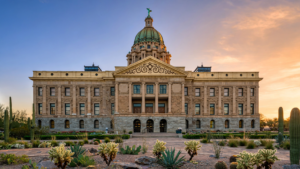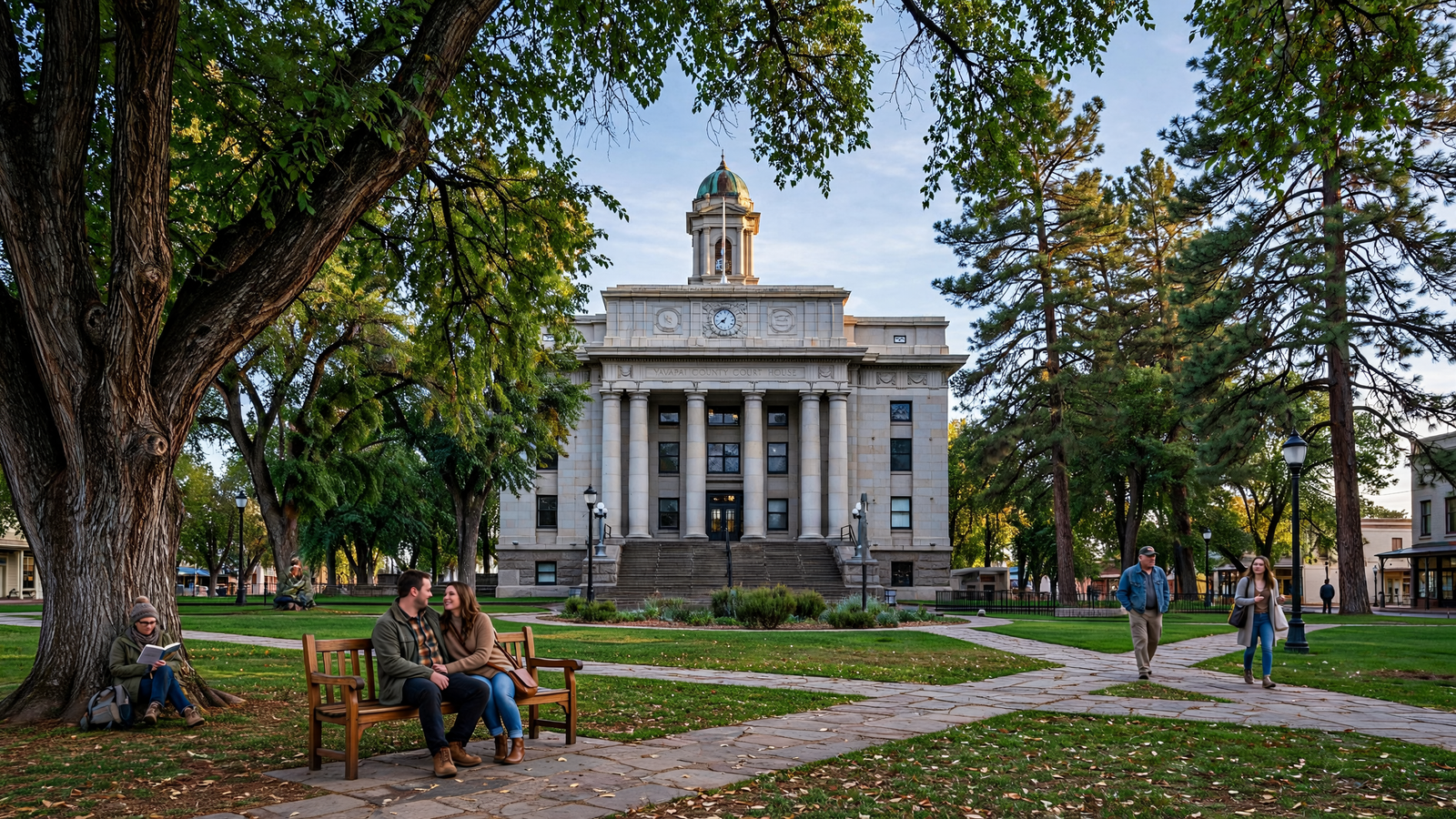
In Prescott, the most important room in town has no ceiling.
It is a broad public square shaded by trees, edged by historic storefronts, and centered on the Yavapai County Courthouse. People cross it on their way to lunch, sit beneath the canopy, gather for ceremonies, listen to music, and return for seasonal celebrations. Visitors may know it as a stop on the way to Whiskey Row. Residents know it as something more durable: a place that belongs to ordinary life.
Courthouse Plaza is one of the clearest examples of how a civic space can outlast the purpose that first gave it a name. Courthouses handle legal business. Plazas, when they work well, handle something broader. They give a community a visible center—a place where the past remains present without preventing the town from changing.
A square at the center of a new territory
Prescott was established in 1864, during the first years of the Arizona Territory. The settlement was selected as the territorial capital and named for historian William Hickling Prescott. Its location in the central highlands made it an important administrative and military center, as well as a gateway to the mining districts and ranching country developing around it.
The town’s early civic life gathered around the courthouse and the commercial streets nearby. That arrangement was practical. Government offices, businesses, hotels, churches, and public meeting places worked best when they could be reached on foot. It also created a pattern that still shapes downtown Prescott: the courthouse square as an anchor, with the surrounding blocks functioning as a connected public landscape rather than as isolated attractions.
Prescott did not remain Arizona’s capital continuously. The territorial government moved to Tucson in 1867, returned to Prescott in 1877, and moved to Phoenix in 1889. The capital’s departure changed Prescott’s political importance, but it did not erase the town’s civic identity. The courthouse, streets, and public square continued to give the community a center.
Fire changed the view without ending the story
In July 1900, a major fire swept through much of downtown Prescott. Fires were a familiar danger in Western towns built with wood, closely spaced buildings, and limited firefighting infrastructure. In Prescott, the blaze destroyed a large portion of the commercial district, including many of the structures that had defined the town’s first decades. For related reading, see Prescott’s Courthouse Plaza: How a Historic Square Became the Heart of Downtown.
The rebuilding that followed helped create the downtown landscape people recognize today. Brick and masonry replaced many vulnerable wooden buildings. Storefronts were rebuilt along the same general street pattern, allowing the town to retain its compact form even as its architecture changed. The result was not a perfect preservation of the nineteenth-century town. It was a layered downtown—one shaped by loss, reconstruction, and continued use.
That distinction matters. Historic places are often described as if they were frozen scenes, but Courthouse Plaza is better understood as a record of adaptation. Its surrounding buildings carry traces of territorial government, commerce, fire, rebuilding, and modern preservation. The square remains historic partly because it has continued to function.
The courthouse gives the plaza its civic weight
The present Yavapai County Courthouse, completed in the early twentieth century, gives the square its formal center. Its architecture communicates permanence in the traditional language of public buildings: a strong front, balanced proportions, and a scale that distinguishes civic work from private business.
Yet the courthouse is only one part of the experience. The open space in front of it makes the building approachable. A courthouse set apart behind fences would express authority. A courthouse facing a public square expresses authority while also acknowledging public presence. The plaza allows residents to see government as part of the town’s daily landscape rather than as a remote institution encountered only when official business requires it.
That is one reason courthouse squares appear across the United States. They are organizational tools, but they are also social ones. A central public space makes it easier for people to encounter one another, to mark important occasions, and to maintain a shared sense of orientation. In Prescott, that function has survived changes in transportation, retail, government, and tourism.
From business district to public living room
Downtown Prescott is compact enough to reward wandering. The plaza helps make that wandering feel purposeful. It is a place to begin a walk, pause during one, or return to after exploring the surrounding streets. Trees soften the formal geometry of the square, while benches and paths give the space a human scale.
These details can seem modest, but they are the infrastructure of public life. A shaded seat invites someone to stay longer. An open central area makes room for a gathering. A visible landmark helps visitors navigate without a map. Storefronts facing the plaza provide activity at the edges, while the square itself offers a break from the pace of commerce.
The arrangement also supports a useful kind of variety. On one day, the plaza may feel quiet, with people reading, talking, or watching the passing street life. On another, it may host music, a ceremony, or a seasonal event. The setting can accommodate both the unplanned and the organized. That flexibility is one of the strongest signs that a public place is working. For related reading, see The Verde River Greenway: How a Yavapai County Riverfront Became a Shared Landscape.
Traditions make the space memorable
Prescott’s identity is closely associated with public traditions, including the annual Frontier Days celebration and the Christmas lighting ceremony. These events attract crowds, but their deeper importance is not simply that they draw visitors. They give residents recurring opportunities to experience the same place together.
Annual traditions turn geography into memory. A child who watches a parade from the plaza may later return as a parent. A family that gathers for the holiday lighting may eventually measure the passage of years by changes in the crowd, the weather, and the people standing beside them. The physical setting becomes a container for personal history.
That process is especially valuable in a growing region. New residents can learn a community’s traditions by participating in them, while longtime residents can see familiar customs take on new meaning. The plaza provides continuity without requiring everyone to share the same background. It is a common setting, not a demand for a single story.
Preservation is more than keeping old buildings
Prescott’s historic downtown is recognized for its concentration of older buildings and its relationship to the city’s development. But the value of the district is not limited to façades. The street network, courthouse grounds, storefronts, sidewalks, and open square work together as a civic composition.
Preserving that composition requires more than repairing masonry. It means protecting the ability of the space to remain useful. A historic plaza needs safe paths, functioning trees, places to sit, accessible routes, and enough flexibility for contemporary community life. If preservation turns a public square into a display that people can only look at, it preserves the shell while losing the purpose.
Courthouse Plaza illustrates a more durable approach. Its historical character remains visible, but the space continues to serve residents who may have no official reason to visit the courthouse. It is still part of the town’s circulation system. People pass through it because it is convenient, pleasant, recognizable, and connected to the places around it. For related reading, see Arcosanti: How a Yavapai County Desert Experiment Made Architecture a Way of Living.
How to experience the plaza today
The best way to understand Courthouse Plaza is slowly. Begin at the square and look outward rather than treating it as a quick photo stop. Notice how the courthouse relates to the open space. Then walk the surrounding blocks and compare the scale of the historic storefronts with newer signs, businesses, and public improvements.
Visit at different times if possible. Morning reveals the plaza as a quiet civic setting. Midday shows how it fits into downtown errands and dining. During a public event, the same ground becomes a stage for collective memory. Each version is authentic because the plaza was never designed for only one kind of use.
Visitors should also remember that the square is part of a living community. Historic downtowns are not outdoor museums; they are workplaces, residences, businesses, and gathering places. Supporting local establishments, keeping paths clear, and treating the landscape with care are small ways to help the public space remain welcoming.
A place that keeps making room
Courthouse Plaza’s story is not only about Prescott’s territorial beginning or its nineteenth-century buildings. It is about the continuing usefulness of a shared center.
The town has changed governments, rebuilt after fire, shifted its economy, and welcomed generations of new residents. Through those changes, the plaza has continued to do something remarkably simple: it gives people somewhere to meet. Its significance lies in the accumulation of ordinary uses—crossing the square, sitting under a tree, attending a ceremony, recognizing a familiar face.
That is why the place remains interesting long after the first visit. Courthouse Plaza is a piece of Arizona history, but it is also a reminder that public spaces earn their meaning through repetition. A community becomes attached to a square because people keep returning to it, season after season, until the landscape becomes part of how they understand home.
Use: Public-space description, civic use, and current municipal context.
Use: City preservation context and information about Prescott’s historic downtown.
Use: Downtown development, the 1900 fire, and the continuing role of the central business district.
Use: Institutional context for evaluating and preserving historic districts and civic landscapes.