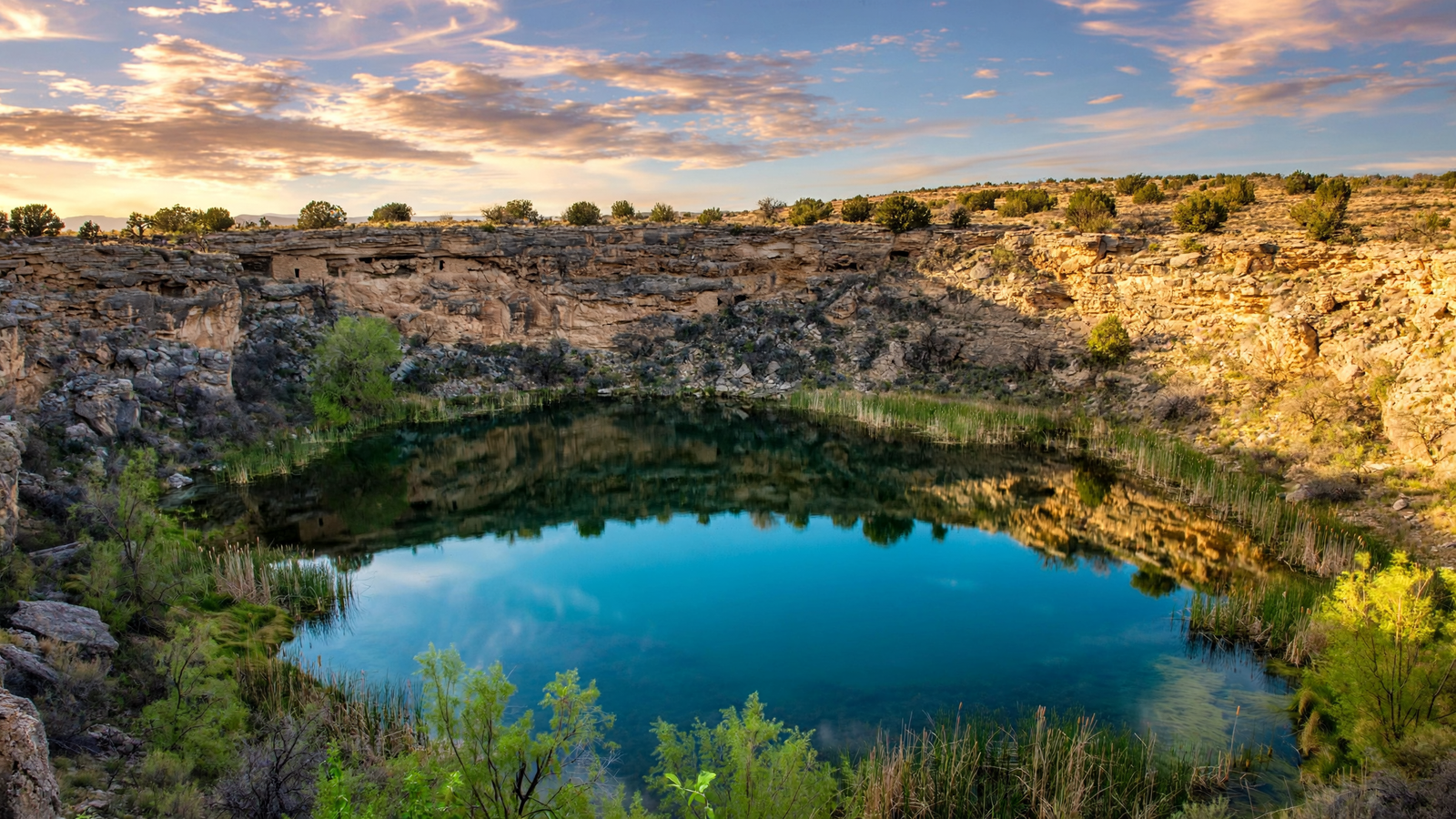
At first glance, Montezuma Well looks like a piece of the desert has been removed. For related reading, see Arcosanti: How a Yavapai County Desert Experiment Made Architecture a Way of Living.
The circular opening sits in the limestone country north of Camp Verde, its dark water held far below the rim. Cottonwoods and other vegetation gather around the edge, making the site feel unexpectedly cool and enclosed compared with the surrounding high desert. Yet the well is not simply a scenic hole in the ground. It is a water system, an archaeological site, and a small ecological world that has remained connected to human life for centuries. For related reading, see Montezuma Well: The Desert Spring That Became an Ancient Waterway.
That combination makes Montezuma Well one of Yavapai County’s most revealing places. It shows how water can create habitat in an arid landscape—and how people learned to recognize, use, and protect that water long before modern infrastructure arrived. For related reading, see Mingus Mountain: The Yavapai County Ridge Where Desert Meets Forest.
A desert landscape with a hidden source
Montezuma Well is a limestone sinkhole roughly 368 feet across and about 55 feet deep, according to the National Park Service. The water is fed by underground springs and leaves the well through a natural opening on the eastern side. From there, it enters a channel that carries water into the surrounding landscape.
The flow is remarkably consistent. The National Park Service estimates that approximately 1.5 million gallons of water move through the well each day, even though the visible pool occupies a relatively small area. In a region where seasonal rainfall can be unpredictable and summer heat quickly draws moisture from exposed ground, that dependable discharge would have been a powerful reason to settle nearby.
Modern visitors encounter the well as part of Montezuma Castle National Monument, but the name can be misleading. The site has no known connection to the Aztec ruler Montezuma, and the nearby cliff dwelling was not built by him. Those names reflect a period when Euro-American travelers and settlers often attached familiar historical labels to Indigenous places they did not yet understand.
The deeper story is local. The people archaeologists call the Sinagua lived in the Verde Valley and used the area’s water, fields, and trade routes for generations. Their presence remains visible not only in nearby masonry structures but also in the irrigation features that extend from Montezuma Well.
Water that still carries an ancient design
One of the most striking features at Montezuma Well is the irrigation ditch leading away from the outlet. Archaeological evidence indicates that Indigenous farmers modified and maintained channels to move the spring water toward fields below the well. The ditch is not merely a remnant beside a historic attraction. It is evidence of an early engineering decision: instead of waiting for the desert to provide ideal farmland, people reshaped the flow of water to make cultivation possible.
The channel connected the well to a broader agricultural landscape. In the Verde Valley, farming communities grew crops such as corn, beans, and squash while adapting to a climate that could be both productive and unforgiving. Water from Montezuma Well could support crops beyond the immediate rim, helping make settlement possible in an otherwise dry environment.
That system also offers a more useful way to think about ancient technology. Engineering does not always arrive as a monumental bridge, a towering building, or a machine made of metal. At Montezuma Well, it appears as a carefully placed channel that follows the land and turns a natural spring into a dependable resource.
The irrigation works are especially important because they connect archaeology with landscape history. A wall or room can show where people lived. A water channel can show how a community organized its days, fields, labor, and expectations for the future.
A pool with an ecology of its own
Montezuma Well is also unusual biologically. The water contains naturally elevated levels of arsenic, a condition that prevents fish from living there but has not made the pool lifeless. Instead, the well supports a group of small organisms that have adapted to its distinctive chemistry.
The National Park Service identifies several species found only at or closely associated with Montezuma Well, including a diatom, a leech, a water scorpion, and an amphipod. These creatures are easy to overlook from the trail. They do not announce the well’s importance in the way a large mammal or colorful bird might. Their significance lies in the fact that an isolated, chemically unusual environment has allowed specialized life to persist.
This is one reason the site rewards patient observation. The obvious attraction is the broad, blue-green pool. The less obvious one is the network of relationships below and around the surface: spring water, algae, invertebrates, plants, birds, insects, and the animals that use the surrounding woodland. The well is a compact example of how geology can create biological opportunity.
Its ecology also explains why the site requires care. A place that looks durable from a distance may be vulnerable to small changes in water quality, trampling, introduced species, or disturbance of shoreline vegetation. Protection here is not only about preserving a beautiful view. It is about keeping a rare set of conditions intact.
Reading the place without reducing it to a ruin
Montezuma Well is often visited alongside Montezuma Castle and other Verde Valley attractions, but it deserves to be understood on its own terms. The well is not simply a backdrop for a story about the past. It is a place where geology, living systems, and Indigenous history remain visible at the same time.
The surrounding archaeological record shows that the Verde Valley was not an empty wilderness awaiting discovery. Communities built homes, cultivated fields, exchanged goods, and developed ways to live with the region’s water patterns. Some structures remain standing; others survive as traces in soil, rock, and vegetation. Together, they challenge the idea that desert environments are naturally barren or that successful settlement requires transforming them completely.
The site’s history also includes loss and change. Sinagua communities gradually moved away from the area centuries ago, and the reasons were likely complex rather than the result of one simple event. Environmental pressure, social change, shifting trade networks, and other factors may all have played roles. Archaeology can identify patterns, but it cannot always provide a single definitive explanation for every departure.
That uncertainty is part of the value of the place. Montezuma Well does not offer a neatly finished historical narrative. It offers evidence—water channels, masonry, agricultural traces, and a continuing natural flow—from which a larger human story can be approached with care.
Why the well still matters now
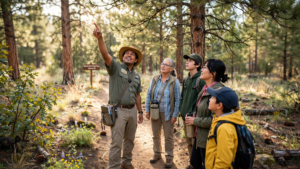
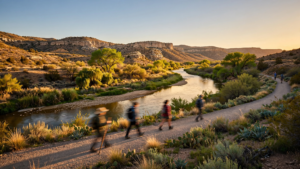
Today, Montezuma Well sits within a protected national monument managed by the National Park Service. Visitors can walk to viewpoints and follow trails that reveal the relationship between the pool, the outlet, and the surrounding landscape. Interpretive signs and ranger information help explain the ecology and archaeology, while basic visitor rules keep people from damaging sensitive resources.
Those rules are part of the story rather than an interruption to it. The site has survived because its water, plants, archaeological features, and unusual species are treated as connected. Removing a piece of the landscape—even something as small as an artifact or as seemingly harmless as a plant—can weaken the evidence that makes the place meaningful.
Montezuma Well also has a lesson for the present-day Southwest. Water is often discussed through reservoirs, pipes, wells, and allocation agreements. At this site, water can still be encountered as a living force that shapes settlement, habitat, and memory all at once. The spring does not solve the region’s modern water challenges, but it makes the basic relationship visible: where reliable water appears, life gathers, people adapt, and responsibility follows.
That may be the most hopeful feature of Montezuma Well. Its importance does not depend on a new construction project or a dramatic discovery. The place continues to do what it has done for centuries—move water through a dry country, sustain a rare community of organisms, and preserve evidence of people who learned how to work with the desert rather than simply overcome it.
For a county known for mountain towns, red-rock scenery, and long stretches of public land, Montezuma Well offers a quieter kind of landmark. It is a reminder that a place can be both small and immense: a single spring opening that contains an ecosystem, an engineering history, and a continuing invitation to pay attention.
Use: Visitor information, dimensions, access, landscape context, and stewardship guidance.
Use: Ecology, geology, and unusual aquatic species associated with Montezuma Well.
Use: Sinagua history, archaeology, Indigenous settlement, and cultural-resource context.
Use: Authoritative regional context on groundwater, springs, and water science in Arizona.
National Park Service — Montezuma Well, Montezuma Castle National Monument — https://www.nps.gov/moca/planyourvisit/montezuma-well.htm — Visitor information, dimensions, access, landscape context, and stewardship guidance.
National Park Service — Nature and Science at Montezuma Castle National Monument — https://www.nps.gov/moca/learn/nature/index.htm — Ecology, geology, and unusual aquatic species associated with Montezuma Well.
National Park Service — History and Culture at Montezuma Castle National Monument — https://www.nps.gov/moca/learn/historyculture/index.htm — Sinagua history, archaeology, Indigenous settlement, and cultural-resource context.
U.S. Geological Survey — Arizona Water Science Center — https://www.usgs.gov/centers/arizona-water-science-center — Authoritative regional context on groundwater, springs, and water science in Arizona.