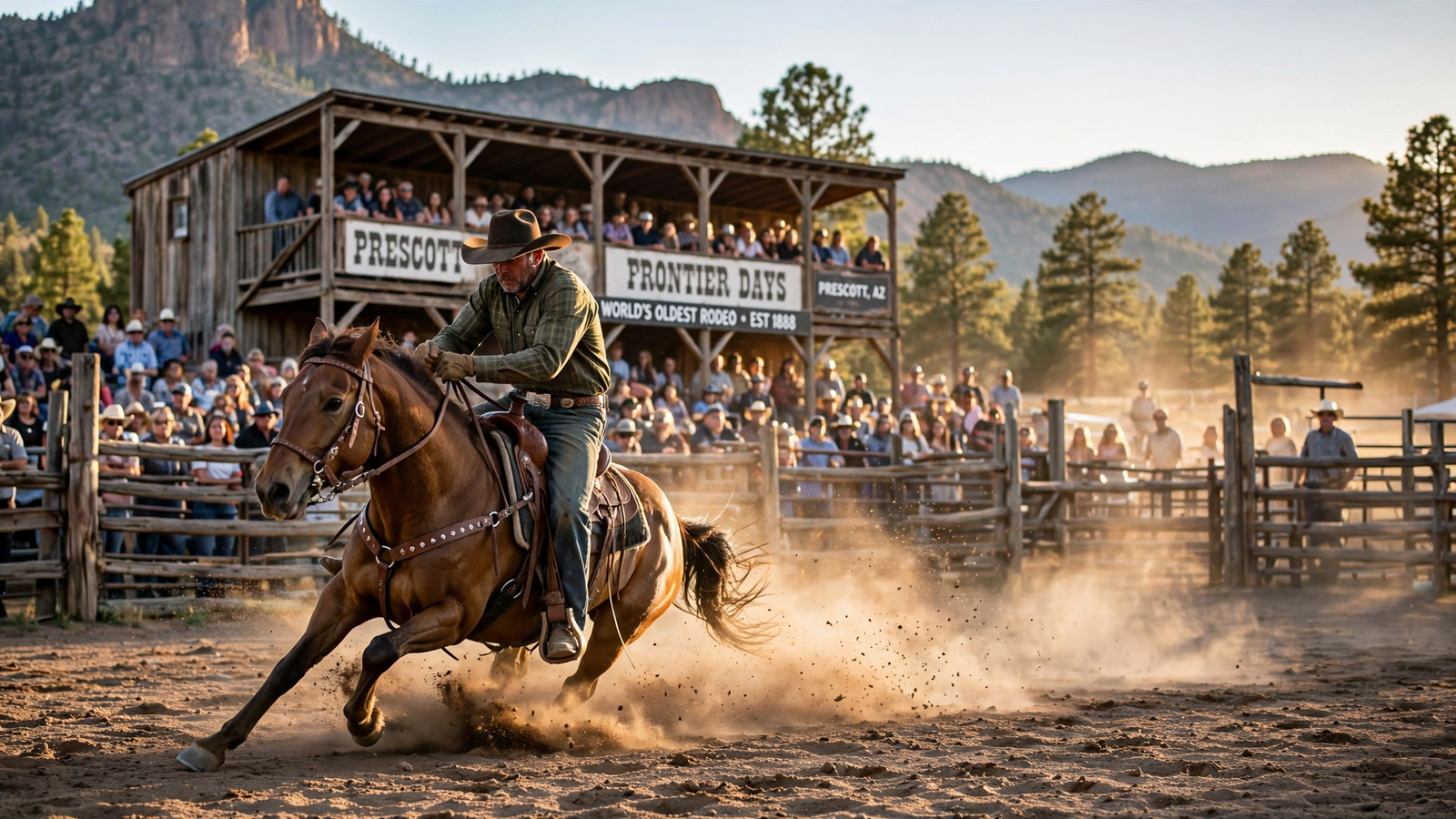
In Prescott, summer does not arrive quietly. It comes with horses in the street, flags along the courthouse square, music in the evening, and a crowd moving toward the rodeo grounds on the edge of town.
The occasion is Prescott Frontier Days, the event widely known as the World’s Oldest Rodeo. Its history reaches back to 1888, when Prescott held a Fourth of July celebration that included contests of riding and roping. More than a century later, the rodeo remains one of the city’s clearest annual expressions of place.
That endurance is not simply a matter of age. Many old events survive as museum pieces, remembered more often than attended. Prescott’s rodeo has continued by remaining part of everyday civic life. It brings together professional competitors, ranching families, volunteers, performers, visitors, merchants, and residents who may experience the week in very different ways. The result is a tradition that is historical without being frozen.
A frontier celebration finds a permanent home
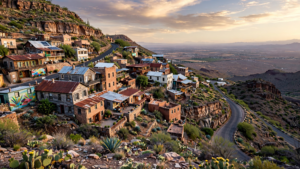
Prescott was established in the 1860s as a territorial capital and a center of government, commerce, and transportation in central Arizona. By the late nineteenth century, the community was already developing the public rituals that helped a young town define itself.
The first Prescott rodeo is generally dated to July 4, 1888. Like many early western celebrations, it grew from a holiday gathering rather than from a modern sports league. The program combined entertainment and competition, drawing on skills that were practical parts of life around ranches, farms, freight routes, and horse-centered communities.
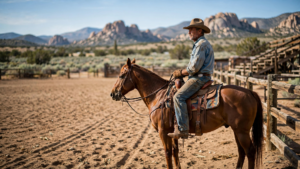
Riding, roping, and handling livestock were not invented for the arena. They were working abilities, and the early contests made those abilities visible to an audience. The rodeo offered spectators a version of the working West that could be watched, judged, and celebrated in a public setting.
That distinction helps explain why Prescott’s event became so durable. It was never only a contest. From the beginning, it was also a holiday, a gathering, and a way for the town to tell a story about itself. For related reading, see Prescott’s World’s Oldest Rodeo: How a Frontier Contest Became a Civic Tradition.
What “oldest” means in Prescott
Prescott Frontier Days is promoted as the World’s Oldest Rodeo, a title tied to its 1888 beginning and long-running annual identity. The phrase is easy to treat as a slogan, but the underlying idea is more interesting: Prescott has kept returning to the same broad civic occasion while allowing the event around it to change.
The rodeo has not been identical across generations. Equipment, judging, safety practices, professional organization, advertising, and audience expectations have all evolved. So has Prescott itself. A territorial-era settlement became a county seat, a regional service center, and a popular destination for people seeking the city’s cooler mountain climate and historic character.
The rodeo changed along with that community. Its meaning expanded beyond the people who worked with livestock every day. It became a public introduction to western horsemanship for newcomers and visitors, while remaining a familiar annual marker for longtime residents.
That is the difference between a relic and a living tradition. A relic asks people to look backward. A living tradition asks them to show up again.
The arena is only one part of the story
For many spectators, the main attraction is the competition: horses, riders, timed runs, livestock, and the concentrated skill required to perform under pressure. But Prescott Frontier Days also reaches well beyond the arena.
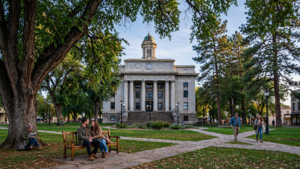
The rodeo is associated with a parade through downtown Prescott, a tradition that places western celebration in the city’s most recognizable public spaces. Floats, horses, marching groups, flags, and local organizations turn the streets into a temporary stage. The courthouse square, already a gathering place throughout the year, becomes part of the rodeo’s larger setting.
That movement between arena and downtown matters. It keeps the event from becoming an isolated ticketed performance. A visitor can encounter it through a parade, a storefront, a concert, a volunteer station, or a conversation with someone who has attended for decades. The rodeo becomes a town-wide experience rather than a single building’s program. For related reading, see Prescott’s Courthouse Plaza: How a Territorial Square Became Yavapai County’s Shared Living Room.
Local businesses also become part of the event’s rhythm. Restaurants, hotels, shops, and galleries see a seasonal influx of visitors, while residents adjust to busier streets and a more crowded calendar. The economic effect is important, but the civic effect is just as visible: Prescott briefly becomes a town organized around a shared story.
Skills, spectacle, and the work behind both
Rodeo is sometimes viewed only as spectacle, yet its appeal depends on skills that are difficult to fake. A rider must read an animal’s movement, maintain balance, react quickly, and commit to a short burst of action in which small errors matter. Timed events demand precision from both horse and rider. The best performances are not merely dramatic; they are coordinated.
That coordination extends to the people who make the event possible. Stock contractors, veterinarians, judges, announcers, arena crews, competitors, officials, safety personnel, ticket staff, and volunteers each occupy a part of the system. A successful rodeo depends on many kinds of attention, much of it invisible from the stands.
Animal welfare and safety practices are also part of the modern event’s responsibilities. Contemporary professional rodeo operates under rules and oversight intended to reduce avoidable harm, and local organizers must manage the practical demands of livestock care, transport, arena conditions, and emergency response. Those responsibilities are not side issues. They are central to whether an old tradition can remain credible in the present.
Prescott’s rodeo therefore sits between history and accountability. Its heritage gives it meaning, but heritage alone cannot do the work. Each year’s event has to be organized, staffed, regulated, and carried out in real time.
A western identity with more than one origin
The word “frontier” can suggest a simple story of cowboys and open land. Arizona’s actual history is more complicated. The region’s ranching and horse cultures were shaped by Indigenous peoples, Mexican and Spanish traditions, Black westerners, immigrants, miners, soldiers, farmers, and families whose lives did not fit neatly into a single legend.
A modern public event cannot recover every part of that history through costumes and ceremony. But it can offer an opening for a broader understanding of the West. The skills displayed in a rodeo have multiple roots, and the communities that participate in western life have never been as narrow as popular imagery sometimes suggests. For related reading, see Arizona’s Pioneers’ Home: The Prescott Institution That Turned Frontier Memory Into a Civic Promise.
That wider view does not weaken Prescott’s identity. It makes the identity more honest and more durable. A place becomes meaningful not when it repeats one perfect story, but when it keeps learning how its stories connect.
Why the tradition still works
Prescott has many historic landmarks, but the rodeo is unusual because it is both inherited and renewed. The courthouse plaza, old buildings, museums, and mountain landscape preserve the city’s past in physical form. The rodeo preserves the past through participation.
Children can watch a parade and recognize the event as something their parents or grandparents also experienced. Young competitors can enter a profession or sport that has deep roots in the region while using modern training and equipment. Volunteers can attach themselves to the community through work that is practical, social, and repeated year after year.
Visitors often come for the novelty of an old western celebration. Residents may come because it is familiar. Those motivations are different, but they meet in the same public ritual.
That may be the rodeo’s most important achievement. It has kept a historic event useful—not as a reconstruction of 1888, and not as an advertisement for an imaginary frontier, but as a recurring opportunity for Prescott to gather in public.
When the horses leave the arena and the parade route clears, the city returns to its ordinary pace. Yet the event leaves behind something more lasting than a week of spectacle. It renews a shared calendar, supports local work, and gives several generations a reason to occupy the same streets at the same time.
In Prescott, the oldest rodeo is not old because it refuses to change. It is old because the community keeps finding a place for it.</n
Use: Event history, the 1888 origin of the rodeo, and its continuing identity as the World’s Oldest Rodeo.
Use: Context on Prescott’s territorial-era origins and civic development.
Use: A primary-source newspaper research trail for contemporary Arizona coverage from 1888.