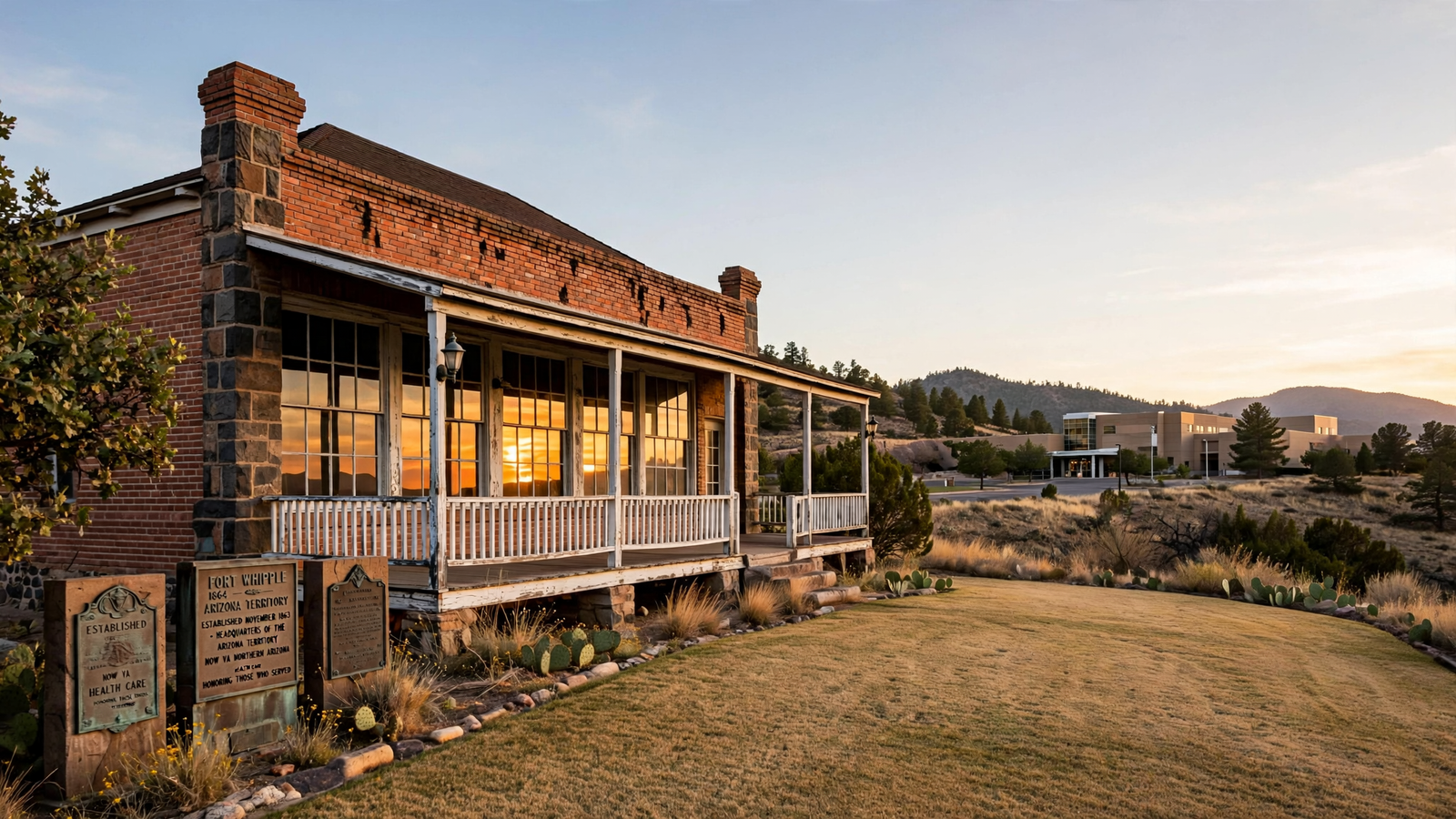
On a wooded rise east of central Prescott, the past does not sit behind a museum rope. It shares space with hospital buildings, roads, offices, tall pines, and the daily movement of people receiving care.
This is Fort Whipple, one of the places where Prescott’s territorial history remains part of the living city. Founded during the Civil War, the post helped anchor the United States military presence in a newly organized Arizona Territory. More than a century later, its grounds are associated with the Northern Arizona VA Health Care System, continuing a long transition from frontier defense to public service.
That change gives Fort Whipple a significance beyond its surviving military name. The site is not simply a remnant of the army’s western expansion. It is a place where several chapters of Prescott’s history overlap: Indigenous landscapes, territorial government, military movement, veterans’ care, historic preservation, and the everyday life of a modern community.
A post built during a turbulent beginning
Fort Whipple was established in 1863, shortly after the United States created the Arizona Territory. The new territory was vast, politically unsettled, and connected to the rest of the country by difficult roads and long supply lines. The Civil War added another layer of urgency. Federal officials wanted to secure the territory for the Union while maintaining military routes and protecting strategic settlements.
The post was named for Amiel W. Whipple, a Union officer who had died earlier in the war. Its first location was near present-day Chino Valley, north of Prescott. In 1864, the army moved the post closer to Prescott, where the surrounding hills offered a more defensible position and better access to the territorial capital.
Prescott itself was founded in the same period. It became Arizona’s first territorial capital in 1864, and Fort Whipple was part of the young town’s institutional landscape. Government officials, soldiers, merchants, prospectors, and Indigenous communities were all drawn into a rapidly changing region. The post represented federal power, but it also became one of the places through which the territory’s new civic systems took shape. For related reading, see Fort Verde: How Camp Verde Keeps a Frontier Post Open to a Larger Story.
That history should not be reduced to a simple story of settlement. The arrival of the territorial government and the army brought profound disruption to Native peoples whose homelands and political relationships predated the United States. Fort Whipple belongs in that larger context. Its buildings and records can help explain how Arizona’s territorial order was created, but they also point toward the unequal forces that made that order possible.
From military station to historic landscape
Frontier posts were never only collections of barracks. They required roads, supply buildings, workshops, officers’ quarters, storage areas, medical facilities, and communication systems. They were working communities as much as defensive installations.
Fort Whipple changed repeatedly as the army’s needs changed. The post supported military operations in central Arizona, served as a base for troops moving through the territory, and remained connected to the federal presence in Prescott long after the most intense years of frontier conflict had passed. As transportation improved and the army reorganized its western installations, the original military role gradually diminished.
What survived was a landscape shaped by that earlier use. Historic structures, mature trees, road alignments, and the setting itself preserve clues about how a nineteenth-century post functioned. Even when a building’s purpose changes, its location can retain meaning. A former military office may later become part of a medical campus; a parade ground may become open space; an old road may continue to guide movement across the hill.
This is one reason historic places can be more revealing than isolated artifacts. Fort Whipple’s story is legible through relationships: the post and Prescott, the buildings and the forest, the military past and the medical present. The place shows how public landscapes accumulate uses rather than losing their earlier identities all at once.
The beginning of a veterans’ mission
The strongest modern connection to Fort Whipple is its association with veterans’ health care. After the military post’s active era, the property became part of a federal effort to provide medical services to veterans in northern Arizona. The VA’s history of the Northern Arizona system traces that mission to the Fort Whipple campus in the early twentieth century.
That transition changed the meaning of the site. A frontier post had been designed around defense, command, and logistics. A veterans’ campus was organized around treatment, rehabilitation, housing, and long-term care. The same high-country setting that once supported a military garrison became a place intended to help former service members rebuild daily life. For related reading, see Prescott Frontier Days: How an 1888 Rodeo Became a Living Civic Tradition.
The shift also reflects a broader change in how the United States understood its responsibilities. Veterans’ care was once often handled through scattered local arrangements, charitable institutions, or military hospitals. Over time, the federal government built more permanent systems for medical treatment and benefits. Fort Whipple became part of that expanding public commitment in Arizona.
Today, the Northern Arizona VA Health Care System serves veterans from across a large region. Its work includes primary care, specialty services, mental-health support, rehabilitation, and other forms of treatment. The modern system is far more complex than the original post, but the connection between place and mission remains visible: a site first created for a national emergency now serves people who carried out the nation’s military duties.
Why the setting matters
Prescott’s elevation and climate helped make Fort Whipple suitable for both military and medical use. The surrounding landscape is cooler and more forested than the low desert cities of central Arizona. Ponderosa pine, open slopes, and distant mountain views give the campus a distinctive character.
That setting is not merely scenic. Landscape can affect how people experience institutions. A wooded campus offers shade, orientation, and a sense of separation from the noise of a city. For patients and families, those qualities can make a medical environment feel less anonymous. For staff, they help create a workplace tied to a recognizable region rather than an interchangeable complex.
At Fort Whipple, the natural setting also helps connect the site to Prescott’s larger identity. The city is often described through its courthouse square, historic streets, forested mountains, and high-desert climate. The former post adds another dimension: a place where civic history and public health occupy the same landscape.
Preserving more than a military story
Historic preservation can be most useful when it resists a single, polished narrative. Fort Whipple is important because it can hold several stories at once. For related reading, see Fort Whipple: The Prescott Place Where Arizona’s Territorial Story Took Shape.
It is a reminder of Arizona’s territorial period and the federal government’s effort to establish authority in the Southwest. It is evidence of the army’s changing role after the Civil War. It is part of Prescott’s development as a capital, supply center, and regional community. It is also connected to the long, unfinished work of caring for veterans.
Those stories do not all point in the same direction. The post’s history includes military conflict and the displacement of Native communities. A responsible account should acknowledge that complexity rather than treat the site as a romantic frontier tableau. Preservation is not the same as celebration. It can provide a durable setting for asking better questions about power, service, memory, and public responsibility.
The living character of Fort Whipple makes those questions more immediate. Visitors may encounter historic buildings or interpretive materials, but the campus is also a functioning place of care. Veterans arrive for appointments. Families accompany them. Health professionals work ordinary shifts. The site’s history continues not because it has been frozen, but because a public mission has taken root there.
A Prescott place still doing public work
Many historic sites survive by becoming museums, monuments, or carefully bounded ruins. Fort Whipple followed another path. Its older identity remains visible within a working medical campus, where the past is part of the setting rather than the sole purpose of the place.
That may be the most hopeful lesson in Fort Whipple’s long history. Public places can change without becoming meaningless. A military post can become a health-care campus. A frontier installation can become part of a community’s obligation to veterans. Historic buildings can remain useful while carrying memories that reach well beyond their original function.
For Prescott, Fort Whipple is therefore more than an old name on a map. It is a reminder that the city’s history was made not only in grand civic buildings or famous landscapes, but also in institutions that adapted to new needs. Its enduring value lies in that combination of memory and service: a place that preserves evidence of the past while continuing to do work in the present.
Use: Background on the development of veterans’ health care at the Fort Whipple campus and the modern Northern Arizona VA system.
Use: Federal historic-preservation context for researching Fort Whipple and associated historic properties.
Use: Local context on Fort Whipple’s place in Prescott and its public landscape.
Use: Territorial-era and archival context for Arizona’s early government and military history.