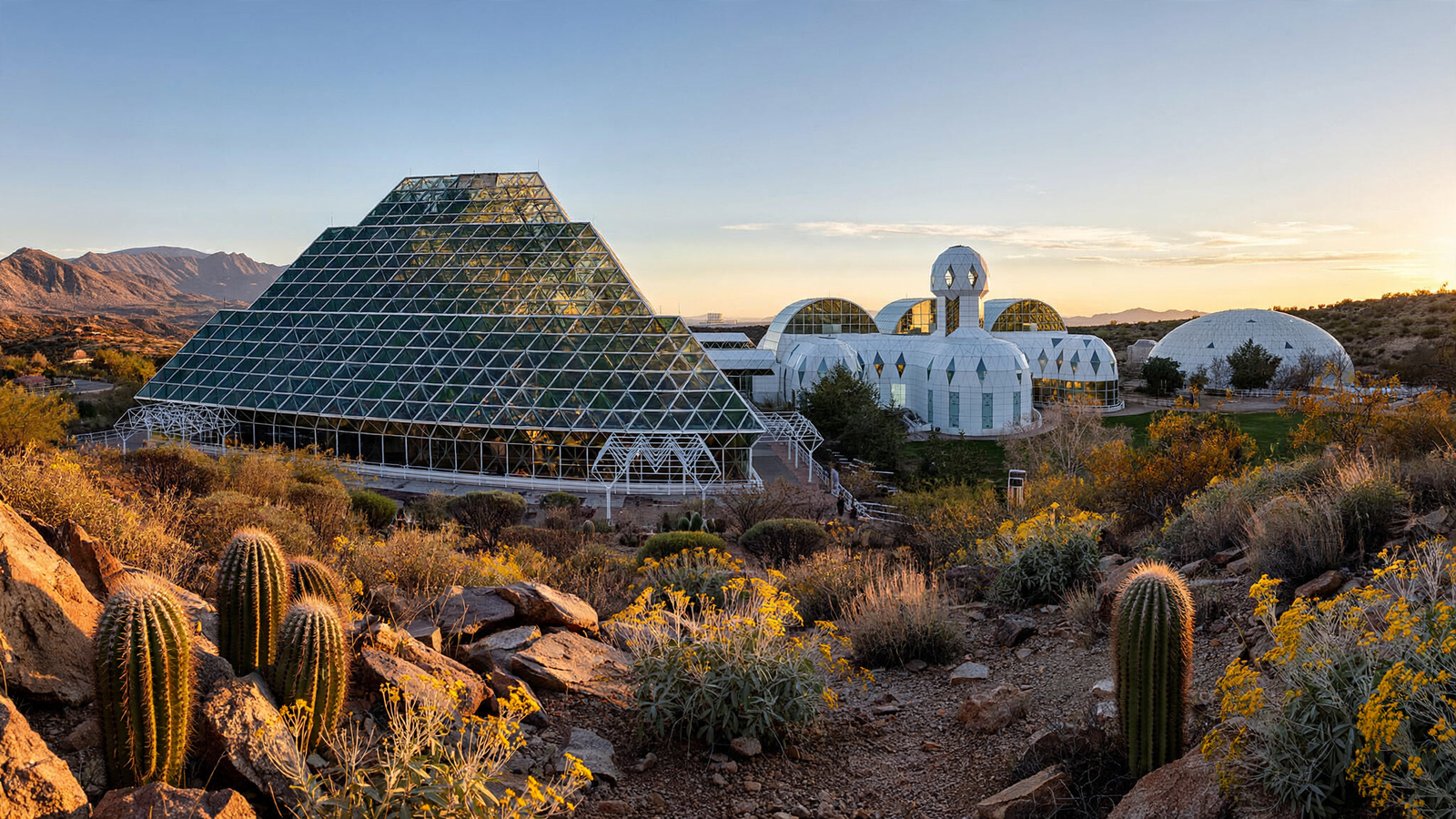
At first glance, Biosphere 2 looks like a group of enormous glass buildings set against the Santa Catalina Mountains. The forms are striking enough to seem futuristic: white frames, curved roofs, angular skylights, and a cluster of structures that catch the desert sun.
But the most interesting thing about the place is not its appearance. It is the question built into the architecture. Can a carefully designed collection of forests, wetlands, crops, water, air, and people function as a living system?
That question has made Biosphere 2, in Oracle, Arizona, one of the state’s most distinctive places to visit. It is part laboratory, part classroom, part architectural experiment, and part reminder that the planet outside its walls is a connected system rather than a collection of separate parts.
A small world in the high desert
Biosphere 2 sits on roughly 40 acres in the foothills of the Santa Catalina Mountains, about 30 miles north of Tucson. The facility’s name reflects its original ambition: Earth is Biosphere 1, while this enclosed complex was intended to be a second, human-built biosphere.
The main structure contains several distinct ecological environments. Visitors can move through a tropical rainforest, a fog desert, a savanna, a mangrove wetland, an ocean area with a coral reef, and agricultural spaces. There are also human living and working areas, where the practical needs of shelter, food, water, and air meet the demands of the surrounding ecosystems.
These environments do not recreate the planet at full scale. They are carefully selected and compressed representations of different ecological processes. A rainforest under glass cannot behave exactly like the Amazon, and a small ocean cannot reproduce the complexity of a real sea. Yet the arrangement makes relationships visible. Water moves between systems. Plants influence air chemistry. Soil, microbes, insects, crops, and people become part of the same managed experiment.
For a visitor, that means the facility is more than a greenhouse or botanical garden. It is a walk through a set of questions about interdependence.
The experiment that made headlines
Biosphere 2 was built in the late 1980s and early 1990s by Space Biospheres Ventures, a group associated with the project’s original conception and development. The first major mission began in September 1991, when eight people entered the facility for a planned two-year stay.
The residents grew some of their food, managed the enclosed environments, and lived with the consequences of decisions made inside the structure. The mission attracted worldwide attention because it presented a dramatic version of a problem that space agencies and scientists had long considered: how might people live for extended periods in an environment cut off from Earth’s broader systems?
The experiment also revealed how difficult that challenge is. Oxygen levels fell during the first mission, requiring oxygen to be added. Crop production and food supplies did not always meet expectations, and the enclosed ecology behaved in ways that were difficult to predict. Some species thrived, while others disappeared. The project did not produce a simple demonstration that a sealed miniature planet could operate independently.
That is part of Biosphere 2’s value. The facility showed that even a highly engineered environment can develop surprises when living systems interact. A mathematical model or a laboratory container can isolate variables. A functioning ecology does the opposite: it links variables together.
From spectacle to working research site
Biosphere 2’s public identity changed over time. After the early human-closure missions, the site became increasingly connected to university research and education. The University of Arizona assumed management of the facility in 2011, and today the university describes Biosphere 2 as a research and learning center.
The change did not make the place less relevant. In some ways, it gave Biosphere 2 a more durable purpose. Instead of being defined mainly by one extraordinary human experiment, the complex could support many kinds of work: studies of water, soil, climate, plant growth, ecosystems, and the effects of environmental change.
Its physical design makes it useful for research that would be difficult to carry out in a normal outdoor setting. Scientists can study large-scale ecological processes in a space where conditions are more observable and, in some cases, more controllable. The structure also provides a rare opportunity to examine how environmental systems respond when water, heat, carbon, nutrients, and living organisms are considered together.
The facility has hosted research on subjects including water availability, desert environments, plant growth, and the effects of changing climate conditions. It has also become a setting for experiments that connect Earth science with questions about future habitats, including the challenge of sustaining people in places where ordinary outdoor ecosystems cannot provide reliable support.
Why the desert setting matters
Arizona is not an accidental location for Biosphere 2. The region’s high-desert climate offers abundant sunlight, broad temperature swings, and a landscape where water is already central to every ecological conversation.
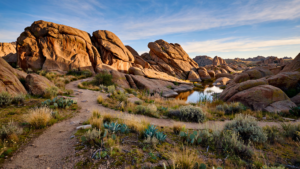
Outside the glass, the Santa Catalina foothills show the constraints of the Sonoran Desert region. Inside, the facility contains environments that are dramatically wetter, greener, and more humid. The contrast turns the complex into a visible lesson in energy and water. A tropical forest under glass may look self-contained, but it still depends on careful management of heat, moisture, airflow, and the movement of water through the system.
That contrast also helps explain why Biosphere 2 remains compelling even for people who are not interested in space exploration. The building is often described through the language of closed worlds and future habitats, but its everyday lessons are terrestrial. How much water does a landscape require? What happens when a food system depends on a narrow range of crops? Which organisms perform unseen work? How quickly can a small ecological imbalance become a larger problem?
A place where visitors can see systems at work
Most environmental processes are easy to overlook because they happen gradually or below the surface. Biosphere 2 brings many of them into view. A visitor can see the structure of a rainforest, walk beside a small ocean, observe desert-adapted plants, and learn how the facility’s agricultural areas fit into its broader design.
The experience is not simply about identifying plants. It is about noticing connections. The same building that shelters a humid forest must also manage Arizona’s intense sunlight. Water is not just scenery; it is a resource moving through multiple environments. Food production is not separate from ecology; it depends on soil, pollinators, nutrients, and careful labor.
Educational programs and guided tours add context to the architecture and the original missions. They also help distinguish the facility from a theme park version of the future. Biosphere 2 is most interesting when it is treated as an imperfect but productive attempt to learn from complexity.
The enduring idea behind the glass
The phrase “closed system” can make Biosphere 2 sound like a finished experiment with a single result. Its longer history suggests something more useful: it is a place where the limits of control can be studied.
People can build walls, install monitoring equipment, choose species, and set starting conditions. They cannot completely dictate how a living system will develop. Microorganisms alter soils. Plants change the air. Water finds pathways. Species compete, cooperate, or fail to survive. Human decisions become ecological events.
That lesson reaches beyond Arizona. Modern cities, farms, reservoirs, and buildings are also managed environments. They may be open to the atmosphere rather than sealed beneath glass, but they depend on networks of energy, water, food, transportation, and waste management. Biosphere 2 makes those relationships unusually tangible.
In a state known for dramatic public landscapes, the place is easy to underestimate. It is not a canyon, a forest, or a river. It is a constructed landscape—one that asks visitors to look closely at what usually remains invisible.
More than three decades after its first residents entered, Biosphere 2 still offers an unusual kind of optimism. It does not promise that humans can engineer their way out of ecological limits. Instead, it demonstrates that careful observation, experimentation, and humility can improve the way we understand those limits. Under its glass roofs, Arizona becomes a classroom for the living planet outside.