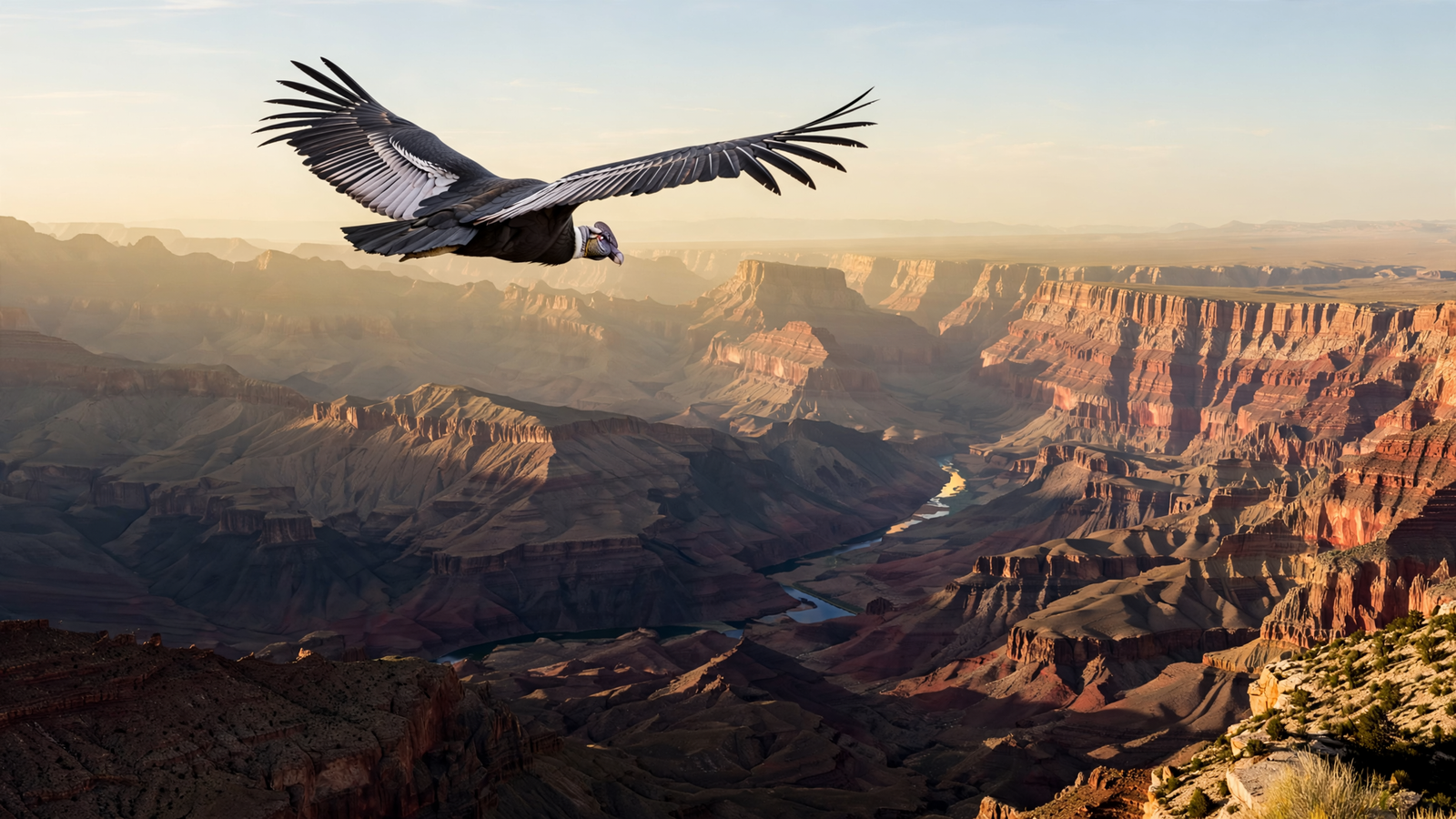
High above the cliffs of northern Arizona, a California condor can appear almost motionless. Its wings stretch nearly 10 feet from tip to tip, allowing the bird to ride rising air above the Grand Canyon, the Kaibab Plateau and the open country around the Colorado River.
That sight would have been difficult to imagine a few decades ago. By the early 1980s, the California condor had been pushed to the edge of extinction. Only 22 birds remained in the world. In 1987, wildlife managers brought the last free-flying condors into captivity, beginning one of North America’s most ambitious bird-recovery programs.
Arizona became one of the places where that effort could begin again in the wild.
A bird built for the American West
California condors are scavengers, and their way of life depends on landscapes large enough to provide food and safe places to nest. They feed on the remains of large animals, then may travel dozens of miles in a single day while searching for their next meal.
Their size makes them unmistakable. Adults have mostly black plumage, white patches beneath their wings and bare skin around the head and neck. That bare skin is an adaptation suited to a bird that feeds on carcasses, while the broad wings are shaped for soaring rather than constant flapping.
Condors also reproduce slowly. A pair generally raises one chick at a time, and young birds may remain dependent on adults for many months. They do not reach breeding age until they are several years old. Those traits helped the species function in a stable ecosystem, but they made it difficult for the population to recover quickly after human-caused losses.
How the condor reached the brink
California condors once ranged across much of the western United States and into Mexico. Over time, habitat changes, shooting, egg collection and other human pressures reduced their numbers. The birds were also vulnerable to poisoning from lead ammunition left in the carcasses of animals they scavenged.
Lead is especially dangerous for condors because they can ingest fragments that are too small to see in their food. Poisoning can weaken a bird, damage its nervous system and eventually cause death. It remains one of the central conservation challenges facing the species.
The condor’s decline accelerated during the twentieth century. By 1982, biologists counted only 22 individuals worldwide. The population included birds in the wild and in captive-care programs, but the number was so small that every individual mattered.
Removing the remaining wild birds was a painful decision. It also created the possibility of protecting them from immediate threats while researchers learned more about their biology and developed a captive-breeding program. Zoos, federal agencies, state wildlife officials and conservation organizations worked together to keep the species from disappearing completely.
Why Arizona mattered
Northern Arizona offered several qualities that made it important to the recovery effort: vast public lands, remote cliffs, large expanses of open habitat and a history of condors using the broader Southwest.
The first California condors released in Arizona returned to the wild in 1996 at Vermilion Cliffs National Monument, north of the Grand Canyon. The release site provided steep cliffs for roosting and nesting, along with the surrounding public lands needed by a wide-ranging scavenger.
The Grand Canyon region also gave the birds room to move between protected landscapes. A condor released near Vermilion Cliffs may travel across northern Arizona and southern Utah, using thermal currents to cross a landscape that includes national parks, national monuments, tribal lands and other public or private areas.
That mobility makes the birds a powerful symbol of connected habitat. The condors do not recognize the boundaries drawn on a map. Their survival depends on cooperation among the agencies and communities whose jurisdictions overlap their range.
From captive breeding to free flight
Captive breeding is not simply a matter of producing more birds. Young condors must learn how to behave like condors, including how to find food, avoid dangerous situations and interact with members of their own species.
Wildlife managers use carefully designed methods to limit human contact. Keepers may use hand puppets shaped like adult condors when feeding young birds, helping prevent the chicks from treating people as part of their social world. Older juveniles can be housed with other condors before release, allowing them to develop behaviors they will need in the wild.
Released birds are monitored closely. Biologists track their movements, check their health and watch for signs of lead exposure. When a condor shows elevated blood-lead levels, wildlife teams may capture it for treatment and return it to the population after it has recovered.
That intensive care can seem unusual for a wild animal, but it reflects the species’ history. The condor population is still rebuilding from an extremely small base, and each adult represents years of work and the possibility of future chicks.
A recovery measured in generations
The California condor population has now grown beyond 500 birds, according to federal wildlife officials. The total includes birds living in the wild and those in managed care. That number is a major change from the 22 birds counted in the early 1980s, but it does not mean the species is secure.
Several free-flying populations now exist in the Southwest and along the Pacific coast. Arizona remains central to the recovery because the Grand Canyon and surrounding public lands provide some of the most recognizable habitat in the program.
The growth is best understood over generations rather than seasons. A condor that flies over the canyon today may be the offspring of a bird that was itself raised in captivity. The young bird may not reproduce for years, and its eventual chick may face many of the same hazards that threatened its parents.
That slow pace is not a failure. It is a reminder that restoration often requires patience. The goal is not merely to place birds on a landscape, but to build a population capable of surviving without constant human intervention.
The lead problem remains
The largest continuing obstacle is the risk of lead poisoning. Because condors feed on carcasses, they can be exposed when animals have been shot with lead ammunition and fragments remain in the meat. Even one poisoned bird can require capture, testing and medical treatment.
Wildlife agencies and conservation groups encourage hunters in condor country to use non-lead ammunition. That choice can reduce the amount of lead available to scavengers while allowing hunters to continue managing wildlife and participating in established hunting traditions.
Education is also part of the recovery program. Visitors who see a condor in Grand Canyon country are asked to give the birds space and avoid approaching roosting or nesting areas. A condor may be resting, caring for a chick or responding to another bird even when it appears still from a distant overlook.
What Arizona’s condors make visible
The condor’s return is more than a wildlife statistic. It is a visible demonstration of how conservation can operate across time. Captive breeding, veterinary medicine, field biology, public-land management and community cooperation all contribute to the same outcome: a bird that can once again occupy part of its former range.
It also changes the way people experience the Grand Canyon. The landscape is not only a geological record or a scenic destination. It is habitat, migration space and a living system in which large animals still make long journeys above the river.
For visitors, the most meaningful condor encounter may last only a few minutes: a dark shape circling above a canyon wall, a numbered tag visible through binoculars, or a sudden shadow crossing the stone. Behind that moment is a recovery effort measured in decades.
Arizona did not save the California condor alone. The work spans states, agencies, tribes, zoos, laboratories and conservation organizations. But the skies over northern Arizona have become one of the clearest places to see what that collective effort has made possible.
The condor is still endangered, and the threats have not disappeared. Yet the bird is no longer represented only by photographs, fossils or stories of what the West once held. It is flying over the canyon again—and that is one of the strongest signs that a nearly lost species can still find a way back.