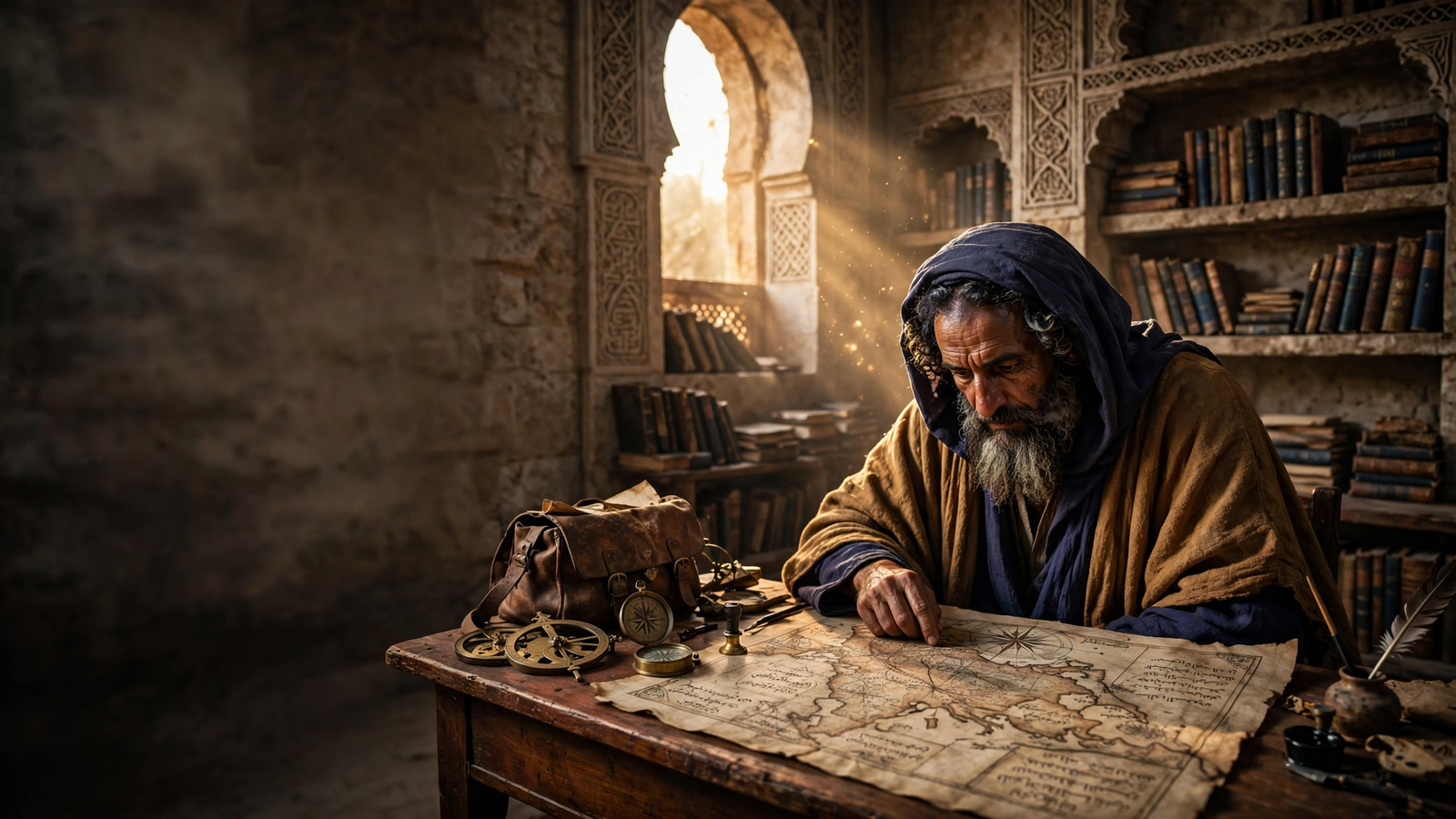
In 1325, a 21-year-old legal scholar left Tangier to make the pilgrimage to Mecca. He expected the journey to be difficult. He could not have known that it would occupy much of his adult life, carry him across an extraordinary portion of the known world, and eventually become one of the most important travel accounts ever written.
His name was Abu Abdallah Muhammad ibn Abdallah al-Lawati al-Tanji ibn Battuta. History usually calls him Ibn Battuta. Over roughly three decades, he traveled through North Africa, Egypt, the Levant, Arabia, Persia, Anatolia, Central Asia, India, the Maldives, Sri Lanka, Southeast Asia, China, al-Andalus, and the kingdoms of West Africa.
The book associated with those journeys is known simply as the Rihla, Arabic for “journey” or “travel account.” Its full title is often translated as A Gift to Those Who Contemplate the Wonders of Cities and the Marvels of Traveling. It is more than a list of destinations. It is a record of roads, courts, mosques, ports, landscapes, customs, dangers, meals, scholars, rulers, and ordinary encounters.
It is also a reminder that travel writing has never been only about where a person went. It is about what the traveler noticed, what he misunderstood, what he remembered, and how he shaped experience into a story that could cross borders long after the traveler returned home.
A pilgrimage that became a life of movement
Ibn Battuta began his first journey during the period of the Marinid dynasty in Morocco. Like many Muslim travelers of his time, he moved through a world linked by religion, scholarship, trade, diplomacy, and hospitality. Arabic served as a language of learning across large parts of the Islamic world, while networks of mosques, religious colleges, merchants, judges, and Sufi communities gave travelers places to seek assistance.
He traveled overland along the North African coast, then through Egypt and Syria before reaching Mecca. The pilgrimage was the first major destination, but it did not become the end of his travels. After completing the pilgrimage, he continued through Iraq and Persia. In later journeys, he visited East Africa, Anatolia, the lands of the Golden Horde, Central Asia, India, the Maldives, and parts of Southeast Asia.
His movements were not those of a modern tourist collecting landmarks. He often traveled as a pilgrim, legal scholar, religious visitor, court official, or guest of powerful patrons. A judge’s education could open doors. A letter of introduction could connect him with a governor or scholar. A position at a court could provide security for a time, even as it placed him inside unfamiliar political worlds.
That mixture of purpose and opportunity helps explain the range of the Rihla. Ibn Battuta was interested in sacred places, but also in legal customs, systems of charity, royal ceremonies, architecture, food, clothing, geography, and the behavior of people whose lives differed from his own.
The world seen through roads and relationships
One of the book’s most compelling features is its sense of connection. Medieval travel was slow and physically demanding, but it was not necessarily isolated. Ibn Battuta repeatedly encountered people who belonged to wider communities of learning and faith. In cities such as Cairo, Damascus, Mecca, and Delhi, he found institutions that linked distant places through scholarship and law.
His account also shows how varied the medieval Islamic world was. Customs that seemed familiar in one region could change dramatically in another. Clothing, marriage practices, religious observance, court etiquette, food, and the treatment of travelers all shifted from place to place.
In the Maldives, for example, Ibn Battuta served as a judge and wrote about local customs and political life. In India, he entered the service of Sultan Muhammad bin Tughluq and was appointed to a judicial position in Delhi. The appointment brought him close to one of the most powerful courts he encountered, but his description of the sultan also reflects the uncertainty of life under a ruler known for both generosity and severity.
Later, Ibn Battuta traveled toward China as an envoy connected to the Delhi court. His descriptions of ports and maritime routes reveal the importance of the Indian Ocean as a zone of commerce and cultural exchange. Ships, merchants, sailors, and religious communities moved between East Africa, Arabia, India, island Southeast Asia, and China.
In West Africa, he visited the Mali Empire during the reign of Mansa Sulayman. His observations of the court, gold trade, public religious life, and social customs became one of the most widely used written accounts of medieval Mali. His perspective was that of an educated visitor from North Africa, not a neutral modern historian, but precisely for that reason the text can be read as both evidence and interpretation.
From memory to manuscript
Ibn Battuta did not write the Rihla as he traveled in the way a modern journalist might keep a daily notebook. After returning to Morocco, he dictated an account of his journeys to Ibn Juzayy, a scholar and secretary connected to the court of the Marinid sultan Abu Inan Faris.
The work was completed in the middle of the 14th century. Its literary form reflects the collaboration between traveler and writer. Ibn Juzayy helped organize and polish the material, while Ibn Battuta supplied the experiences, observations, names, routes, and stories that gave the book its extraordinary scope.
That process matters because the Rihla is not a simple transcript of everything that happened on every day of the journey. Some sections are detailed and personal. Others resemble information drawn from earlier geographical and travel traditions. Scholars have questioned whether Ibn Battuta personally visited every place he describes, especially where his account overlaps with earlier writers or follows conventional literary patterns.
Those questions do not make the book worthless. They make it more interesting. The Rihla belongs to a tradition in which travel knowledge could be gathered from direct observation, conversation, earlier books, and reports from other travelers. Its truth is therefore layered. A passage may tell us about Ibn Battuta’s experience, about what educated readers expected a travel account to contain, or about how one region was understood from another.
Why the journey still feels modern
The most immediate appeal of Ibn Battuta’s writing is its curiosity. He notices things that a purely administrative record might ignore: the hospitality offered to strangers, the visual splendor of a court, the sound of a port, the dangers of a road, the habits of religious communities, and the small differences that make one city feel unlike another.
He also understands that a traveler is never simply an observer. He depends on hosts, interpreters, guides, officials, sailors, and fellow pilgrims. He is welcomed in some places and endangered in others. His social position changes from guest to judge, envoy to supplicant, scholar to foreigner. The book’s movement between confidence and vulnerability gives it much of its human energy.
Modern readers should also approach the Rihla critically. Ibn Battuta writes from a particular religious, social, and gendered position. His descriptions can be judgmental, selective, or shaped by the expectations of his audience. His account is not a complete portrait of the societies he visited, and it should not be treated as one.
Yet every travel writer faces a version of the same challenge. No traveler sees an entire country or understands every community. A journey becomes a book only through selection. What survives is a path through experience, not experience in its entirety.
A map made of stories
Ibn Battuta’s achievement was not simply that he traveled far. Other merchants, pilgrims, sailors, soldiers, and diplomats also crossed great distances. His achievement was to transform movement into a work that allowed distant places to meet on the page.
The Rihla preserves evidence about medieval cities and states, but it also captures a world held together by human mobility. Religious learning traveled with scholars. Commercial knowledge traveled with merchants. Court news traveled with envoys. Stories traveled with everyone.
That is why the book belongs not only to the history of exploration but to the history of writing. Ibn Battuta made geography personal without reducing it to autobiography. He made cultural difference visible without pretending that one traveler could explain everything. And by dictating his memories after returning home, he turned a lifetime of roads into a lasting invitation: look beyond the familiar, and expect the world to be more connected—and more varied—than it first appears.
What the Rihla leaves behind
Today, the book is read by historians studying the medieval Islamic world, by scholars of geography and literature, and by readers interested in the possibilities of travel itself. Its routes can be traced on modern maps, but the most valuable map it offers is less precise. It shows how a person’s understanding can expand through encounters with places that do not conform to expectation.
Ibn Battuta set out for a pilgrimage and returned with a literary world in his keeping. The road became memory; memory became dictation; dictation became a book. More than six centuries later, the journey still works as an act of connection—one traveler’s account opening doors onto cities, cultures, and conversations that might otherwise remain far away.