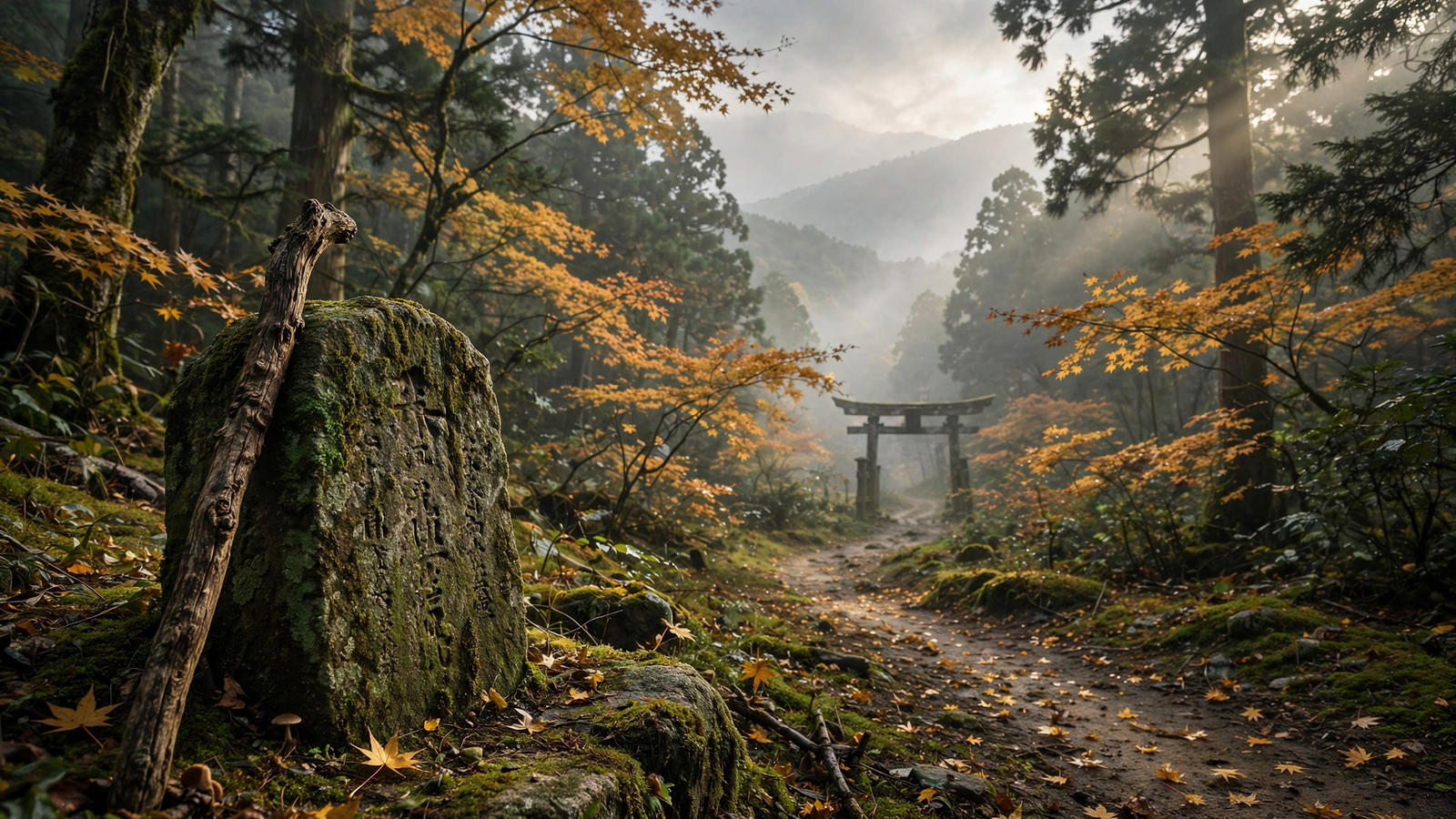
In the spring of 1689, a poet left Edo with a straw hat, a walking staff, a few possessions, and a destination that was as literary as it was geographical. Matsuo Bashō was traveling north across Japan, following roads toward temples, battlefields, remote coastlines, and places already famous in poetry.
He was not simply gathering material for a travel diary. Bashō was entering a conversation with centuries of Japanese writing. Mountains, rivers, old ruins, and moonlit fields were not empty scenery; they carried memories. A famous place could bring earlier poems to mind. A weathered monument could make the past feel briefly present. A road could be measured not only in miles, but in layers of time.
The journey became Oku no Hosomichi, usually translated as The Narrow Road to the Deep North or The Narrow Road to the Interior. Part travel narrative, part prose poem, and part sequence of haiku, it became one of the defining works of Japanese literature. More than three centuries later, its achievement still feels surprisingly modern: Bashō made travel less about collecting sights than about learning how to look.
A poet leaves the city
Bashō was born Matsuo Munefusa in 1644. He first became known in the world of renga, collaborative linked verse in which poets composed alternating sections. The opening verse of a linked sequence, called a hokku, eventually developed into the independent poetic form now known internationally as haiku.
His literary life was closely tied to movement. Bashō lived in different parts of Edo, taught poetry, and spent time in a modest retreat beside a banana plant. The plant’s Japanese name, bashō, became his best-known literary name. It was an apt choice for a poet drawn to the fragile, changeable character of the natural world.
By the late 1680s, Bashō had already earned a reputation, but he was not satisfied with remaining a literary figure in the city. He wanted to walk, observe, and place himself in the landscapes that had shaped the Japanese poetic imagination. In 1689, he began the journey that would become his most famous work.
The route led from Edo into the northern provinces, through areas that were then less familiar to urban readers. The trip included difficult roads, uncertain weather, uncomfortable lodging, and long stretches of travel on foot. Yet the finished book rarely reads like a practical account of hardship. Bashō compresses physical discomfort into moments of perception: a sound in the night, a temple bell, a field under rain, or the sudden shock of seeing a celebrated place for oneself.
Traveling through literary memory
One of the book’s central ideas is that a traveler never arrives at a place alone. Every landscape comes with stories attached to it.
At Hiraizumi, Bashō visited the remains associated with the northern Fujiwara clan and the tragic warrior Minamoto no Yoshitsune. The political power of Hiraizumi had disappeared centuries earlier, but the site remained charged with memory. Bashō’s response is not a catalogue of ruins. He sees the gap between human ambition and the continuing world of nature: grass covering the remnants of warriors’ dreams while the summer sky remains unchanged.
That movement between history and landscape appears throughout The Narrow Road. Bashō visits Matsushima, a coastal area famous for its islands and beauty. He travels toward places associated with earlier poets. He notices roads, rivers, mountains, and villages, but he also measures each scene against the expectations created by poetry and legend.
This makes the book different from a modern guidebook. Bashō is not trying to tell readers where to stay, what to eat, or how long a journey will take. He is exploring what happens when a remembered place meets an actual body moving through it. The destination may be famous, but the experience is personal, weather-dependent, and impossible to repeat exactly.
Where prose and haiku meet
The structure of The Narrow Road is one of its great innovations. Short passages of prose lead into haiku, and the poems alter the meaning of what comes before them. Sometimes the prose establishes a historical or physical setting, while the haiku narrows the focus to one image. Sometimes the poem opens an emotional space that the prose only hints at.
A well-known example comes at the beginning of the journey. Bashō describes leaving his hut and preparing to set out, aware that travelers are always vulnerable to change. The famous opening image of the year’s passing traveler suggests that human life is part of a larger procession of seasons, journeys, departures, and returns.
The writing is spare, but it is not merely simple. Bashō’s brief poems depend on associations that Japanese readers would recognize: earlier poems, seasonal references, Buddhist ideas, and the cultural meaning of particular locations. A single word can connect a present scene to a much older literary world.
That density is part of the book’s appeal and part of its difficulty in translation. No English version can reproduce every sound, historical association, or cultural echo. Translators must decide how much explanation to provide and how much ambiguity to preserve. Even so, the basic experience travels well. Bashō’s writing asks readers to slow down, notice what is easily overlooked, and accept that a moment may be powerful precisely because it will not last.
The art of impermanence
Bashō’s travel writing is often associated with mono no aware, a sensitivity to the poignancy of impermanence. The phrase is not a simple synonym for sadness. It describes an awareness that beauty and loss are connected: blossoms are moving partly because they fall, old buildings are eloquent partly because they decay, and a journey matters because the traveler cannot remain in one place forever.
The book’s landscapes are therefore never just scenic. A ruined battlefield, a fading tradition, or an abandoned dwelling can become a way of thinking about time. Nature is not presented as a frozen refuge from history. It continues around human remains, absorbs them, and gives them a different scale.
That perspective gives The Narrow Road an unusual emotional balance. Bashō is capable of delight, humor, fatigue, reverence, and loneliness, but he does not force every experience into a dramatic conclusion. A travel day may simply be wet. A famous view may be obscured. A planned stop may be disappointing. The writing leaves room for the world to resist the traveler’s expectations.
A journey shaped after the journey
Although the book is based on Bashō’s travels, it should not be read as an untouched notebook. He revised the work over time, shaping episodes and arranging the relationship between prose and verse. The version known today was published after his death, in 1702.
That editorial history matters. The Narrow Road is not valuable because it provides a perfectly transparent record of where Bashō was at every moment. It is a crafted literary journey. The traveler who appears in the book is both a historical person and a carefully constructed narrator.
This does not make the work less truthful. Instead, it reveals a different understanding of travel writing. A journey becomes meaningful through selection, rhythm, memory, and form. Bashō turns movement through physical space into an inward and literary experience without abandoning the real world outside him.
Why the book still travels
The Narrow Road to the Deep North has influenced poets, novelists, translators, walkers, and travelers far beyond Japan. Its reach comes partly from its compactness. The book can be read as a classic of Japanese literature, a work of Buddhist-inflected reflection, a guide to historical landscapes, or an early example of literary travel writing. It does not settle into only one category.
It also offers a useful correction to the idea that travel must be spectacular to matter. Bashō does visit celebrated places, but his deepest attention often falls on transitions: leaving a house, crossing a pass, waiting out bad weather, hearing a sound at night, or standing before a landscape that carries more history than one person can absorb.
For contemporary readers, that may be the book’s quietest lesson. Travel is not only movement toward novelty. It can be an encounter with memory, limits, and the unstable relationship between what we expect to see and what is actually there. The most important souvenir may not be an image or an anecdote, but a changed habit of attention.
Bashō died in 1694, only a few years after the journey that made his name inseparable from the road. His book outlived the circumstances that produced it: the old routes, the particular inns, the political landscape, and the traveler himself. Yet its central motion remains recognizable. Someone leaves home, follows a difficult path, looks closely at the world, and discovers that the road has been carrying the past all along.
That is why The Narrow Road continues to feel alive. It does not promise that travel will solve anything. It suggests something more modest and more durable: that walking attentively through the world can change the scale at which we understand our own lives.