In the spring of 1943, the United States began recruiting volunteers for a new Army unit. The men who answered were asked to serve a country that had placed many of their parents, relatives, and neighbors behind barbed wire.
They became the 442nd Regimental Combat Team, a segregated unit made up largely of Japanese American soldiers. Its record in Europe would become extraordinary: hard-fought victories in Italy and France, thousands of individual decorations, and a rescue mission remembered as one of the most dramatic actions of the Second World War.
The 442nd’s story is not only about battlefield courage. It is also about citizenship under pressure—and about soldiers who used military service to challenge the idea that ancestry determined loyalty.
A unit born from contradiction
After Japan attacked Pearl Harbor in December 1941, Japanese Americans faced intense suspicion across the United States. In February 1942, President Franklin D. Roosevelt signed Executive Order 9066, which led to the forced removal and incarceration of Japanese Americans from much of the West Coast. More than 100,000 people were sent to camps, most of them American citizens.
At the same time, the military had to decide whether Japanese Americans could serve. The Army had classified many Japanese American soldiers as unsuitable for combat, even though some had already enlisted. The 100th Infantry Battalion, formed largely from Japanese American soldiers in Hawaii, was eventually sent to Europe. Its men would become the veteran core of the future 442nd.
In January 1943, the War Department announced the creation of a Japanese American combat unit. Volunteers came from Hawaii, where Japanese Americans made up a large share of the population, and from the mainland, including men released from incarceration camps for military service. The 442nd was activated at Camp Shelby, Mississippi, on June 1, 1943.
The decision to volunteer was complicated. Some families feared that their sons were being asked to prove loyalty to a government that had denied them basic rights. Others saw military service as a direct answer to prejudice. For many recruits, both feelings were present at once.
Training together at Camp Shelby
At Camp Shelby, the 442nd trained as an infantry regiment. The soldiers practiced the demanding routines of modern combat: moving under fire, handling machine guns and mortars, coordinating with artillery, and advancing through unfamiliar terrain.
The unit also became a meeting place for two Japanese American communities with different wartime experiences. The soldiers from Hawaii often used the word “Buddhahead” for themselves and spoke a local form of English known as “pidgin.” Mainland soldiers, many of whom had come from incarceration camps, brought different experiences and expectations. Training did not erase those differences, but shared military life gradually built a common identity.
The 442nd’s motto, “Go for Broke,” came from a phrase associated with taking a full chance. It captured the determination of soldiers who knew that their actions would be judged not only as individuals but as representatives of a group that much of the country viewed with suspicion.
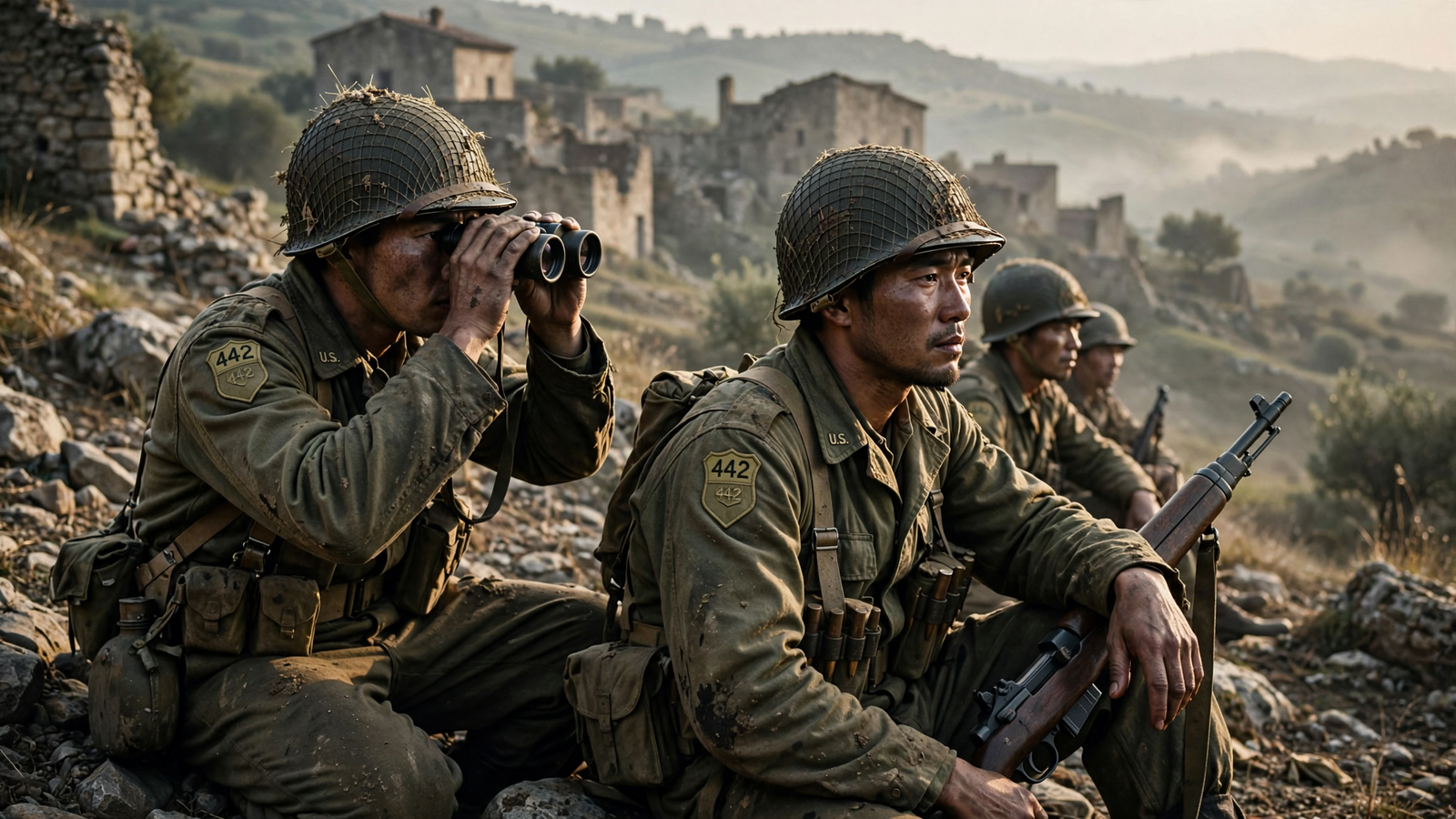
In May 1944, the 442nd joined the Allied campaign in Italy. The 100th Infantry Battalion, already fighting there, became closely associated with the regiment. The unit moved through mountainous country, where steep slopes, stone buildings, minefields, and German defensive positions made every advance costly.
Combat in Italy and France
The 442nd fought as Allied forces pushed north through Italy. Its soldiers helped break through German positions and capture towns, but the progress was measured in difficult marches and heavy casualties rather than quick triumphs.
In the fall of 1944, the regiment was transferred to France. There, near the Vosges Mountains, it encountered a crisis involving the 141st Infantry Regiment, a unit from Texas. One of the 141st’s battalions had been surrounded by German forces near the town of Biffontaine. The trapped soldiers became known as the “Lost Battalion.”
Several American formations attempted to reach them. The 442nd was ordered into the effort despite having already suffered serious losses in Italy and earlier fighting in France.
The rescue began on October 26, 1944. The Japanese American soldiers advanced through dense forest and rugged terrain against determined German resistance. Progress was slow. Units moved through artillery fire, machine-gun positions, and close combat. After days of fighting, soldiers from the 442nd and attached units reached the surrounded Texans and opened a corridor out of the pocket.
The rescue succeeded, but it came at a high price. The 442nd suffered hundreds of casualties in the operation. The scale of the losses has sometimes been softened by the drama of the rescue, but the central fact is stark: the unit saved the battalion while losing many of its own men.
The action became the best-known episode in the regiment’s history because it revealed both its determination and the terrible cost of combat. The 442nd was not a symbolic unit placed safely behind the lines. It was repeatedly sent into some of the hardest fighting available to American troops.
More than a single rescue
The Lost Battalion rescue has dominated popular accounts of the 442nd, but it was only one part of the unit’s wartime record. The regiment fought in the Italian campaign, helped capture strategic positions in France, and continued operations until the end of the European war.
The 442nd also included specialized elements. The 522nd Field Artillery Battalion supported Allied operations in Europe and later helped liberate prisoners from subcamps connected to Dachau. Those soldiers encountered evidence of Nazi persecution as Allied armies advanced into Germany. Their experiences showed that Japanese American units were involved in the broader Allied effort against the concentration-camp system, even though the soldiers’ primary mission remained combat support.
Because the 100th Battalion and 442nd were often attached to different commands, their service records can be difficult to summarize in a single number. Military historians generally describe the combined record as one of the most decorated in American history relative to the unit’s size and time in combat. Members received thousands of awards, including Distinguished Service Crosses, Silver Stars, Bronze Stars, and more than a dozen Distinguished Unit Citations during the war.
For decades, the number of Medals of Honor associated with the unit was widely reported as one. A later review found that some service members had received lower awards despite actions that met the standard for the nation’s highest military decoration. In 2000, 22 Japanese American soldiers from the 442nd and 100th were awarded the Medal of Honor, while other veterans received upgrades to previously awarded decorations. The correction did not change what happened on the battlefield, but it changed how the country officially remembered it.
Returning to a changed country
When the soldiers came home, their reception varied. Some communities welcomed them. Others continued to treat Japanese Americans with hostility. Many veterans returned to families whose homes, farms, businesses, and possessions had been lost during incarceration.
The government eventually ended the incarceration program, but reopening the gates did not undo the damage. Veterans of the 442nd returned to a country that had praised their battlefield service while failing to fully acknowledge the injustice imposed on their families.
Still, their military record became an important source of leverage in the long struggle for recognition. Japanese American veterans and their supporters helped preserve the history of the unit and pressed the government to confront the contradiction between wartime patriotism and domestic discrimination.
In 1988, Congress passed the Civil Liberties Act, which formally apologized for the incarceration and authorized reparations for surviving victims. The law did not erase the experience, but it represented a federal acknowledgment that the wartime policy had been wrong. The service of Japanese American veterans formed part of the historical record that made that reckoning harder to avoid.
A legacy measured in choices
The 442nd’s legacy is sometimes reduced to a slogan: the most decorated unit for its size. That description is accurate as far as it goes, but it leaves out the deeper question behind the medals.
These soldiers did not serve because the country had treated them fairly. Many served while their families were incarcerated. They served amid suspicion, unequal treatment, and uncertainty about whether their citizenship would be recognized as fully as their sacrifice.
Their story therefore belongs to military history and to the history of American democracy. The 442nd fought Germany overseas, but its record also confronted an American assumption at home: that loyalty could be judged by race or ancestry.
The soldiers could not control the government’s policies, the prejudice they faced, or the risks of the missions assigned to them. They could control how they met those conditions. In Europe, they built a record that their country could not easily dismiss. In the decades afterward, their service helped give later generations a clearer view of both American courage and American failure.
The 442nd did not prove that the United States had always lived up to its ideals. It proved something more demanding: that people denied fairness could still claim those ideals—and, through sacrifice and persistence, help force the nation to widen them.