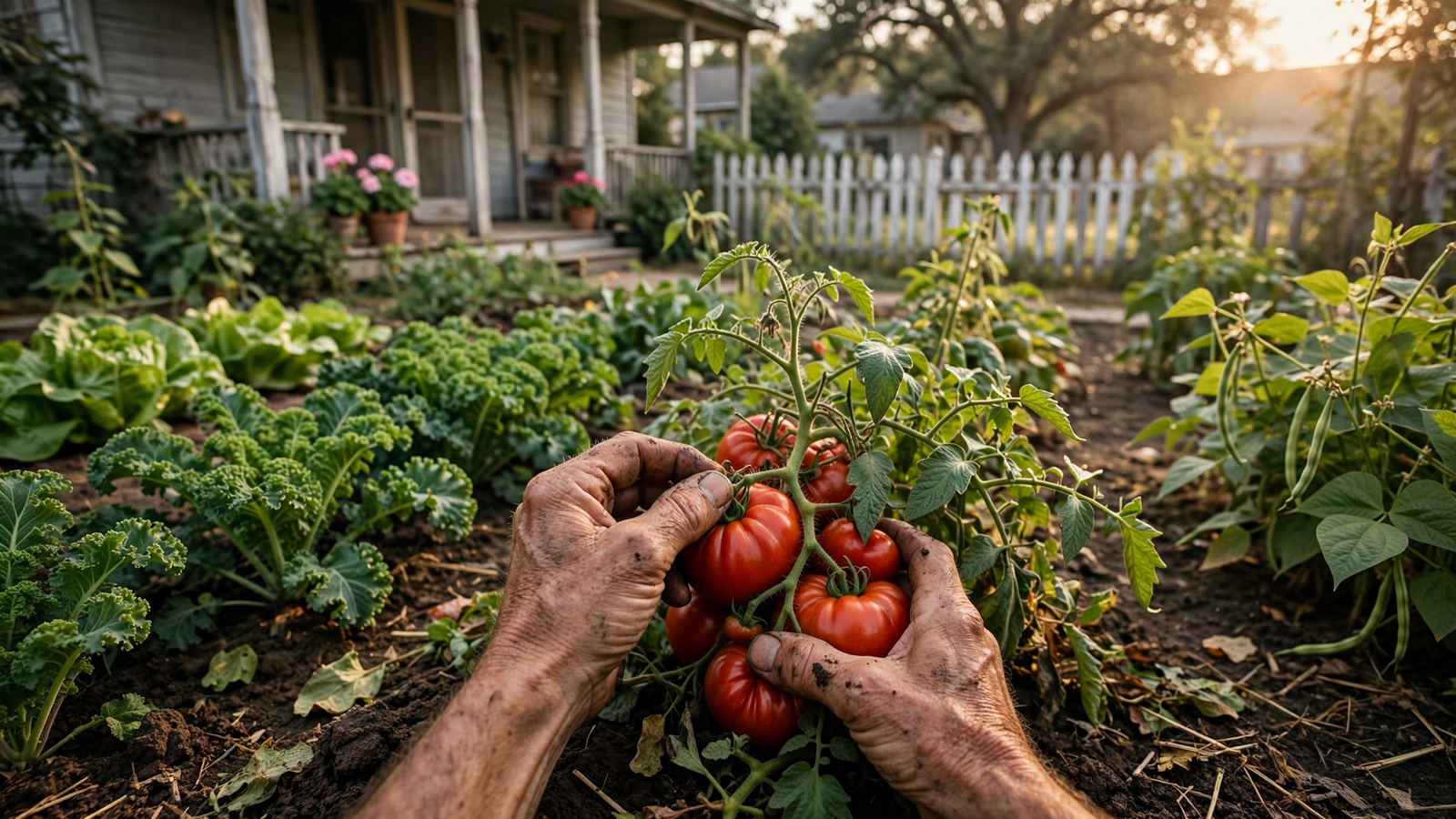
In the spring of 1943, a vegetable garden could be more than a vegetable garden.
It might be a narrow strip beside a city sidewalk, a schoolyard plot tended by children, or a backyard pressed into service between the clothesline and the garage. It might produce lettuce, beans, tomatoes, carrots, beets, or enough zucchini to test a family’s imagination. In wartime America, it was also part of a national food strategy.
These were the Victory Gardens: one of the most recognizable home-front campaigns of World War II. The federal government encouraged civilians to grow food, preserve what they harvested, and make careful use of groceries that were becoming harder to obtain. The effort brought government advice into ordinary kitchens and made gardening feel like a form of public service.
Its legacy survives whenever a family saves tomato seeds, freezes green beans, cans peaches, or decides that a patch of lawn might be more useful as food.
Before victory gardens, there were war gardens
The idea did not begin in 1941. During World War I, the United States promoted “war gardens,” asking households, schools, and communities to grow vegetables while commercial farms concentrated on feeding soldiers and allies. The campaign connected gardening with patriotism and self-reliance, and it established a language that would return a generation later.
When the United States entered World War II, the food situation was different but still demanding. Farmers had to supply American troops, support allied nations, and feed a population facing shortages of labor, equipment, fertilizer, and transportation. Sugar, coffee, meat, and other products were rationed or restricted. Fresh produce was not always rationed in the same way, but it still had to move through a system under pressure.
Government officials did not present home gardens as a replacement for commercial agriculture. Instead, they described them as a way to add food to the national supply, reduce demand on transport, improve household nutrition, and help families live with rationing.
That distinction mattered. A backyard garden could not feed an army. But millions of small gardens could change what families bought, what they preserved, and how much produce traveled from farm to market.
A national campaign with ordinary tools
The wartime garden campaign was coordinated through a mixture of federal agencies, state agricultural colleges, local governments, schools, civic groups, and newspapers. The U.S. Department of Agriculture published advice on planting, pest control, harvesting, and preservation. Posters and public-service messages encouraged people to grow what they could and avoid wasting food.
The campaign’s appeal was practical as much as patriotic. People did not need a tractor or a large farm. A garden could be adapted to the space available. Apartment dwellers might use window boxes or community plots. Schools could turn lessons in biology and arithmetic into a shared growing project. Homeowners could replace part of a lawn with rows of vegetables.
Gardening also gave civilians a visible way to participate in a global conflict that was otherwise experienced through radio reports, ration books, blackouts, and letters from overseas. A seed packet offered a small promise of action: prepare the soil, plant the row, tend the crop, preserve the surplus.
By 1943, estimates commonly placed the number of Victory Gardens in the millions, with federal and historical sources often citing roughly 18 to 20 million gardens nationwide. The exact total is difficult to establish because many household and community plots were never formally counted. The scale, however, is clear: gardens appeared across cities, suburbs, farms, and institutional grounds.
The garden changed the kitchen
Planting was only the first step. A successful garden created a second problem: what to do with a sudden abundance of produce.
Wartime food guidance therefore reached beyond the garden bed. Government publications and extension services taught families how to can, dry, pickle, freeze, and store food safely. The advice was especially important because preservation was not simply a matter of taste. Improperly canned foods could become dangerous, and families needed reliable instructions about equipment, processing times, cleanliness, and storage.
Recipes adapted to the moment. A meal might stretch a small amount of meat with vegetables, beans, or grains. Fresh greens could stand in for ingredients that were scarce. Leftovers were repurposed rather than discarded. Pickles, relishes, jams, and canned tomatoes extended the life of the harvest into winter.
This was not glamorous cooking. It was cooking shaped by supply, thrift, and planning. A family had to think across seasons: plant in spring, harvest in summer, preserve in fall, and draw on the pantry when fresh food was limited. The kitchen became a place where household management and national policy met.
That relationship can be seen in the era’s home-front publications. They did not treat food merely as fuel. They connected balanced meals with health, productivity, and morale. The garden was expected to produce nutritious food, while the kitchen was expected to use it carefully.
Children, schools, and shared ground
Victory Gardens were also social spaces. Schools established gardens as both food-producing projects and lessons in responsibility. Children learned that vegetables did not begin in a grocery store; they began as seeds requiring water, sunlight, patience, and protection from pests.
Community gardens gave people without private yards a chance to participate. In some places, vacant lots and public land were divided into plots. Neighbors shared tools, exchanged advice, and dealt collectively with problems such as poor soil or limited water.
The public nature of the campaign helped turn gardening into a visible expression of solidarity. A row of beans outside a home was not only a private improvement. It announced that the household was contributing something tangible, however small, to a wider effort.
But the story was not equally simple for everyone. Access to land, water, tools, time, and reliable food-preservation equipment varied widely. Farm families already had agricultural knowledge that many urban residents lacked. Some households could afford canning supplies or extra seed; others could not. The cheerful poster image of a garden sometimes concealed the labor required to maintain one.
That labor fell disproportionately on women, who were often expected to manage rationing, meal planning, preservation, and household gardens in addition to other wartime responsibilities. The campaign celebrated domestic work as patriotic, but celebration did not make the work easy.
What the gardens accomplished
It is tempting to measure Victory Gardens only by the tonnage they produced. That number is difficult to calculate with precision because the gardens were decentralized and records varied. Their importance was broader than a single harvest statistic.
Home production gave families access to fresh vegetables at a time when transportation and commercial supplies were under strain. It helped households make better use of rationed foods. It supported preservation skills that reduced waste. It also created a culture in which saving food, sharing surplus, and growing something edible were understood as civic virtues.
The gardens had an emotional value, too. War reorganizes daily life around events that happen far away. Gardening returned attention to something close: the condition of the soil, the appearance of the first blossom, the ripening of a tomato. The work was repetitive, but its results were immediate and visible.
For children, it offered a concrete lesson in time. A seed could not be hurried by enthusiasm. A harvest required care long before it appeared on a plate. In that sense, the garden taught patience as much as patriotism.
After the war, the lawn came back
Victory Gardens did not disappear overnight when the war ended, but the campaign lost its national urgency. Commercial agriculture recovered, rationing ended, consumer goods returned, and many temporary plots were converted back to lawns or ordinary landscaping.
Yet the idea remained available for later generations. Community gardens, school gardens, urban agriculture projects, and household food-growing movements have repeatedly drawn on the wartime example. The language may change—from victory to sustainability, resilience, local food, or food security—but the underlying invitation is familiar: grow what you can, waste less, and share what you have.
The most enduring lesson of the Victory Garden is not that every household should become self-sufficient. It is that food connects private habits to public life. A family recipe can reflect a season, a shortage, an immigrant tradition, or a neighborhood exchange. A pantry can preserve more than vegetables; it can preserve knowledge.
During World War II, millions of Americans discovered that a small plot could carry a surprisingly large meaning. A garden fed the people who tended it. It also made a distant national emergency visible in the most ordinary way: as dinner waiting to be picked.