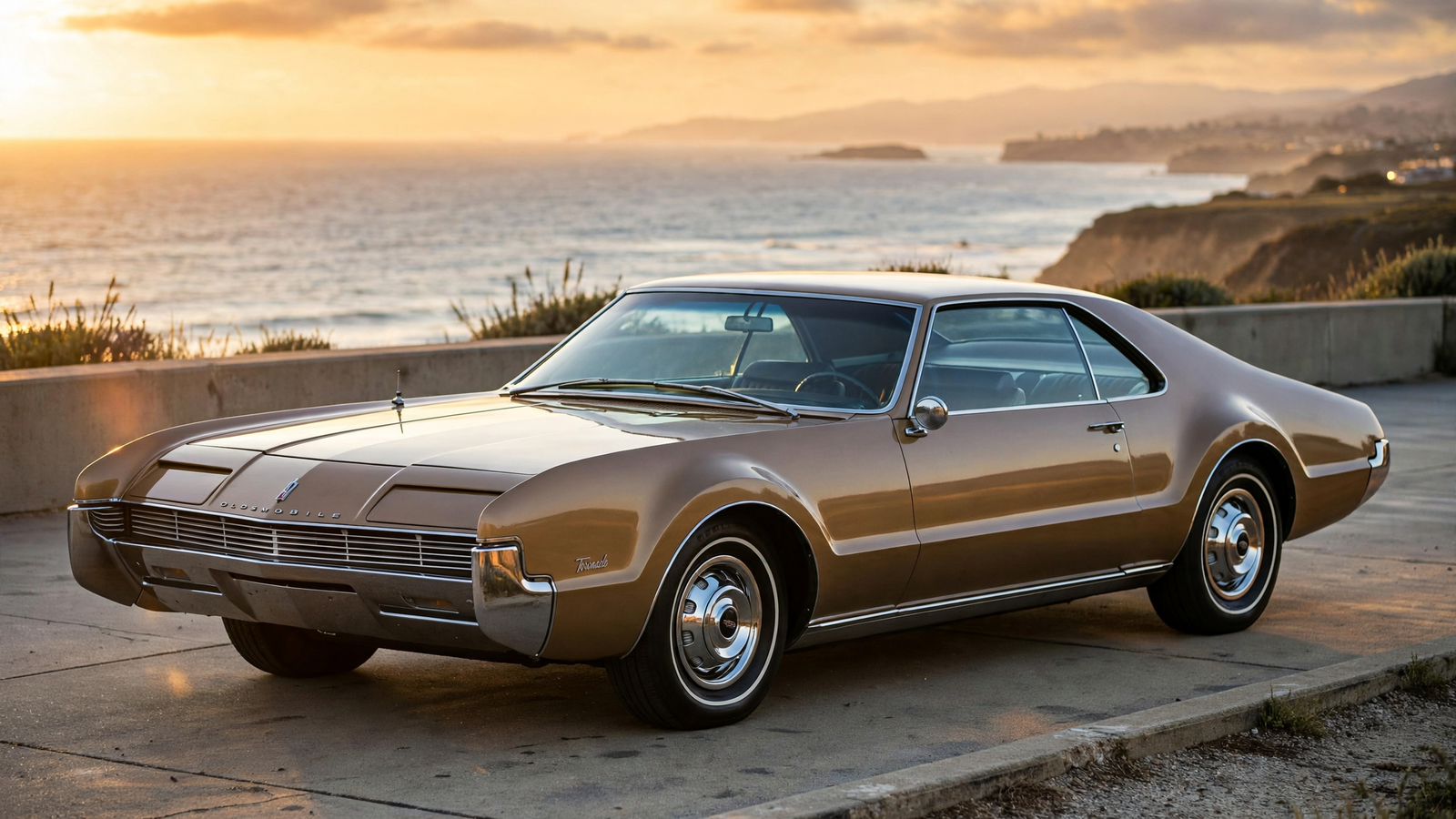
In the autumn of 1965, Oldsmobile introduced a car that seemed to have arrived from a more streamlined future. The Toronado sat low and wide, with a long hood, hidden headlamps, sharply cut fenders, and no visible drive shaft running beneath its passenger compartment. Its proportions suggested a powerful grand touring car. Its mechanical layout suggested something far more unusual.
The 1966 Oldsmobile Toronado was front-wheel drive.
That arrangement was not new to the automobile. Front-wheel drive had already appeared in pioneering cars such as the 1929 Cord L-29 and the 1936–37 Cord 810 and 812. But by the postwar era, most American cars used the familiar formula of a front-mounted engine driving the rear wheels. Oldsmobile’s achievement was to bring front-wheel drive back into a mainstream American car at a moment when Detroit was becoming increasingly confident in size, horsepower, and visual spectacle.
The Toronado did not look like an engineering exercise. It looked like a new kind of American luxury car.
A problem hidden beneath the styling
Oldsmobile had been considering a front-wheel-drive automobile for years. The challenge was not simply to place the engine at the front and send power to the front wheels. The system had to fit inside a car large enough for American roads, American passengers, and an American V8.
Engineers developed a compact arrangement that placed the transmission beside the engine rather than behind it. Power traveled through a chain drive to the transmission, then through half-shafts to the front wheels. This allowed the Toronado to use a conventional longitudinal V8 while keeping the major mechanical components forward in the body.
That packaging created a useful benefit: without a driveshaft and rear differential taking up space beneath the floor, the passenger compartment could have a flatter interior. The Toronado was still a large car, but its layout made the space work differently. The front wheels both steered and pulled the car, while the rear of the vehicle could be devoted primarily to passengers, luggage, and styling.
Oldsmobile also had to manage the forces created by putting so much power through the front wheels. The first Toronado used a 425-cubic-inch Rocket V8, producing 385 horsepower. Its front-wheel-drive system, known as Unitized Power Package, was engineered to cope with the weight and torque of a full-size American automobile rather than a small economy car.
From concept-car drama to production car
The Toronado’s styling was shaped by Oldsmobile designer David North, working within a General Motors design culture that encouraged experimentation while demanding production discipline. The finished car retained much of the visual impact expected from a show car: its grille was clean and horizontal, its headlamps disappeared behind clamshell doors, and its roofline flowed into a short rear deck.
Yet the Toronado was not a limited engineering demonstrator. Oldsmobile planned to build it in volume, and the company gave the car a place in its regular lineup for the 1966 model year.
The decision mattered. A concept car can make almost any idea appear possible because it does not have to meet the full demands of manufacturing, service, safety, durability, and everyday use. The Toronado had to survive all of them. It had to be assembled on a production line, sold through Oldsmobile dealers, and driven by customers who might never have cared about drivetrain architecture.
Its design helped make the unfamiliar seem approachable. Drivers did not have to buy a small, austere, or visibly experimental automobile to experience front-wheel drive. They could buy a dramatic personal coupe with a large V8, automatic transmission, power steering, and the comfort expected of a contemporary Oldsmobile.
The road test that changed the conversation
When automotive journalists tested the Toronado, they found a car whose behavior was different from that of a conventional rear-wheel-drive coupe. The front tires had to handle steering, braking, and driving forces at the same time, but the arrangement also gave the car strong traction under many conditions. The weight of the engine and transmission rested over the driven wheels, a characteristic that could be especially useful on wet or slippery pavement.
The Toronado was not a sports car in the lightweight European sense. It was a substantial American machine, weighing well over two tons. But its front-wheel-drive layout gave it a distinct sense of direction and stability. The car could put its power down without the rear-end behavior familiar to drivers of powerful rear-wheel-drive cars.
Its significance was recognized quickly. The Toronado received Motor Trend’s Car of the Year award for 1966, an honor that reflected more than its appearance. The car represented an engineering achievement that had been made visible to ordinary buyers.
Oldsmobile’s work also demonstrated that front-wheel drive did not have to be associated only with small cars or unusual specialty vehicles. In the decades that followed, the layout would become common in family sedans, compact cars, minivans, and many crossovers. The Toronado was not solely responsible for that transformation, but it was one of the clearest American demonstrations that the arrangement could work at scale.
What the Toronado changed—and what it did not
The Toronado did not instantly convert Detroit to front-wheel drive. General Motors continued to build large rear-wheel-drive cars, and many buyers still preferred the familiar mechanical arrangement. The Toronado itself remained a distinctive branch of the Oldsmobile family rather than becoming the template for every car in the showroom.
Its first-generation design lasted through the 1970 model year, with annual changes to trim, equipment, and performance. The car grew more ornate as the 1960s progressed, reflecting the period’s appetite for chrome, luxury, and visual confidence. Later generations changed direction. The 1971 Toronado became more formal, while the 1973 model introduced a sharper, more upright shape.
Over time, the Toronado also became part of a wider shift in how Americans understood personal transportation. The large personal coupe was eventually displaced by more practical formats, but the idea of placing the driven wheels at the front continued to spread. By the late twentieth century, front-wheel drive had become a familiar solution for manufacturers trying to make efficient use of interior space, reduce weight, and provide predictable traction.
In that sense, the Toronado’s legacy is larger than its sales figures or its place in Oldsmobile history. It helped separate front-wheel drive from the idea of the oddball car. The technology could be wrapped in chrome, horsepower, and comfort. It could be sold not as a compromise, but as part of an exciting new automobile.
An American answer to an old question
Automotive history is often told through inventions that seem inevitable in retrospect. Front-wheel drive can look that way today, especially when viewed from an era filled with front-driven cars. In 1965, however, an American buyer shopping for a powerful coupe had every reason to expect the rear wheels to do the work.
The Toronado challenged that expectation without asking its customers to give up the pleasures they associated with an American car. It offered a big engine, a long-distance character, dramatic styling, and a new mechanical layout underneath. The innovation was real, but it was presented as something desirable rather than dutiful.
That may be the Toronado’s most enduring lesson. A breakthrough becomes part of everyday life not only when engineers make it function, but when designers and manufacturers make people want it. Oldsmobile understood that the future would need more than a clever transmission and a compact engine bay. It needed a face, a stance, and a reason to leave the showroom behind the wheel.
The Toronado supplied all three. For a brief, remarkable moment, it made the future of American motoring look wide, low, powerful, and ready for the open road.