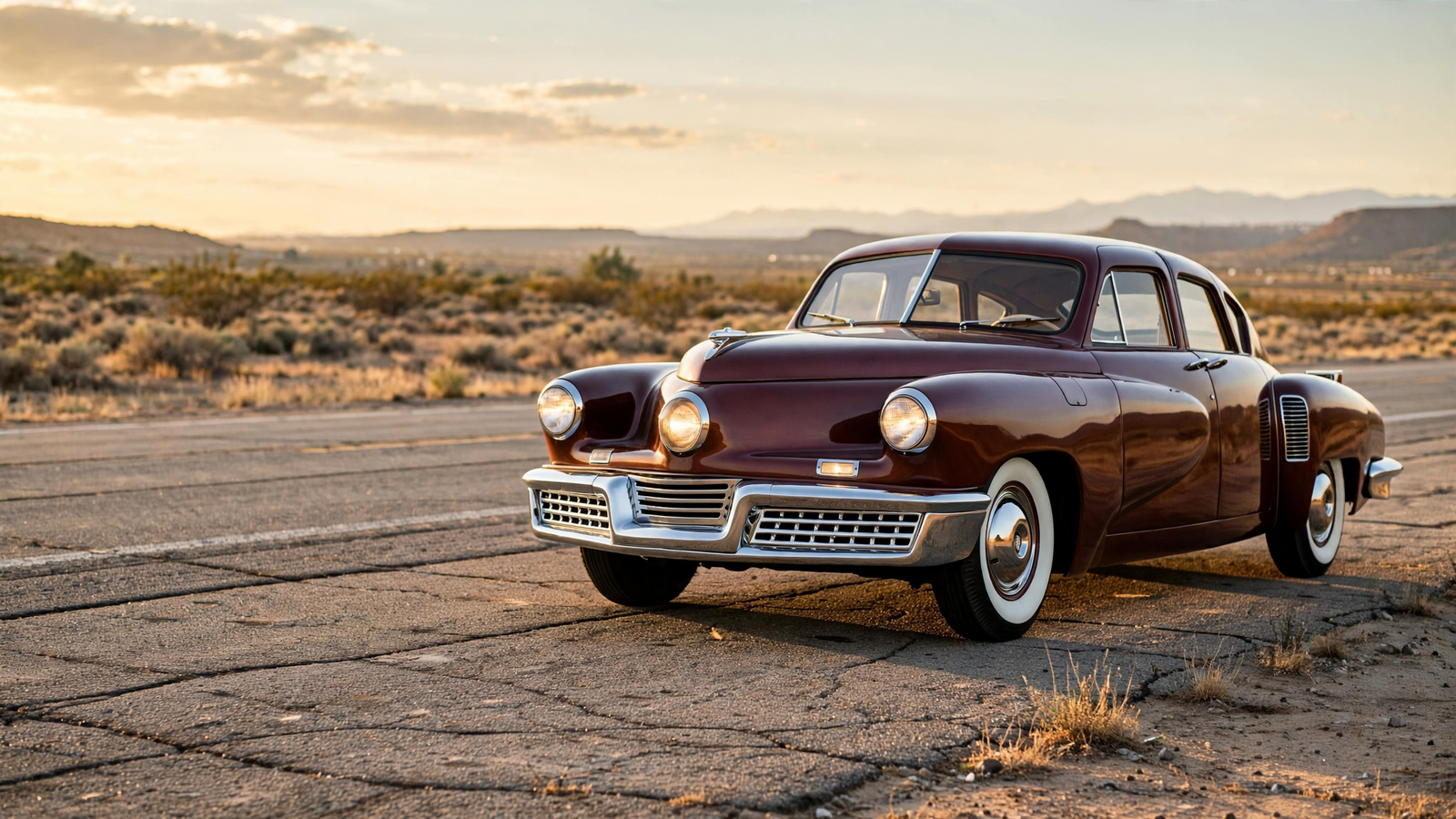
In the years after World War II, American car buyers were offered a familiar promise: more chrome, more power, more room, and a newer-looking version of the same basic automobile. Preston Tucker proposed something different.
His car, introduced in 1947 and produced in small numbers as the 1948 Tucker, was designed around a question that Detroit rarely placed at the center of the sales pitch: what happens to the people inside when a car crashes?
The answer was the Tucker 48, one of the most unusual American automobiles ever built. It had a rear-mounted engine, a steering-linked center headlamp, a padded dashboard, a pop-out windshield, and a cabin designed to give occupants more room to escape injury. Its proportions were unlike those of the dominant Detroit sedans, and its engineering was ambitious enough to attract both public fascination and official scrutiny.
Only a small number were completed before the Tucker Corporation collapsed. Yet the car became more than a failed business venture. It became a durable symbol of American automotive imagination: proof that a new company could challenge an established industry by changing the question from “How much car can we sell?” to “How much better can a car be?”
A car born into a changing America
Preston Tucker was not a conventional automaker. He had worked in sales and automotive distribution and had already built a reputation as an energetic promoter and inventor. During the war, he was associated with military vehicle and armament projects, including work connected with the Tucker Turret, a powered gun turret used on some aircraft.
When the war ended, the United States faced a huge pent-up demand for new cars. Civilian automobile production had been sharply restricted during the conflict, while families had spent years postponing purchases. The opportunity for a new manufacturer seemed enormous.
Tucker’s answer was first presented under the dramatic name “Torpedo.” That name emphasized the car’s streamlined shape, but the underlying idea was more important than the styling. Tucker wanted a car that was spacious, mechanically distinctive, and safer than the ordinary family sedan.
The final production model was called the Tucker 48. Its design came from a team that included stylist Alex Tremulis, whose work gave the car its low, rounded profile. The body looked futuristic without being purely decorative. The fenders flowed into the doors, the roof was unusually broad, and the wheels were set toward the corners, helping create a long, open passenger compartment.
Safety was part of the design, not an afterthought
The Tucker’s most important innovations were inside its shape.
One of the most recognizable features was the central headlamp, often called the “Cyclops eye.” It was connected to the steering system and turned with the front wheels, helping illuminate the direction of a bend. The idea was simple: a headlamp should help the driver see where the car was going, not merely shine straight ahead.
The passenger compartment also included a padded dashboard. At a time when dashboards commonly contained hard metal surfaces and prominent knobs, padding represented a direct attempt to reduce the consequences of a collision.
The windshield was designed to pop out during a severe impact rather than remain a rigid barrier in front of occupants. Tucker also promoted a reinforced central section of the passenger compartment—a “safety chamber,” in the company’s language—intended to protect the people inside while allowing the front and rear sections to absorb some of the crash forces.
Modern crash protection is far more sophisticated. Today’s vehicles rely on carefully engineered crumple zones, airbags, seat-belt systems, advanced materials, and computer-modeled crash structures. The Tucker did not invent all of those principles, and some of its solutions were difficult to manufacture or evaluate by later standards. But it placed occupant protection unusually close to the center of the car’s identity.
That was a meaningful departure. In the late 1940s, safety was not yet the comprehensive engineering discipline it would become. Many buyers judged cars by styling, size, comfort, and power. Tucker tried to make protection itself part of the automobile’s appeal.
A radical mechanical layout
The Tucker 48 was also unusual beneath its body. Instead of placing the engine in front, Tucker’s engineers mounted it behind the passenger compartment. Rear-engine layouts could free space in the front of the car and provide strong traction at the driven wheels, although they also created handling and cooling challenges.
The company eventually used a 335-cubic-inch flat-six engine derived from an air-cooled aircraft powerplant. It was adapted for automotive use and paired with a transmission designed for the car. The engine’s placement contributed to the Tucker’s low nose and open front structure, but it also made the vehicle unlike the front-engine sedans that dominated the American market.
Some planned features did not reach production. Tucker originally promoted a “floating” suspension concept and other ambitious mechanical ideas, but the production cars were simplified as the company struggled to move from prototype to manufacturing. That distinction matters: the Tucker story is often told as if every dramatic proposal became reality. In practice, the finished cars represented a mixture of advanced ideas, compromises, and engineering solutions under intense time pressure.
Building a factory was harder than building a dream
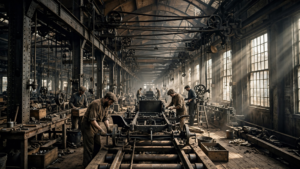
Tucker’s company acquired a huge former aircraft plant in Chicago. The facility offered space and industrial prestige, but a vacant factory is not automatically a functioning automobile plant. Production required tooling, suppliers, trained workers, quality control, financing, and a reliable flow of thousands of components.
The company tried to raise money before full-scale production through a controversial accessory-sales program. Prospective buyers could purchase items such as seat covers and other accessories in advance, with the expectation that this would help support the new car. Federal authorities challenged the company’s promotional and financial practices, and the resulting investigation damaged confidence at a critical moment.
In 1949, Preston Tucker and several associates faced federal fraud charges. The case became a major public spectacle because the government argued that the company had misled investors and customers about its ability to produce the car. Tucker was acquitted, but the trial consumed time, money, and public attention. By then, the company’s financial position had deteriorated badly.
The Tucker Corporation ceased regular production after completing only a small run of cars. The exact count is commonly given as 51, including the prototype and production examples, though descriptions can vary depending on how surviving vehicles and early development cars are counted. Whatever the accounting, the number was tiny compared with the mass production that Tucker had promised.
Why the Tucker still matters
The Tucker 48 did not transform the American automobile industry in the way its creator hoped. It did not become a mass-market rival to General Motors, Ford, or Chrysler. It did not prove that every radical automotive idea could be turned into a dependable product at scale.
Its influence is therefore less about direct commercial success than about the questions it raised. Could a family car be designed around the people inside it? Could a new manufacturer challenge the assumptions of an industry built on repetition? Could styling, mechanical layout, and safety be reconsidered at the same time?
The car’s rarity has also helped preserve its story. Surviving Tuckers are now prized by museums and collectors, but they are more than expensive artifacts. They show visitors what industrial experimentation looked like before modern safety regulation, computer-aided design, and globalized automotive supply chains made innovation a more structured process.
The Tucker’s legacy can be seen in the later evolution of automotive safety—not as a single direct line of invention, but as part of a broader history in which engineers, regulators, and manufacturers gradually treated vehicle protection as a central responsibility. Padded interiors, safer windshields, stronger occupant compartments, and better crash performance eventually became expected features rather than eccentric selling points.
That is why the Tucker 48 remains so compelling. It was not a perfect car, and its company was not a lasting success. But it arrived with an unusually clear sense of purpose. At a moment when the automobile industry was returning to peacetime production and preparing for a new era of abundance, Tucker asked whether abundance alone was enough.
The answer embedded in the car’s design was unmistakable: a new American automobile should not merely be larger, faster, or shinier. It should give the people inside it a better chance of coming home.