In the early 1960s, Chrysler asked an unusually simple question: What if the engine in an automobile worked more like a jet?
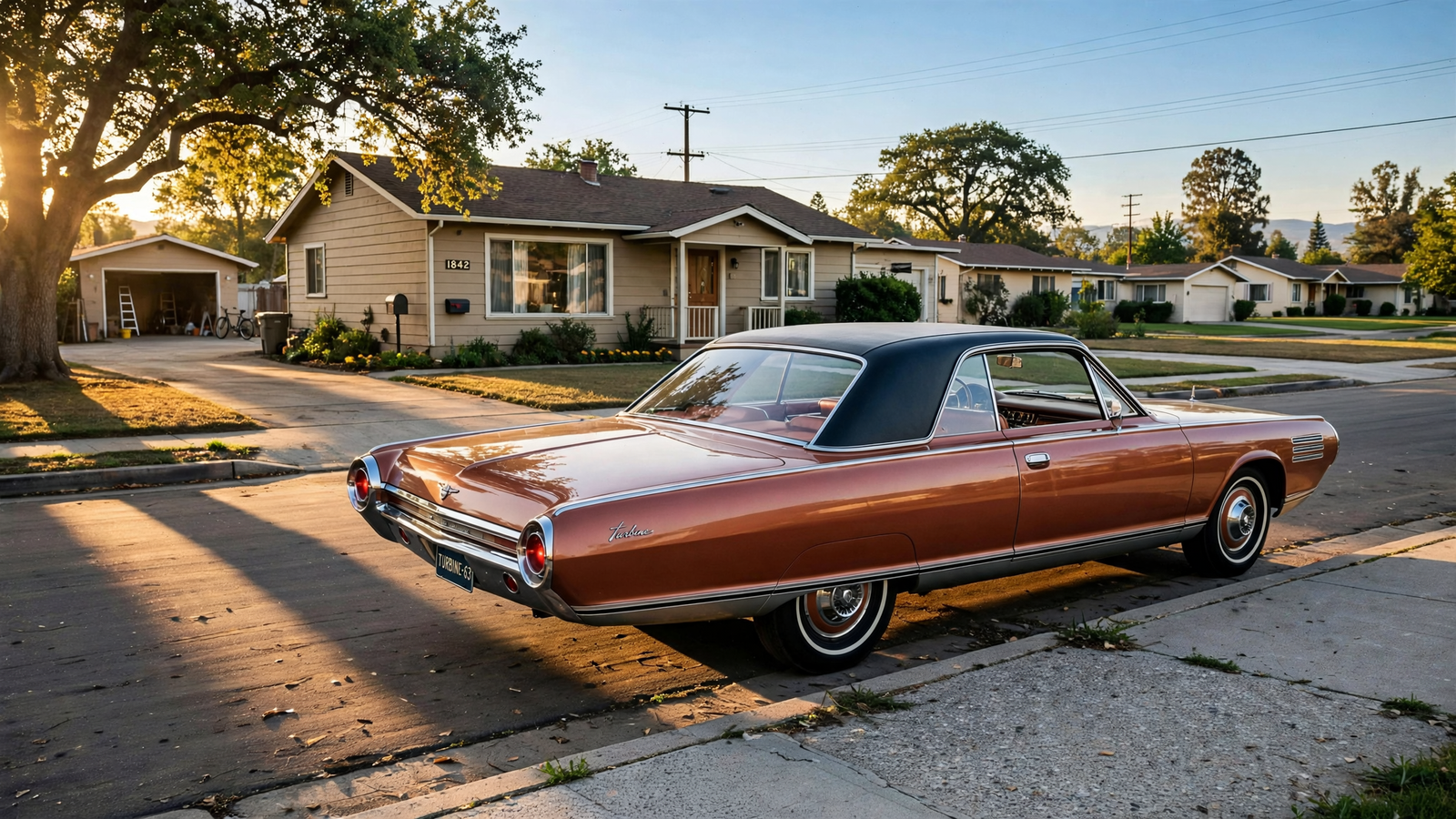
The answer was the Chrysler Turbine Car, one of the most distinctive American vehicles ever built. With its metallic bronze paint, turbine-shaped wheels, sharply creased body and jet-inspired power plant, it looked like a machine that had arrived from the future. Yet Chrysler’s real ambition was not to create a museum curiosity. The company wanted to know whether turbine power could survive the ordinary routines of American life.
Could a family drive it to work? Could a parent take it to the grocery store? Would it start reliably on a cold morning? Could an engine designed around the principles of aircraft propulsion become a practical alternative to the piston engine?
For a brief period, Chrysler let the public help answer those questions. Fifty Turbine Cars were placed with selected drivers across the United States and in a few other countries. The participants used them as everyday transportation, reporting on their experiences to the company. The experiment did not lead to a production turbine automobile, but it gave America something nearly as valuable: a rare glimpse of a major automaker testing the future in public.
When jet technology moved onto the road
A gas turbine does not operate like the familiar reciprocating engine found in most cars. Instead of using pistons moving up and down inside cylinders, a turbine draws in air, compresses it, mixes it with fuel and sends the expanding gases through rotating turbine wheels. That spinning motion can be used to turn the car’s drivetrain.
The technology had obvious appeal in the years after World War II. Jet aircraft had transformed aviation, and engineers wondered whether the same basic idea could simplify road vehicles. Turbine engines had fewer moving parts than piston engines, did not require a conventional transmission in the same way and could, at least in theory, operate on a wide range of fuels.
Chrysler began serious turbine research in the 1950s. The company’s engineers built experimental engines, installed them in test vehicles and gradually worked toward a car that could be driven outside a laboratory. The early prototypes were important steps, but they were not yet suitable for ordinary motorists. They could be noisy, slow to respond and expensive to build.
By the early 1960s, however, Chrysler believed it had a design worth showing to the public. The production-style Turbine Car was introduced in 1963 with a body created in Italy by Ghia and assembled for Chrysler in small numbers. Its design was unmistakably American in purpose but unusually international in appearance: long, low and formal, with a broad glass area and a copper-colored finish that became its visual signature.
A car designed to make technology visible
The Turbine Car was not styled as a plain engineering mule. Chrysler understood that public enthusiasm mattered. The car needed to look advanced before anyone opened the hood.
Its body combined the sharp lines associated with early-1960s Detroit with details that hinted at aviation. The turbine wheels suggested motion even when the car was parked. The roofline and rear treatment gave it a formal presence, while the bronze paint helped distinguish it from the ordinary parade of sedans on American roads.
Inside, the car was more familiar than its engine. It had seating for four, automatic transmission, power steering, power brakes and air conditioning. The goal was not to ask drivers to become mechanics. Chrysler wanted the turbine to disappear into a recognizable American driving experience.
That contrast was central to the experiment. The engine was radically different, but the daily responsibilities of the automobile remained the same. The car had to move smoothly through traffic, idle at intersections, climb hills, start in changing weather and behave predictably in the hands of people who had not designed it.
The public became the test fleet
Chrysler built 55 examples of the production Turbine Car. Most were used in the company’s public lending program, which placed the cars with selected families, businesspeople and other drivers for short periods. Participants were asked to use the cars normally and provide feedback.
The program turned test driving into a form of citizen engineering. Instead of confining the vehicles to a proving ground, Chrysler sent them into neighborhoods, parking lots, suburban commutes and long-distance trips. Drivers discovered what the car felt like in circumstances no laboratory could fully reproduce.
According to historical accounts preserved by automotive and museum collections, the cars were driven by more than 200 members of the public and accumulated well over a million miles during the program. Participants encountered a vehicle that was remarkably smooth and mechanically unusual, but also one with habits unlike those of a conventional car.
The turbine engine produced a distinctive whine as it accelerated. It could run on several fuels, including diesel, kerosene and, in demonstrations, less conventional choices. The engine’s ability to tolerate different fuels became one of the project’s most memorable features, although that flexibility did not solve the larger economic and technical challenges.
Drivers also had to adjust to delayed throttle response. A piston engine reacts through a familiar sequence of combustion and crankshaft movement. A turbine needs time to increase its rotational speed, so pressing the accelerator did not always produce the immediate response motorists expected. Chrysler worked to refine that behavior, but the difference remained noticeable.
The promise—and the price—of turbine power
The Turbine Car offered genuine advantages. Its engine ran with very little vibration, and the absence of many conventional engine parts promised reduced mechanical complexity. It could be started without the roughness associated with a cold piston engine, and its broad fuel tolerance suggested a future less dependent on one particular petroleum product.
But the same technology created serious obstacles. Turbines were expensive to manufacture, especially at a scale far below ordinary automotive production. They were not equally efficient in every driving condition, particularly during the stop-and-go operation common in cities. The engine also generated extremely hot exhaust, requiring careful engineering around the rear of the car.
Fuel economy was another concern. A turbine could perform well at a steady speed, but an automobile spends much of its life accelerating, slowing and idling. The engine’s strengths did not always align with the realities of everyday traffic.
There was also the question of infrastructure. A production automobile would need service technicians, replacement parts and manufacturing systems capable of producing turbine engines at a competitive price. Chrysler could build an impressive demonstration fleet; building millions of affordable family cars was a much larger challenge.
Why the Turbine Car never reached showrooms
The public program generated attention, but it did not make turbine power commercially practical. Chrysler eventually ended the experiment, and most of the cars were destroyed. The decision reflected more than one problem. Development costs were high, fuel economy remained difficult, and the conventional piston engine continued to improve.
The timing also mattered. The Turbine Car appeared during a period when automakers were pursuing many possible futures at once: larger engines, compact cars, safer vehicles, new emissions systems, electric experiments and alternative fuels. A turbine would have needed to overcome its disadvantages while competing against a mature production technology supported by an enormous industrial network.
Only a small number of Turbine Cars survived. Several entered museum collections, where they became valuable reminders of an era when the automobile still seemed open to almost any mechanical possibility. One surviving example at The Henry Ford remains especially important because it connects the experiment to the broader history of American manufacturing and consumer culture.
A failed product, but not a failed idea
It is tempting to judge the Turbine Car only by its commercial outcome. It never became a common sight, never established a new engine category and never replaced the piston engine. By those measures, the project failed.
But its deeper achievement was different. Chrysler demonstrated that advanced technology could be evaluated not only by specialists but by ordinary people living ordinary lives. The company exposed the machine to the unpredictable conditions that define real transportation: traffic, weather, errands, family schedules and personal habits.
That approach still feels modern. Today, automakers test electric vehicles, driver-assistance systems and alternative powertrains with fleets that gather information from real roads. The tools are more sophisticated, but the underlying lesson is familiar: a technology is not ready simply because it works in a laboratory. It must also fit into human routines.
The Turbine Car also showed why technological elegance is not enough. An engine can be smooth, dramatic and capable of running on unusual fuels while still being too costly or inefficient for the marketplace. Progress in transportation is shaped by manufacturing, fuel systems, service networks, regulations and consumer expectations as much as by engineering imagination.
That is why the surviving bronze cars continue to attract attention. They are not merely relics of a discarded engine design. They represent a moment when an American automaker built a fleet of futuristic machines and allowed the public to decide what the future felt like from behind the wheel.
The Chrysler Turbine Car did not change the automobile industry in the way its creators hoped. Instead, it became something rarer: a serious experiment that remained honest about the distance between possibility and practicality. Its jet-age promise still glows in the paint, but its real legacy lies in the questions it put on the road.