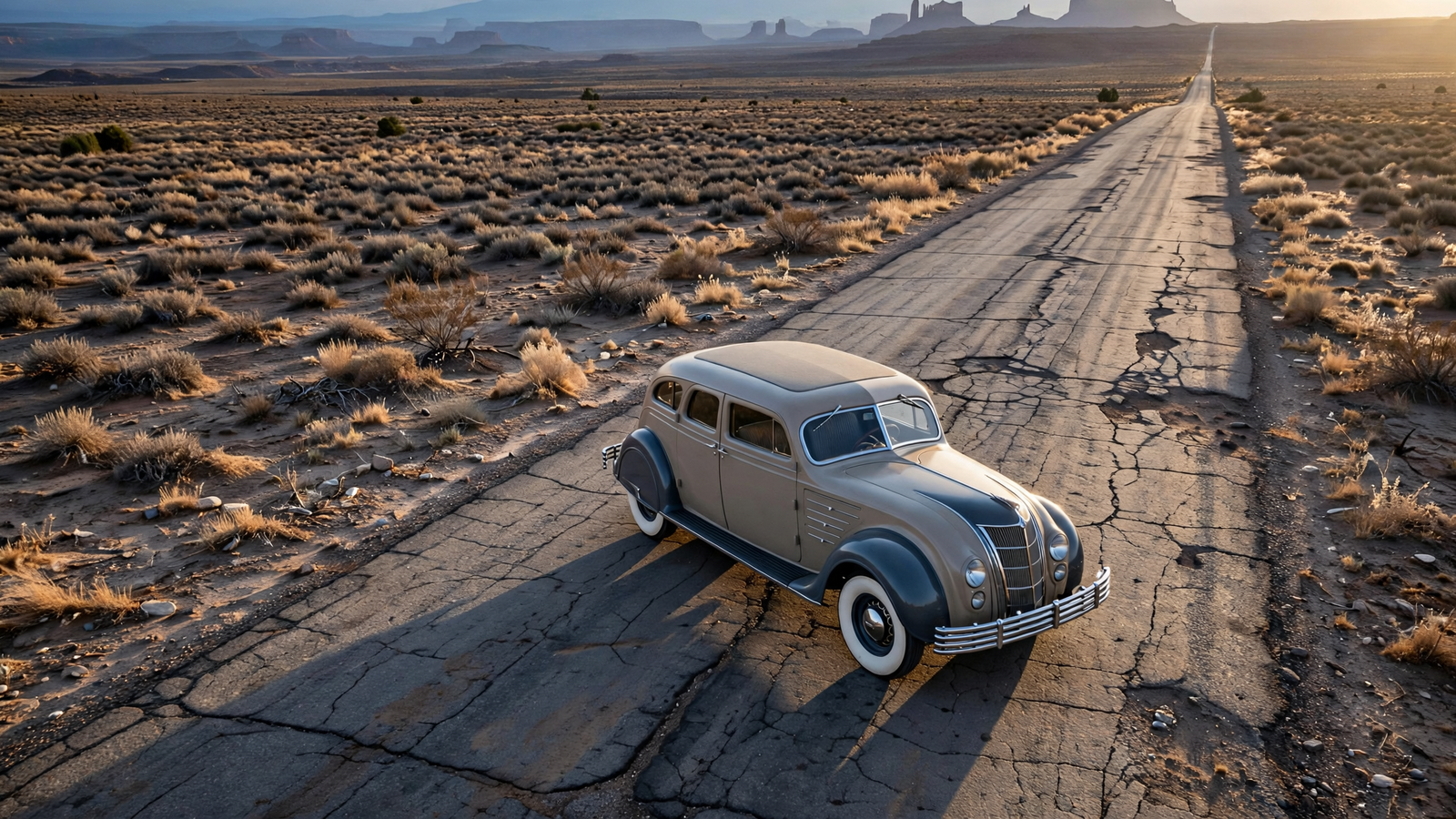
In the early 1930s, the American automobile still carried much of the visual language of the carriage. Cars were tall, upright, and often built around a separate frame with bodies that looked placed on top. Their shapes reflected the roads and expectations of an earlier age.
Then Chrysler unveiled the Airflow.
It arrived for the 1934 model year with a rounded nose, a sloping rear, fully integrated fenders, and a passenger compartment pushed forward between the axles. It looked less like a motorcar from the past than a machine arriving from a future that had not yet happened.
The Airflow was not a commercial triumph. Buyers found its appearance unfamiliar, and early production problems damaged confidence. But its importance did not depend on sales alone. The car changed the conversation around automotive design. It showed that an American automobile could be shaped by air, tested by science, and organized around the people inside it.
A car designed from the inside out
The Airflow grew from a question that seems obvious today: Why should a car be shaped like a box if it is meant to move through the air?
At Chrysler, engineer Carl Breer became interested in the behavior of air around moving vehicles. The company used wind-tunnel testing and scale models to study how different body shapes affected resistance and stability. The work drew on ideas from aviation, an industry then rapidly changing the way Americans thought about speed and form.
The resulting automobile did more than receive a smoother exterior. Chrysler moved the passenger compartment forward, placing occupants between the front and rear axles rather than leaving them mostly behind the engine. The wheels were pushed toward the corners, while the engine was moved farther forward than in many conventional cars of the period.
That arrangement created a lower center of gravity and gave passengers more usable room without requiring a dramatically longer car. The body also wrapped more completely around the mechanical structure. Instead of treating the body as a separate decorative shell, Chrysler made it part of the vehicle’s basic architecture.
To modern eyes, those ideas are familiar. In the 1930s, they were not. The Airflow asked customers to accept that a car’s shape could be the visible result of engineering rather than a collection of established styling cues.
Streamlining reaches the American road
The Airflow appeared during the high period of American streamlining. Trains, airplanes, radios, household appliances, and skyscrapers were all being given smoother, more continuous forms. The style suggested speed and efficiency, even when the object itself never moved.
Automobiles were especially suited to the new language. A car already had to confront wind resistance, road shock, heat, and vibration. The Airflow made those practical concerns part of its public identity.
Its rounded front replaced the upright grille-and-fender arrangement familiar to many drivers. The windshield was more steeply angled. The headlights were integrated into the front fenders, and the rear body flowed toward a tapered tail. The whole car appeared to have been pulled forward by motion.
Chrysler also emphasized the Airflow’s strength. Its steel body structure was more integrated than the construction used by many competitors, and the passenger compartment was designed to offer greater protection than the open, lightly separated bodies common in earlier cars. It would be misleading to call the Airflow a modern safety car in the full contemporary sense—seat belts, crash testing, airbags, and many other standards were still decades away—but the company was thinking about the body as a protective structure.
Inside, the new proportions mattered as much as the exterior. Passengers sat in a roomier central section, with improved visibility and a more balanced sense of space. The car’s engineering was not hidden completely; it was expressed through the way the cabin was arranged.
When the future looked strange
Being early is not the same as being welcomed.
Many automobile buyers in 1934 expected a car to look recognizable. They understood the visual grammar of a long hood, upright grille, separate fenders, and a cabin set toward the back. The Airflow broke that grammar all at once.
Its styling was often described as ungainly or unfamiliar. The front end did not provide the visual separation that customers associated with a conventional automobile. The smooth body looked heavy to some observers, even though the design had been developed to reduce drag. The very features that made the Airflow significant also made it difficult to understand at a glance.
Early cars also suffered from manufacturing and quality problems. Chrysler had attempted a major change in construction, and new production methods did not immediately deliver the consistency buyers expected. Negative impressions spread quickly in a market where a large purchase was also a public statement about taste, status, and reliability.
The Airflow was revised during its run, and Chrysler continued to offer more conventional-looking models alongside it. The DeSoto division received its own Airflow-based cars, extending the experiment beyond the Chrysler name. But the marketplace did not move as quickly as the engineers had hoped.
By the end of the decade, the Airflow had disappeared from production. Its commercial life was short, but its design ideas continued to travel.
The influence that survived the model
Automotive history is full of cars that sold well and then vanished from memory. The Airflow belongs to a different group: vehicles whose influence was larger than their market performance.
After Chrysler’s experiment, other American manufacturers became more comfortable with lower, smoother, more aerodynamic bodies. The industry gradually adopted integrated fenders, curved windshields, more forward cabins, and designs that reduced the visual separation between body and chassis.
Not every later change can be credited directly to the Airflow. Automobile design was moving toward streamlining for many reasons, including new manufacturing techniques, competition among styling departments, and the growing cultural fascination with speed. Still, Chrysler’s car made the direction unmistakable. It placed aerodynamic thinking in showrooms and on ordinary streets.
The Airflow also helped establish the idea that automotive design was a form of problem-solving. A car could be evaluated not only by its ornament, horsepower, or prestige, but by how effectively it carried people, handled air, managed weight, and organized space.
That way of thinking became increasingly important after World War II, when American cars grew lower and wider, and later when fuel economy and emissions made aerodynamic efficiency impossible to ignore. The Airflow did not solve those later problems, but it had already introduced a new habit: looking at the automobile as a system rather than a decorated carriage.
A lesson in the risk of useful ideas
The Chrysler Airflow is sometimes remembered as a failure because it did not win over the buying public. That judgment is understandable, but incomplete.
Commercial success measures whether a product fits its moment. Innovation often asks whether the moment is ready to change. The Airflow’s designers were working with tools and assumptions that were unusual for the automobile industry of their day. They were using wind tunnels, structural reasoning, and human-centered packaging to challenge a familiar shape.
The car’s story is therefore not simply about an unsuccessful design. It is about the gap between technical progress and cultural acceptance. A vehicle can be intelligently engineered and still look wrong to the people expected to buy it. It can influence generations of products without becoming a household favorite itself.
That tension gives the Airflow a lasting place in Americana. It represents the country’s faith in engineering, its appetite for speed, and its occasional willingness to put an unfamiliar idea on a showroom floor. It also reveals something more human: people do not purchase the future merely because someone has built it. They need to recognize themselves in it.
Today, nearly every modern car reflects principles the Airflow helped popularize—occupants centered within the wheelbase, bodies shaped by aerodynamic concerns, and design that treats structure, comfort, and motion as connected problems. The cars around us no longer look radical for following those rules.
That may be the Airflow’s quietest achievement. It made a once-strange question ordinary: What should an American car become when it stops imitating the past?